Clear Sky Science · en
Alpha oscillatory activity reveals focused-attentional disparity between cochlear implant users and normal hearing listeners
Why some listening feels harder than others
For many people with severe hearing loss, cochlear implants open the door to spoken communication. Yet some implant users follow conversations with ease while others struggle, even when their devices are technically working well. This study asks a deceptively simple question with big everyday consequences: when sound reaches the brain through a cochlear implant, does the brain focus attention on important sounds in the same way as in people with natural hearing? The answer may help explain why listening through an implant can be so effortful and why outcomes vary so widely.
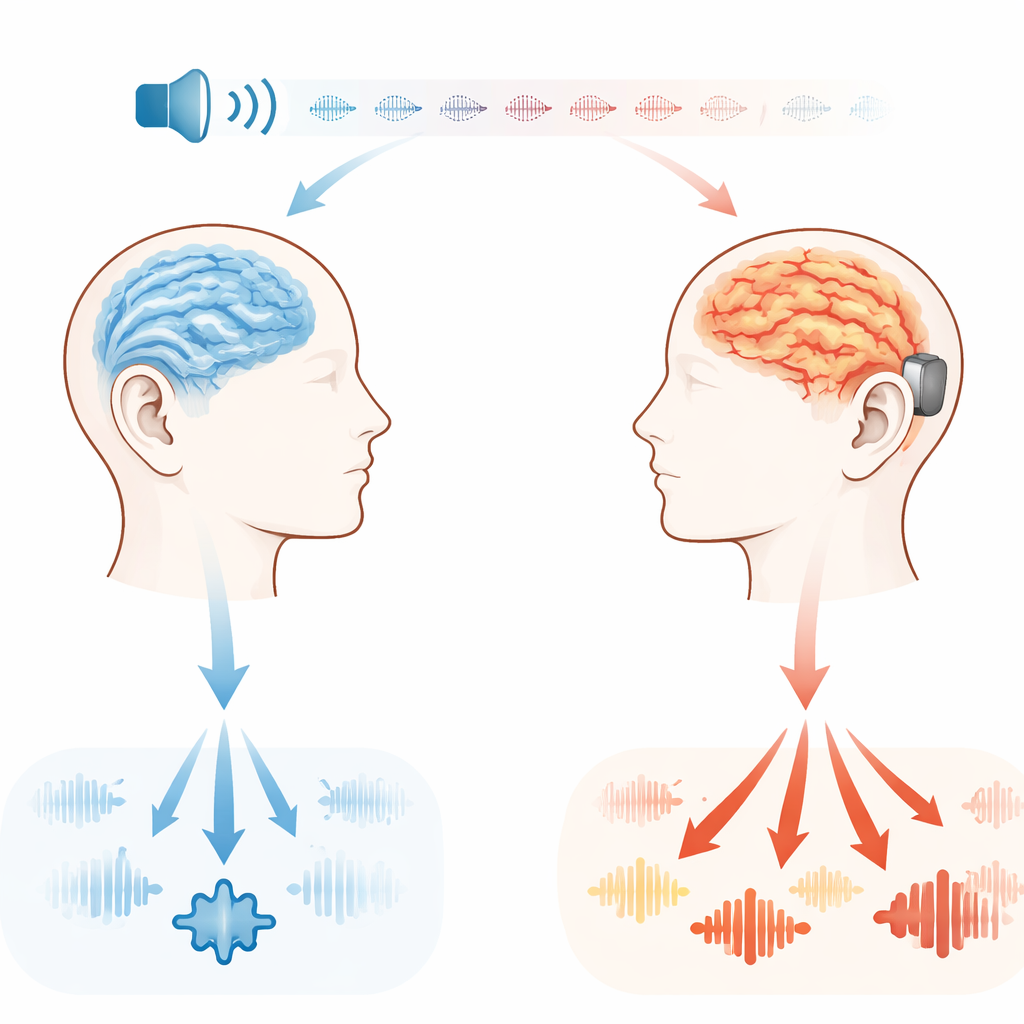
Listening as a mental spotlight
Hearing is not just about the ears; it is also about where the mind chooses to point its spotlight. In this experiment, adults with cochlear implants and age-matched adults with normal hearing listened to a sequence of sounds. Most were identical simple tones, some were slightly different tones that required a button press, and others were one-off everyday noises such as a dog bark or a phone ring. These "novel" sounds were deliberately made task-irrelevant: listeners were told to ignore them. By comparing brain activity when people simply listened versus when they actively searched for the target tones, the researchers could separate automatic responses to sound from the extra brain work involved in focusing attention.
Brain rhythms that signal focus
The team recorded brain activity using electroencephalography (EEG), which tracks tiny voltage changes at the scalp. Instead of looking only at quick spikes in response to each sound, they examined ongoing brain rhythms at different frequencies. In particular, they focused on so-called alpha waves, which oscillate about eight to twelve times per second and are known to be closely linked to attention. When people concentrate on something relevant, alpha activity typically drops in the brain regions processing that information, as if releasing a brake so those areas can work harder. Other, slower rhythms in the delta and theta range were used as markers of how clearly the brain represented and distinguished the sounds themselves.
Similar hearing, different priorities in the brain
Both groups showed clear brain responses when they had to listen actively, and both could distinguish the rare target tones from the frequent standard tones. But important differences emerged. Compared with normal-hearing listeners, cochlear implant users showed weaker slow-wave activity that supports fine-grained discrimination between similar tones. This fits with the idea that electric hearing, which provides fewer details than natural hearing, makes close distinctions between sounds more difficult. Most striking, however, was how alpha rhythms behaved. In normal-hearing listeners, alpha activity dropped strongly in attention-related brain regions when target tones appeared, and stayed relatively higher for the distracting novel sounds. In cochlear implant users, alpha behaved differently: their brains showed strong and sustained alpha changes even for the novel, irrelevant sounds, especially in parietal and visual areas that are part of attention networks.
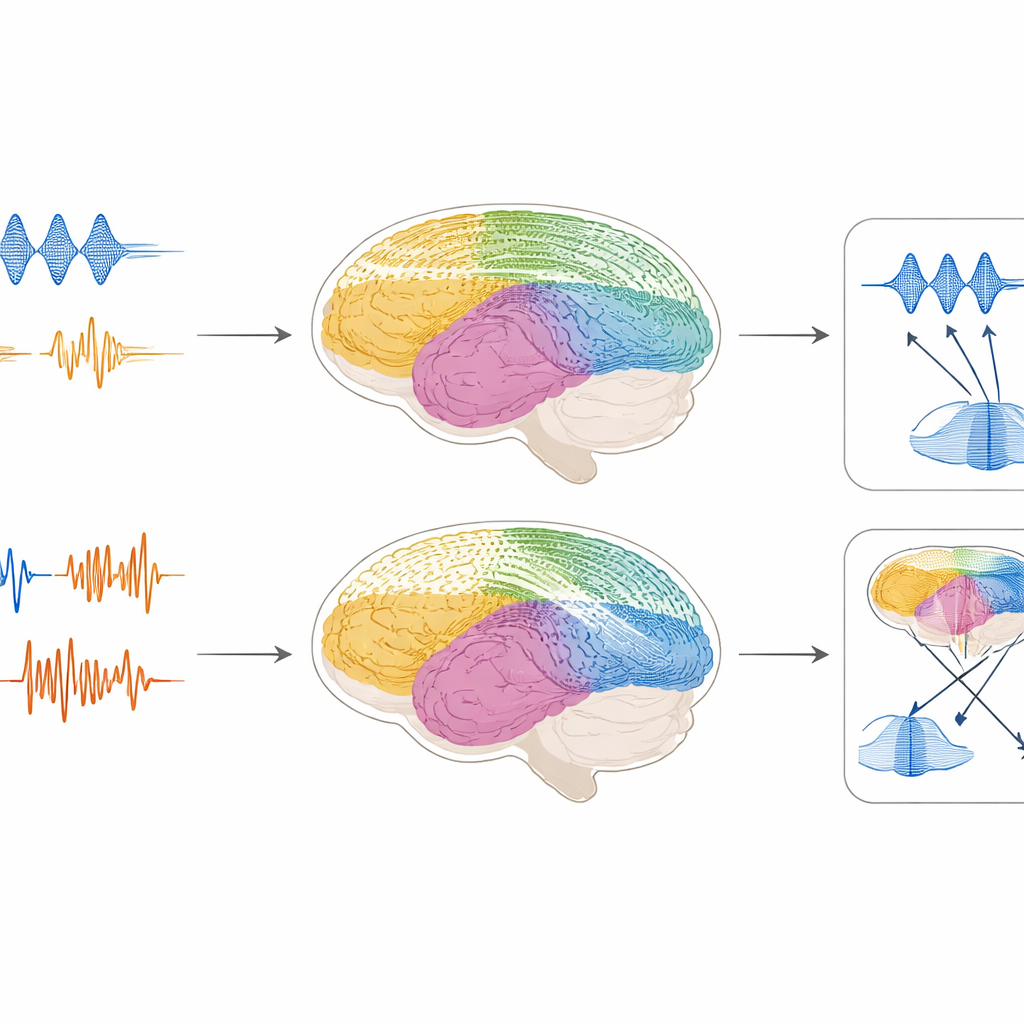
Attention pulled toward the wrong sounds
To pinpoint where in the brain these differences arose, the researchers used source modeling to estimate activity in three key regions: the primary auditory cortex, a frontal "control" area involved in planning and decision-making, and a parietal area important for shifting and maintaining attention. In all three, cochlear implant users generally showed weaker late activity linked to higher-level processing, particularly when they needed to suppress distracting sounds. At the same time, they seemed to recruit extra frontal and cingulate regions often associated with effort and monitoring. Put simply, rather than cleanly boosting responses to the target tone while damping down the pull of the novel noises, their brains appeared to spread attention more broadly—and sometimes preferentially—toward the distracting events.
What this means for everyday listening
The study suggests that some of the listening difficulty and fatigue reported by cochlear implant users may stem not only from the quality of the sound provided by the device, but also from how the brain allocates attention once that sound arrives. Because the implant delivers less distinct cues, the brain has a harder time telling similar sounds apart and may be overly drawn to sudden, eye-catching noises that ought to be ignored. This misdirected focus can leave fewer mental resources for the sounds that truly matter, such as speech. Understanding these brain rhythms and the networks behind them could guide new training or stimulation strategies aimed at helping implant users sharpen their attentional "spotlight" and make everyday listening less of a struggle.
Citation: Brilliant, Schierholz, I., Sandmann, P. et al. Alpha oscillatory activity reveals focused-attentional disparity between cochlear implant users and normal hearing listeners. Sci Rep 16, 14690 (2026). https://doi.org/10.1038/s41598-026-52434-6
Keywords: cochlear implants, auditory attention, brain oscillations, listening effort, electroencephalography