Clear Sky Science · en
Synergistic enhancement of zinc anode stability via bismuth alloying and CO2 exposure in 1 M KOH for alkaline battery applications
Why better batteries matter
From electric vehicles to backup power for homes, we rely on rechargeable batteries more each year. Zinc-based batteries are attractive because zinc is cheap, abundant, and safer than lithium. But zinc anodes tend to corrode and form gas bubbles, which waste energy and shorten battery life. This study explores a simple way to make zinc anodes tougher and longer lasting by adding a tiny amount of bismuth and letting carbon dioxide from the air help rather than harm.
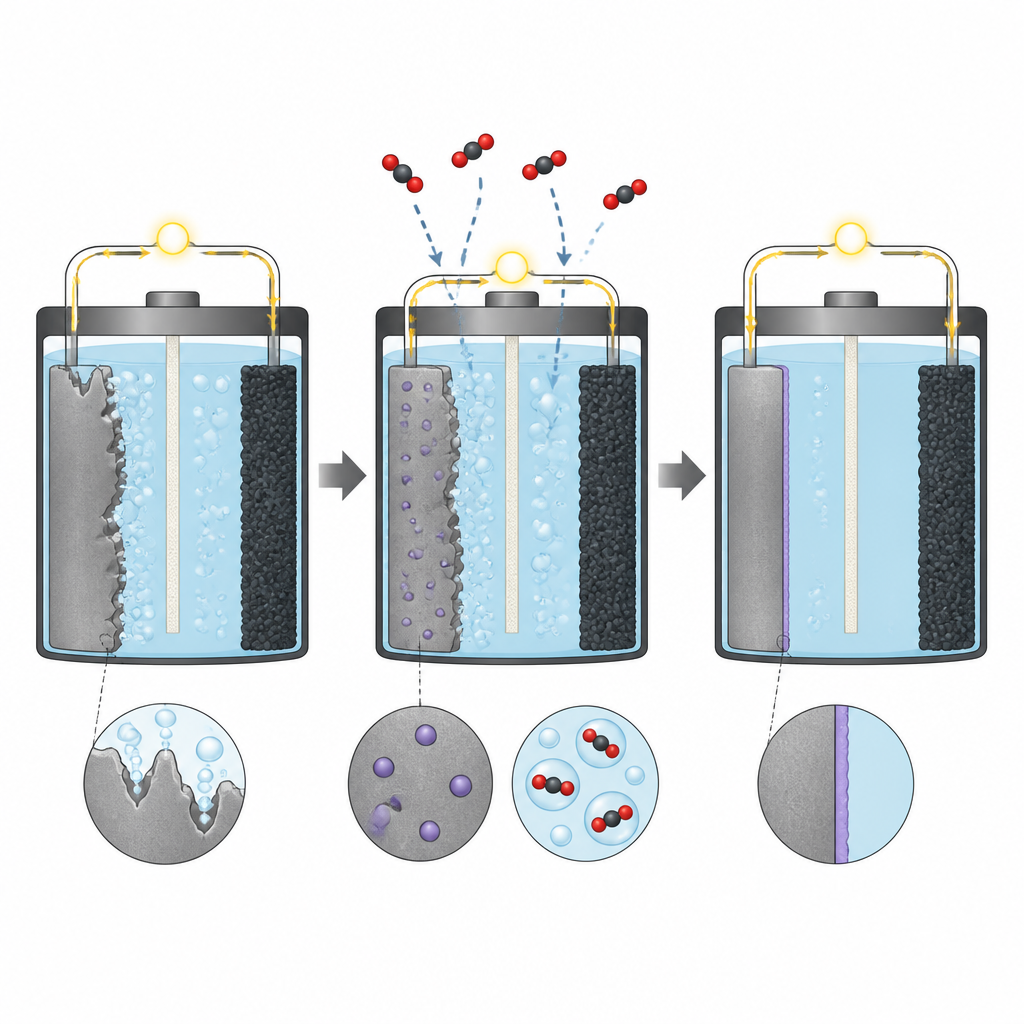
The problem with plain zinc
In common alkaline batteries, zinc sits in a strong basic solution and gradually breaks down. Its surface dissolves unevenly, grows needle-like structures, and releases hydrogen gas. These changes damage the anode, lower the useful capacity, and make it hard to recharge the battery many times. Conventional fixes often require complex coatings or costly additives. The authors asked whether a very small dose of another metal, bismuth, together with controlled exposure to carbon dioxide, could calm this chaotic surface behavior without adding much cost.
A tiny tweak to the metal mix
The team made two kinds of circular anodes: one from pure zinc, and one from zinc mixed with only 0.5 percent bismuth by weight. Both were tested in a standard alkaline solution of potassium hydroxide, either on its own or after bubbling in carbon dioxide. Using well established electrochemical methods, they measured how fast the metals corroded, how easily charge moved across the surface, and how the electrodes behaved during repeated charging and discharging. Microscopes and X-ray techniques then revealed what kinds of solid layers formed on the surfaces.
How carbon dioxide becomes a helper
Surprisingly, adding carbon dioxide to the alkaline liquid made both zinc surfaces less, not more, corrosive. The gas reacted with dissolved zinc and the solution to build a layer rich in zinc carbonate on top of the metal. On pure zinc, this layer was somewhat rough and porous. On the zinc–bismuth alloy, however, the protective film became denser and better attached. The presence of bismuth encouraged the formation of compact oxide and carbonate phases that blocked both metal loss and unwanted hydrogen bubbles. As a result, the alloy showed a much smaller corrosion current and required more energy to start corroding, clear signs of improved stability.
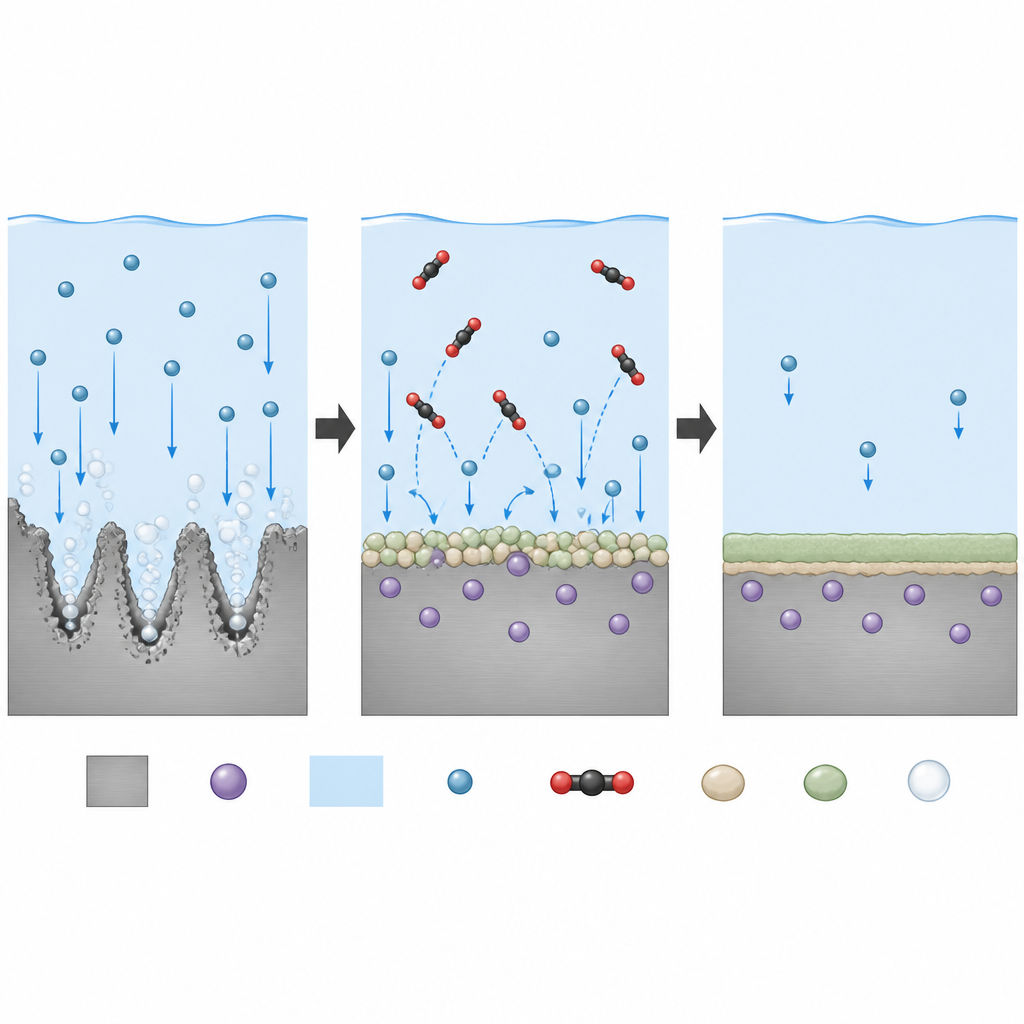
More stable charging and discharging
When the researchers cycled the electrodes at different currents, the benefits translated directly into battery-like performance. The zinc–bismuth anodes held their voltage more steadily and discharged for longer times than pure zinc in the same conditions. Under carbon dioxide rich conditions, the improvements were even stronger: the alloy kept working at more demanding voltages, with better capacity retention over many cycles. Advanced impedance measurements showed that charge had a harder time leaking through the protective layer, and the thin film at the surface behaved more like a stable barrier than a leaky sponge.
What this means for future batteries
Overall, the study shows that a trace amount of bismuth, combined with the natural presence of carbon dioxide, can greatly strengthen zinc anodes in alkaline batteries. Instead of treating carbon dioxide only as a threat, the work turns it into part of the solution by harnessing it to build a self-protecting surface film. For everyday users, this approach points toward zinc based batteries that last longer, waste less energy, and remain safer, all while relying on abundant materials and simple processing.
Citation: Adel, M., Elsayed, A. & Elrouby, M. Synergistic enhancement of zinc anode stability via bismuth alloying and CO2 exposure in 1 M KOH for alkaline battery applications. Sci Rep 16, 15879 (2026). https://doi.org/10.1038/s41598-026-52415-9
Keywords: zinc batteries, alkaline anode, bismuth alloy, corrosion inhibition, carbon dioxide