Clear Sky Science · en
A comparative study between microwaves and ultrasound assisted in- situ reduction of platinum supported γ-Al2O3 using different organic templates for enhanced catalytic activity and potential applications
Turning Tiny Materials into Better Fuel Makers
Modern life runs on fuels and chemicals made from oil, and industry is always searching for ways to make these products more efficiently and with less energy. This study looks at how to build tiny, highly organized materials that help turn simple molecules into more useful ones, such as cleaner fuel components and a key building block called ethylene. The researchers compare two high‑energy tools, microwaves and ultrasound, to see which one makes better "helper" particles based on platinum and alumina.
Building a Sponge-Like Support
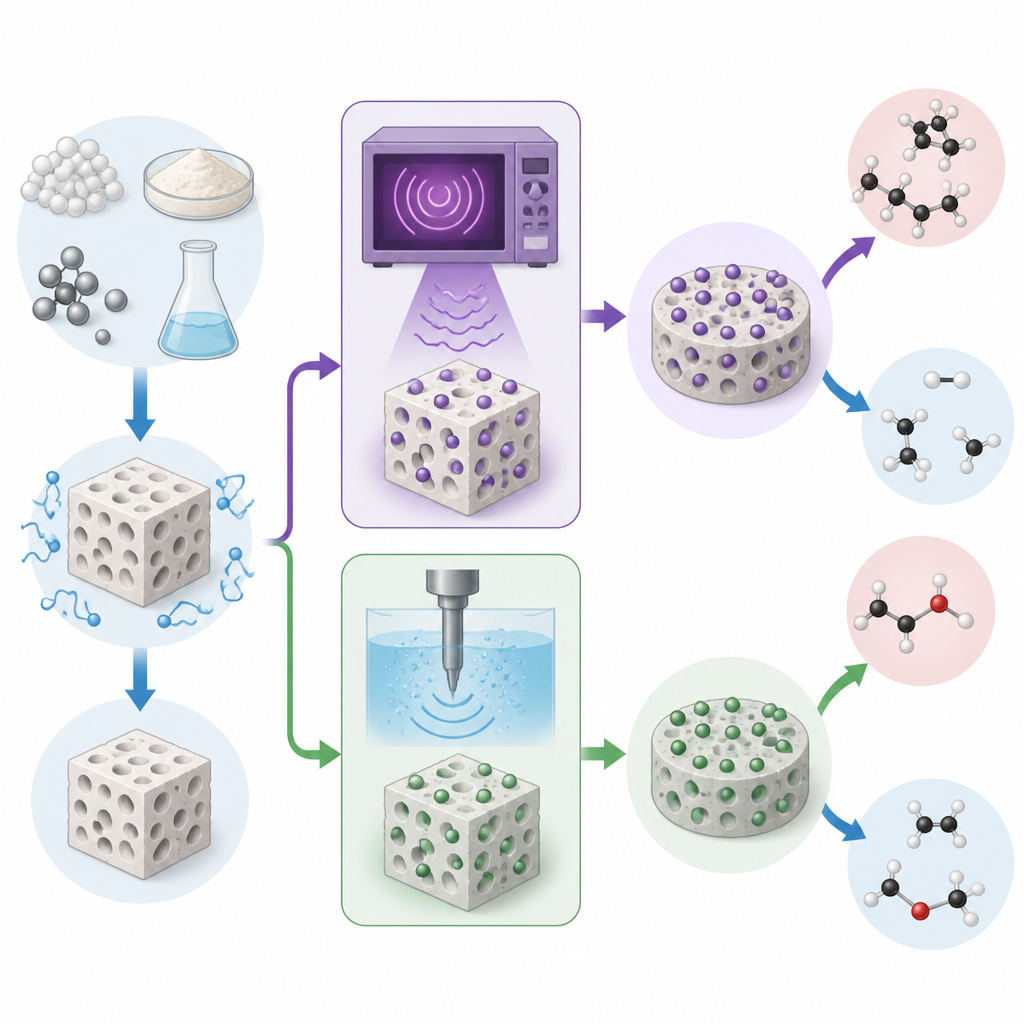
The heart of the catalyst in this work is a form of aluminum oxide, or alumina, shaped into a fine powder full of tiny, evenly spaced pores. Using a wet-chemistry route, the team creates a gel from aluminum salts and then adds special soap-like molecules, known as surfactants. These surfactants act as temporary templates that guide the formation of a sponge-like solid with a very large internal surface area. After heating, the surfactants burn away, leaving behind mesoporous alumina, whose pores are only a few billionths of a meter wide. By tuning the type and amount of surfactant, the scientists can control how wide and how uniform these pores are, which is crucial because the walls of these pores will later host the active platinum particles.
Shaping the Pores with Smart Additives
The team tests two different surfactants: a charged one called CTAB and a neutral polymer called P123. When small amounts of CTAB are added, both the surface area and the total pore volume of the alumina increase. Raising the CTAB content further sharpens the pore size distribution and produces a support labeled AC2.5, with especially high surface area and stable, narrow pores. By contrast, alumina made with P123 has a somewhat lower surface area and different pore sizes. Measurements of gas uptake, X-ray patterns, and electron microscope images confirm that all samples share the same basic crystal structure but differ in pore layout and particle size. Among them, AC2.5 stands out as the most promising base for dispersing metal nanoparticles.
Placing Platinum with Microwaves and Sound
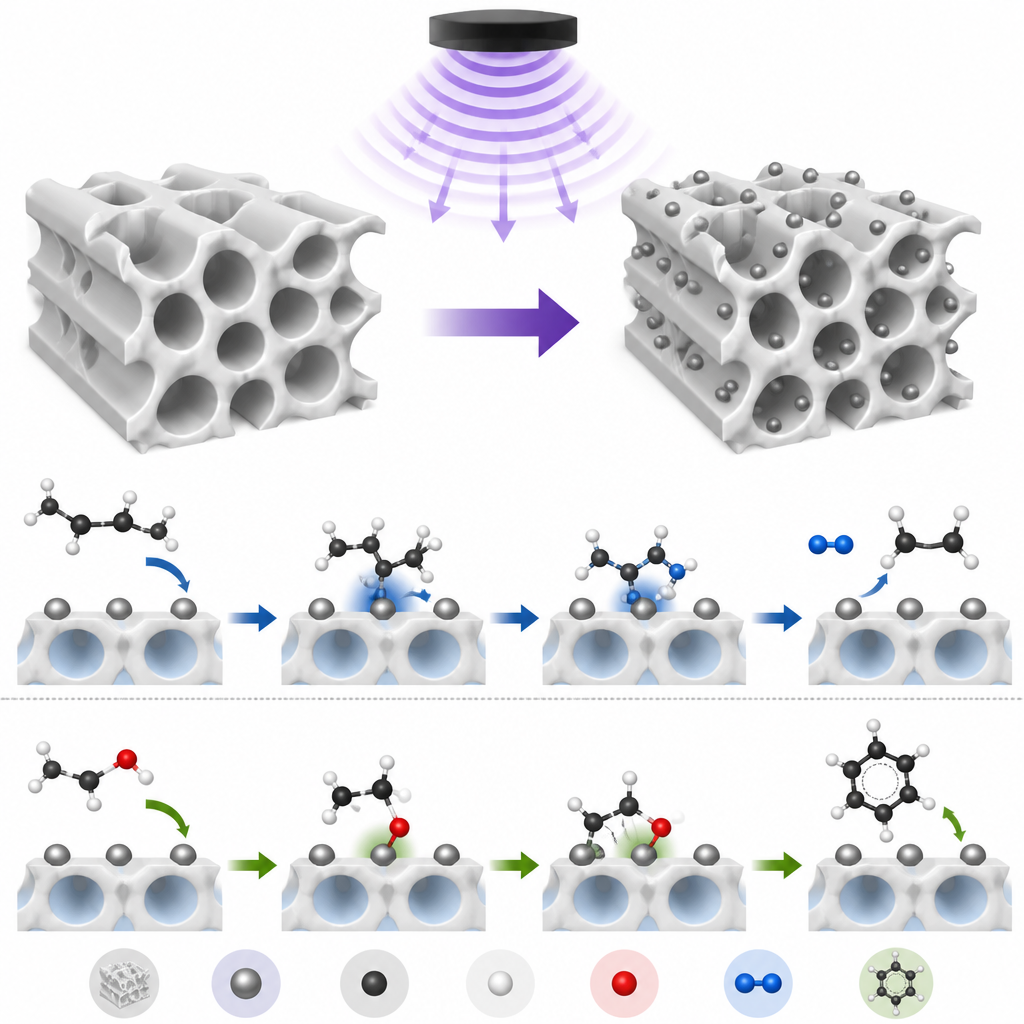
Next, the researchers load a small amount of platinum, less than one percent by weight, onto the AC2.5 support. They dissolve a platinum salt, allow it to soak into the pores, and then transform the salt into metallic platinum using two distinct routes. In one route, ultrasound waves passing through a liquid create intense local mixing, helping tiny platinum particles to form and latch onto the alumina. In the other route, microwave radiation heats the liquid and the solid from the inside out, speeding up the reduction of platinum. In both cases, a common solvent not only transfers heat efficiently but also helps reduce the metal. Imaging and gas adsorption measurements show that both methods create very small platinum particles, typically no larger than six nanometers, spread across the porous surface.
Testing How Well the Catalysts Work
To see how these materials perform, the team feeds three test molecules over the catalysts at high temperature: n-hexane, cyclohexane, and ethanol. These stand in for typical components of fuels and chemical feedstocks. In cyclohexane conversion, the goal is to remove hydrogen and form benzene, a ring-shaped molecule used widely in industry. The microwave-treated catalyst converts up to 86 percent of cyclohexane to benzene at 450 °C, with essentially perfect selectivity, while the ultrasound-made version reaches a lower conversion. For n-hexane, both catalysts favor turning the straight chain into benzene rather than cracking it into light gases, again with the microwave route giving the higher benzene yield. In ethanol conversion, both materials steer the reaction toward ethylene, an essential starting point for plastics, reaching ethylene yields a little above 50 percent under the tested conditions.
Why Microwaves Have the Edge
Although ultrasound produces slightly smaller platinum particles, the microwave route gives the best all-around performance. Detailed studies suggest that this is not just about size but about how well the metal sticks to and interacts with the alumina surface. Microwaves help place some platinum near the outer surfaces of the pores and strengthen the link between metal and support, improving access for reactant molecules and stabilizing the active sites at high temperatures. For a lay reader, the takeaway is that by carefully designing both the porous "sponge" and the way platinum is attached using focused energy sources, scientists can make catalysts that turn simple molecules into valuable fuels and chemicals more efficiently.
Citation: Mohamed, R.S., Gobara, H.M., Khalil, F.H. et al. A comparative study between microwaves and ultrasound assisted in- situ reduction of platinum supported γ-Al2O3 using different organic templates for enhanced catalytic activity and potential applications. Sci Rep 16, 15713 (2026). https://doi.org/10.1038/s41598-026-52286-0
Keywords: mesoporous alumina, platinum catalyst, microwave synthesis, ultrasound synthesis, ethanol to ethylene