Clear Sky Science · en
Body-centered encoding of passive tactile pattern memories
Why touch memories matter
We do not just feel the world through our skin; we also remember how it felt. From the texture of a favorite mug to the pressure of a comforting hand, these touch memories shape how we recognize objects and react to bodily sensations. This study asks a deceptively simple question: when we store memories of touch, does the brain pin them to the body itself, or to the outside world around us?
Two ways to remember a touch
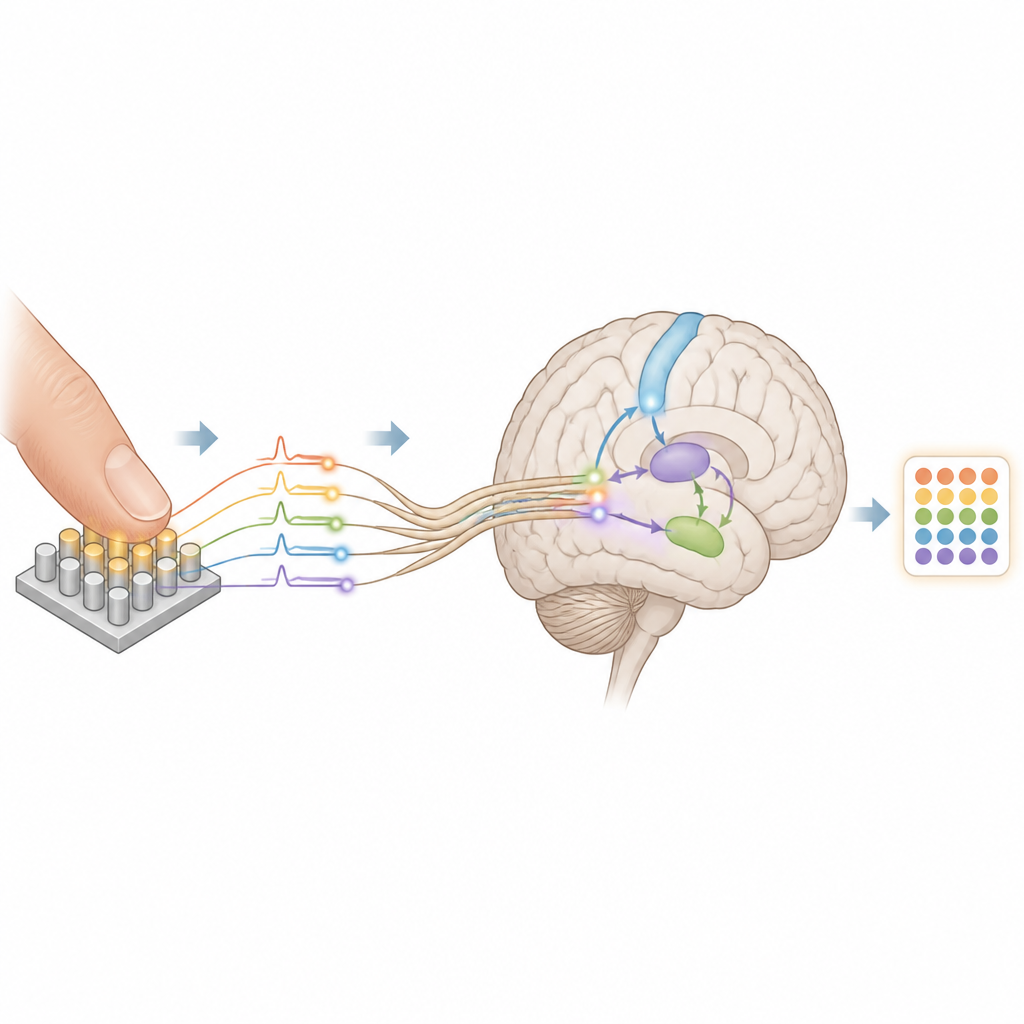
Scientists have long known that touch signals first arrive in brain areas that map the body like a “sensory map,” where each fingertip has its own spot. Later, other brain regions combine this body map with information about where our limbs are in space and what we see. That combination helps us know, for instance, that a tap on the right hand came from a phone on the left side of the table. The open question is whether long-lasting touch memories, such as patterns felt on the skin, are stored mainly in this body-based map or in a world-based map that blends touch with posture and vision.
Testing touch with still hands
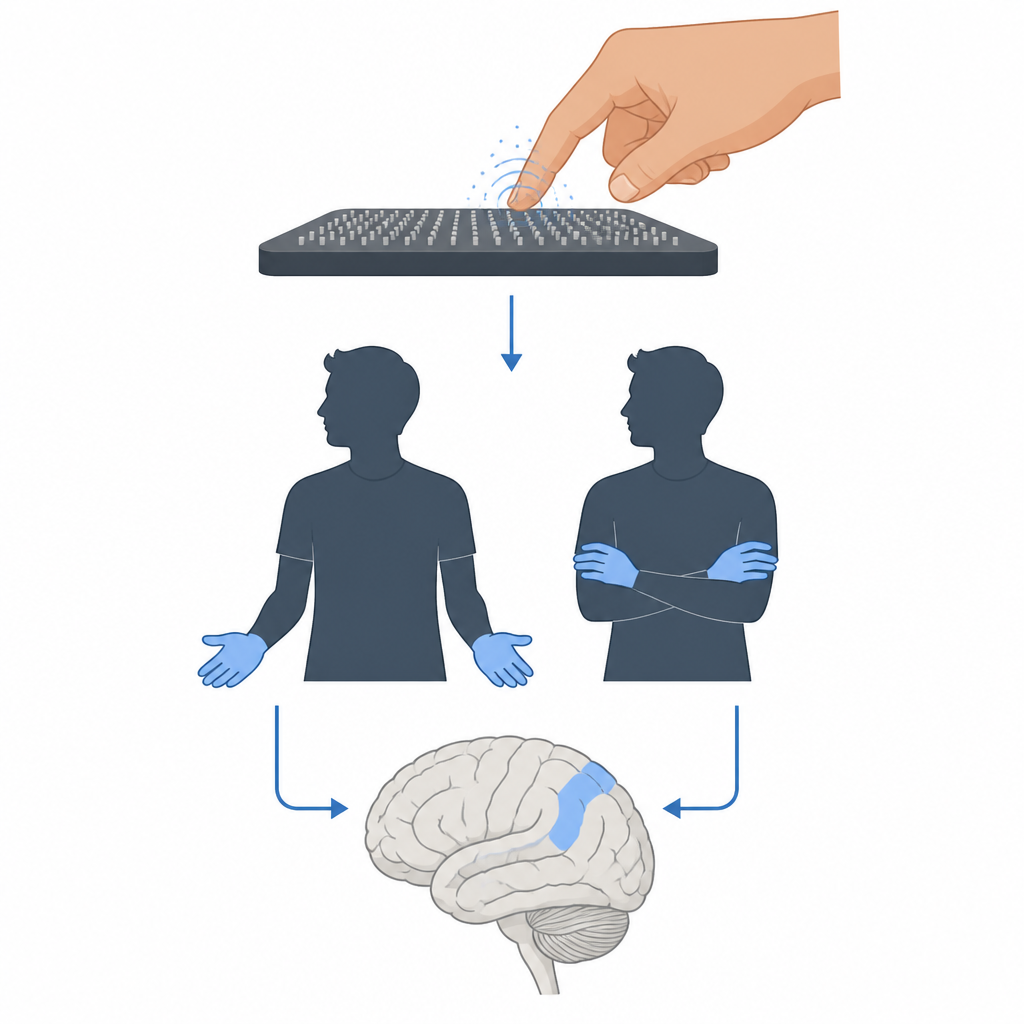
To probe this, the researchers used a device that presses tiny vibrating pins against the right index fingertip, forming simple patterns. Sixty-five young adults were asked to memorize four such patterns without moving their fingers; the touch was entirely passive. Later, they had to decide whether a presented pattern was one they had learned or a new one. Crucially, the team used the classic “crossed-hands” setup: sometimes participants learned patterns with hands placed side by side, and sometimes with arms crossed. During later testing, hand position could match the learning position or be switched. If the brain’s stored patterns depended on where the hands were in external space, changing posture between learning and test should make recall worse.
Adding sights to the sense of touch
In the first experiment, participants’ hands were hidden from view, so only the sense of body position could conflict between learning and recall. In the second experiment, the setup became more life-like: the hands rested on a screen showing beach and rock scenes, with real objects such as a stone and a seashell placed near them. Now both posture and visual surroundings could be either the same as during learning or changed for the recall test. Across both experiments, people remembered the patterns well above chance, meaning they truly formed tactile memories. This made it possible to look for subtle drops in performance when posture and visual context were mismatched.
What the results revealed
Surprisingly, changing how the hands were arranged in space did not alter how accurately people recognized the fingertip patterns. Whether arms were crossed or uncrossed, whether the hand and nearby scene looked exactly as before or not, performance stayed essentially the same. Standard statistical tests and more nuanced Bayesian analyses converged on the same message: there was no convincing sign that matching or mismatching posture and visual context between learning and recall helped or hurt memory for these passive touch patterns.
Touch memories anchored to the body
These findings suggest that, at least for touch patterns passively delivered to a fingertip, the brain stores memories in a body-centered format. In other words, the remembered pattern seems tied to “this spot on my finger” rather than to “this place in the room.” The work fits with clinical reports that certain bodily memories, such as painful or traumatic sensations, often stay tied to specific locations on the body. It also hints that brain regions closely following the body’s sensory map may play a central role in storing such tactile memories. While future brain-imaging and patient studies are needed, this research provides an important behavioral pointer: for some kinds of touch, our memories may live more in the map of the body than in the map of the outside world.
Citation: Indurkar, S., Kayacik, B., Liu, P. et al. Body-centered encoding of passive tactile pattern memories. Sci Rep 16, 16589 (2026). https://doi.org/10.1038/s41598-026-52275-3
Keywords: tactile memory, body-centered encoding, touch perception, somatosensory cortex, crossed hands paradigm