Clear Sky Science · en
Flexural behaviour of RC shear wall using enhanced finite element model
Why safer concrete walls matter
Modern city skylines rely on tall buildings that must stay standing when the ground shakes. In these structures, thick vertical concrete walls act like spines that help resist earthquake forces. This article explains how engineers can better predict how those walls bend, crack, and finally fail during strong quakes, using smarter computer models. The work matters because more reliable models help designers choose safer and more economical buildings without guessing or oversimplifying how concrete behaves under extreme stress.
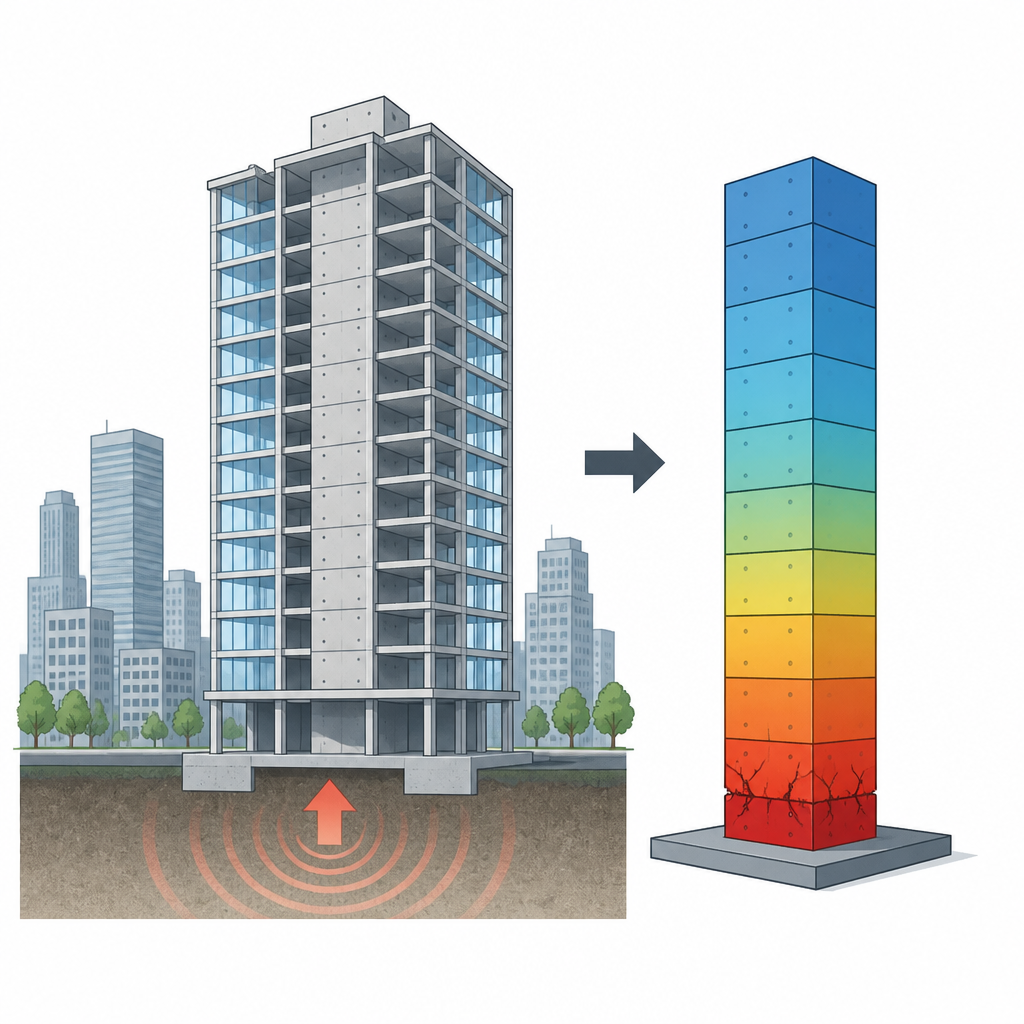
How concrete walls protect tall buildings
Reinforced concrete shear walls are key elements that help buildings resist side-to-side motion from wind and earthquakes. Steel bars inside the concrete give the walls strength and ductility, while the concrete itself carries compression. Depending on their shape, these walls can fail in different ways. Slender walls in taller buildings tend to bend like vertical beams, with cracks and crushing concentrated near the base. Shorter, stockier walls are more likely to fail through diagonal cracking or sliding. Because bending failures in slender walls are common in high-rise construction, this study focuses on predicting that specific type of behavior more accurately.
What makes earthquake prediction so difficult
During an earthquake, a wall does not simply stay elastic and then suddenly break. Instead, it passes through several stages: first it cracks, then steel bars yield, the concrete near the base crushes, and finally the wall loses strength. All along, its stiffness gradually decays, and deformation concentrates in a small region near the base. Traditional computer models often either simplify this behavior too much or require huge computing effort. They may spread damage unrealistically, depend strongly on how the wall is sliced into elements, or misjudge how much the wall softens after peak load. These weaknesses can lead to unsafe or overly conservative designs.
A smarter way to slice and test the wall in the computer
The authors propose an improved finite element model built into standard building analysis software. Instead of treating the wall as a single hinge at its base, they divide it into multiple stacked segments along its height. Within each segment, the cross-section is represented by many small “fibers” of concrete and steel, each following its own stress–strain curve. Two key advances make this setup more realistic. First, the concrete model is adjusted so that the energy required to crush it is consistent with laboratory tests, no matter how many segments the wall is divided into. This tackles the problem of artificial mesh sensitivity. Second, the stiffness of the wall is linked to a four-stage curve that mirrors how real walls crack, yield, reach peak strength, and then soften, capturing the gradual loss of stiffness seen in experiments.
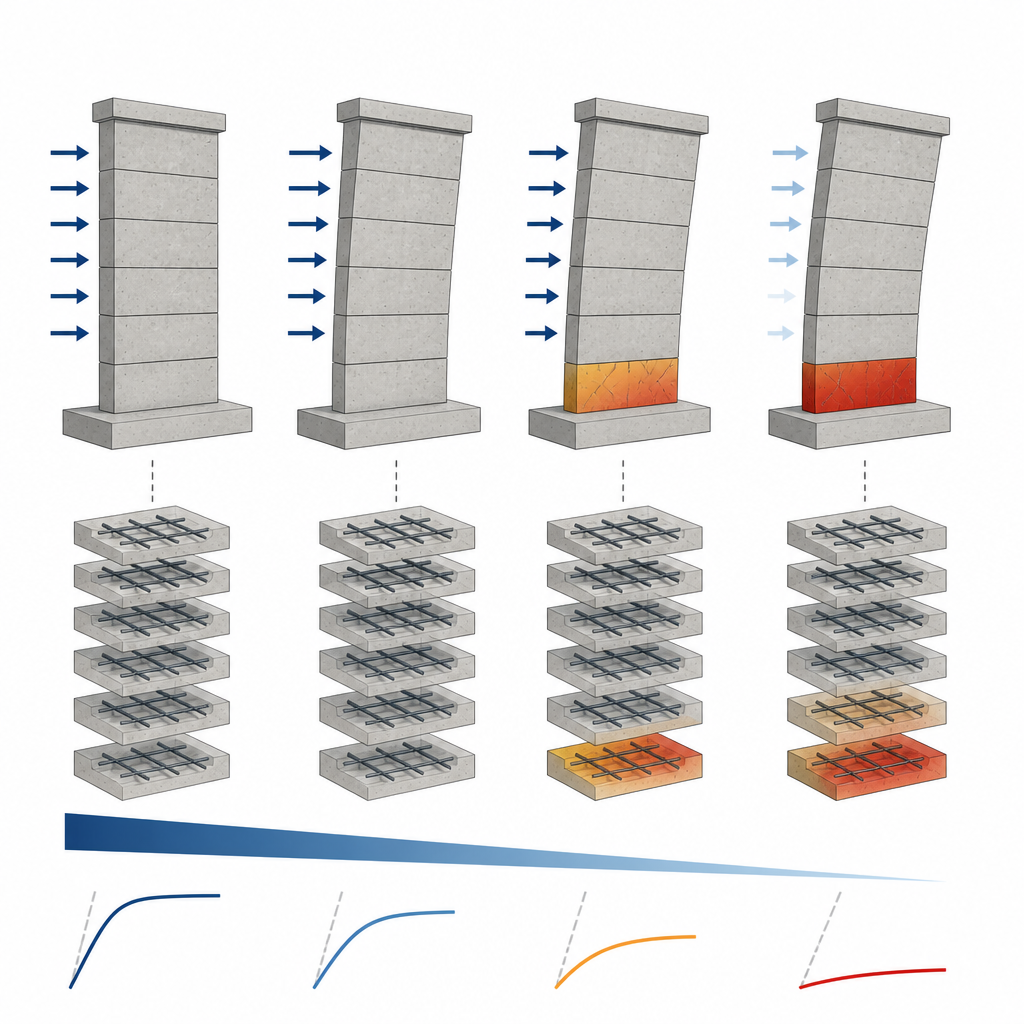
Checking the model against real broken walls
To test their approach, the researchers gathered data from thirteen previously tested concrete walls from nine different laboratories. These walls covered a wide range of sizes, reinforcement layouts, and loading conditions representative of practical building design. In the lab, each wall had been pushed back and forth until failure to reproduce earthquake-like demands. The new model used a simpler one-way “pushover” loading, yet its predicted curves of base force versus top displacement closely followed the experimental results. It matched important features such as initial stiffness, peak strength, post-peak softening, and how far the walls could sway before losing their capacity. Errors in key points like cracking, yield, and maximum load were generally small, indicating that the model tracks real behavior across the full loading range.
What this means for safer buildings
In plain terms, the study shows that engineers can use a practical, improved computer method to simulate how tall concrete walls bend and degrade during strong earthquakes without resorting to oversimplified or excessively complex tools. By tying the wall model more closely to how concrete actually cracks and crushes, and by making results less sensitive to how the wall is chopped into elements, the method gives more trustworthy predictions. This can support better seismic design and retrofit decisions, helping ensure that the concrete “spines” inside our buildings behave in the computer much like they do in real earthquakes.
Citation: Nasr, O., Moustafa, A. & Ghallab, A.H. Flexural behaviour of RC shear wall using enhanced finite element model. Sci Rep 16, 15491 (2026). https://doi.org/10.1038/s41598-026-52257-5
Keywords: reinforced concrete shear walls, finite element modeling, seismic performance, nonlinear behavior, pushover analysis