Clear Sky Science · en
Sequential visual stimuli increase high frequency power in the visual cortex
Why fast brain rhythms matter
Our brains hum with tiny electrical rhythms that help cells talk to each other. Some researchers hope that carefully timed flashes of light could tune these rhythms and support brain health, for example in conditions linked to memory loss. This study explores a new way of flashing light patterns on a screen so that they more effectively drive very fast brain activity in the part of the brain that processes vision.
A new way to flash light
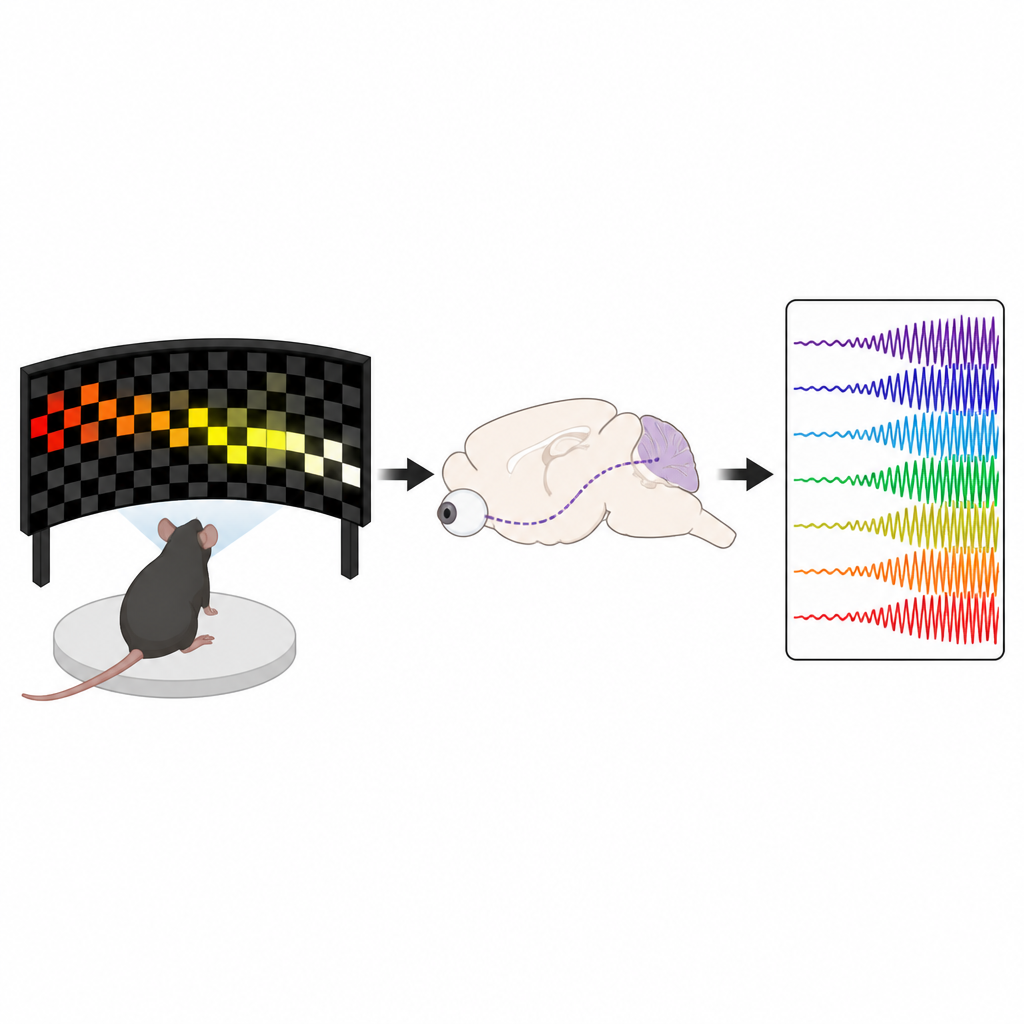
Most past experiments used simple flickering lights that brighten and dim across the whole screen at the same time. That approach works well for slower brain rhythms, but the brain’s wiring naturally dampens very fast signals, acting like a low-pass filter that lets slow waves through more easily. The authors asked whether they could overcome this limit by changing not just how fast the screen flickers, but also where on the screen it flickers from moment to moment.
Building moving patterns for the eyes
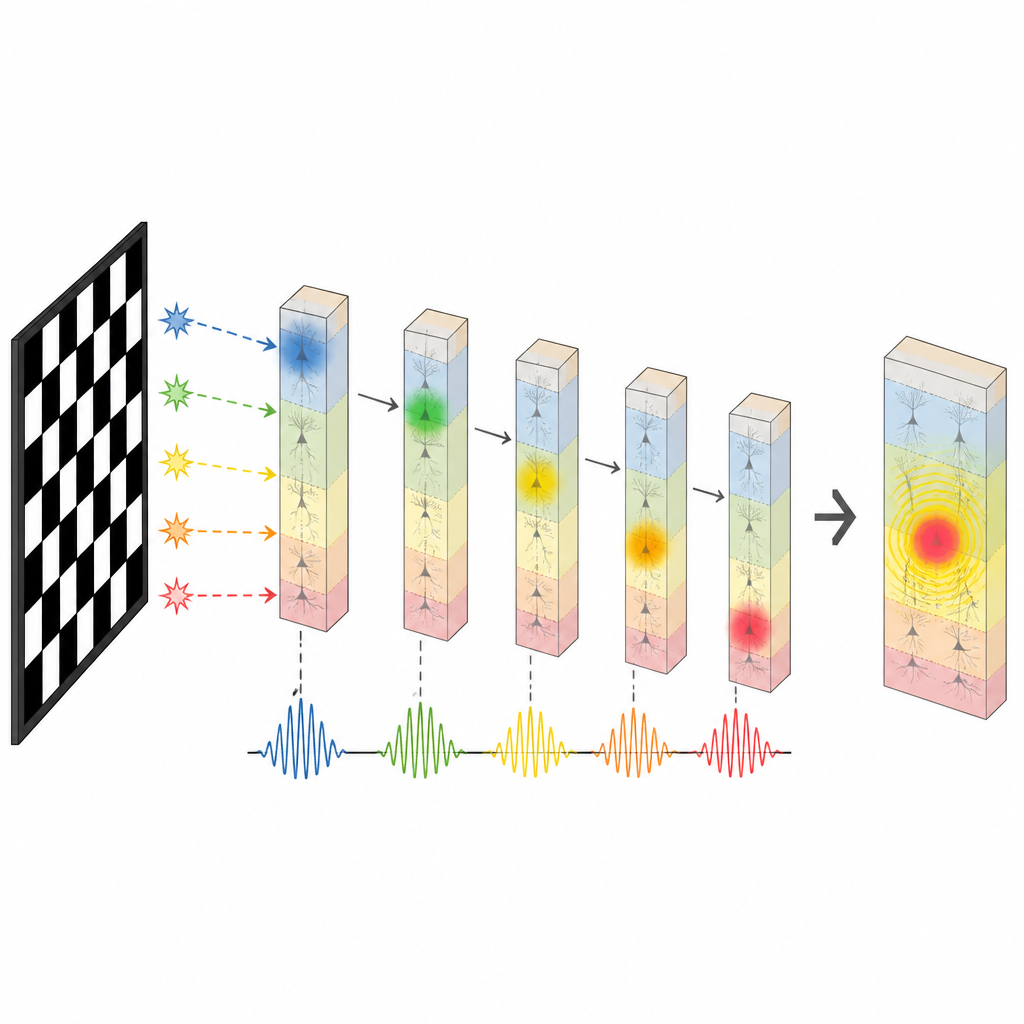
The team created checkerboard patterns that did not flash everywhere at once. Instead, the image was sliced into wedges and bars that lit up one after another across the curved screen in front of a mouse. Each tiny section appeared for only a few thousandths of a second, and then the pattern stepped to the neighboring section, sweeping across the animal’s field of view before repeating. By tuning the number of sections and the screen’s refresh rate, the researchers could control both how quickly each spot on the retina was revisited and how tightly in time neighboring spots were linked.
Listening in on thousands of brain cells
To see how the visual cortex responded, the authors used Neuropixels probes, tiny multi-sensor electrodes that can record signals from many layers and locations of brain tissue at once. They recorded both the spikes of individual neurons and the slower local field potentials, which reflect the combined activity of many cells. Recordings were taken in awake, head-fixed mice trained to sit calmly while they watched the series of visual patterns, including standard full-field flickers, moving bars, and the new sequential patterns.
Fast power from slow repeats
The key measure was how much power appeared in very high frequency bands between 100 and 190 hertz in the visual cortex. The sequential patterns reliably boosted power in this fast band in specific regions that matched the stimulated parts of the visual field. Tangential probe insertions that spanned a wide stretch of visual cortex revealed that these high-frequency boosts could extend over hundreds of micrometers of tissue. Interestingly, patterns with lower repeat rates, meaning each location on the screen was revisited less often but for slightly longer flashes, led to stronger high-frequency power and more consistent timing of neuron firing than faster-repeat patterns.
Comparing to classic flicker
When the authors tested more traditional visual stimuli, such as alternating full-field checkerboards and moving bars, they did see moderate increases in mid-range gamma rhythms up to about 60 hertz. However, these classic patterns did not produce the same strong, localized increases in the 100 to 190 hertz range as the sequential stimuli. This suggests that the spatial ordering and timing offsets across neighboring regions of the screen are crucial ingredients for pushing the visual cortex into higher frequency activity, beyond what uniform flicker can achieve.
What this could mean for future therapies
To a non-specialist, the main message is that how and where light flickers across our eyes can change the way fast brain rhythms are engaged. By carefully sequencing flashes across neighboring spots rather than lighting everything at once, this mouse study shows it is possible to strengthen very fast electrical activity in visual brain areas despite the brain’s tendency to damp such signals. In the long run, similar ideas might be adapted and tested in humans and perhaps even extended to hearing and touch, opening new avenues for non-invasive ways to influence brain rhythms linked to perception and cognition.
Citation: Keil, J., Hernandez-Urbina, V., Vassiliou, C. et al. Sequential visual stimuli increase high frequency power in the visual cortex. Sci Rep 16, 15228 (2026). https://doi.org/10.1038/s41598-026-52253-9
Keywords: visual cortex, brain rhythms, gamma oscillations, sensory stimulation, mouse neuroscience