Clear Sky Science · en
Chelator-engineered nano-electroless copper coatings on epoxides: surface and electrochemical properties
Why smoother metal coatings matter
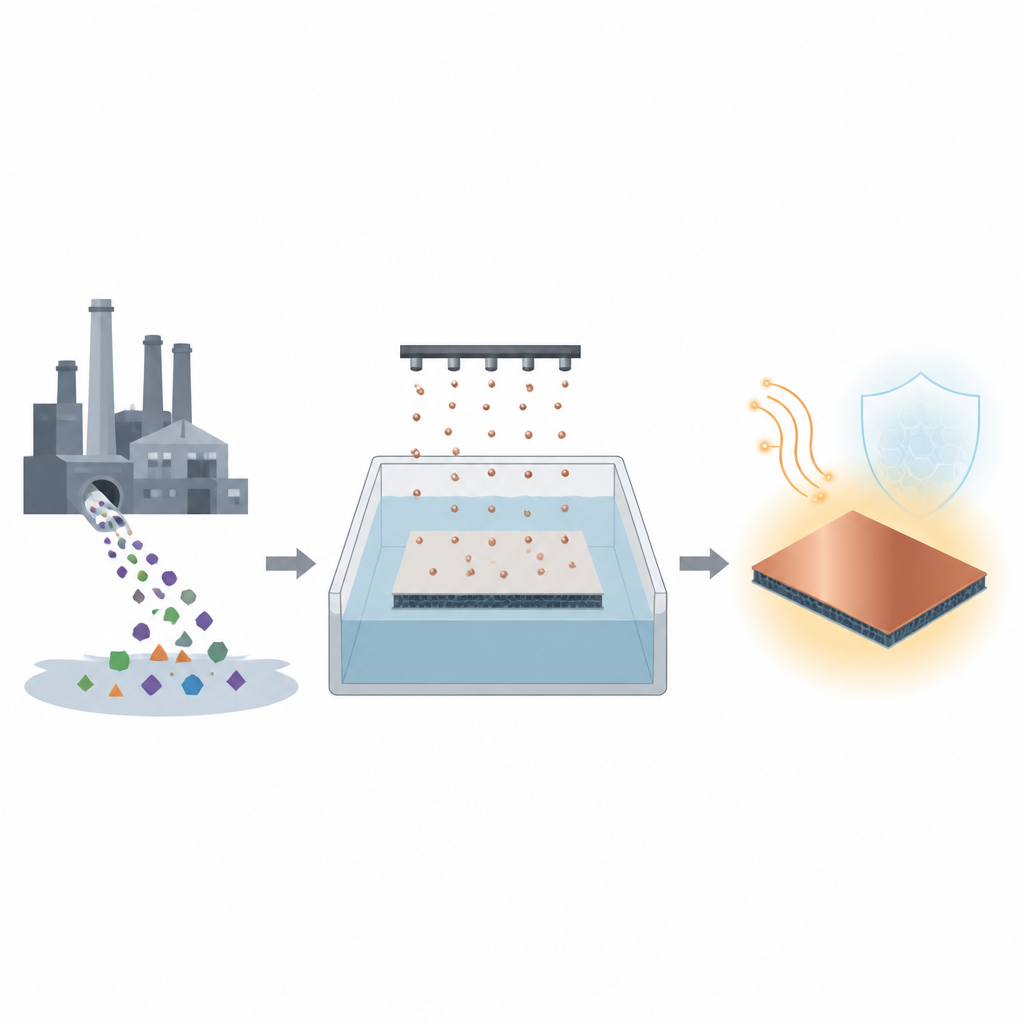
From smartphones to solar panels, many everyday devices rely on thin copper layers laid down on plastic-like materials. These coatings help carry electrical signals and protect delicate parts, but making them usually involves harsh, long-lasting chemicals that can harm waterways. This study asks a simple question with big consequences: can common sugars help us make better copper coatings in a cleaner way?
Making copper stick without plugging in
The research focuses on a technique called electroless copper deposition, where copper forms a thin layer on a surface without using an external power supply. Instead, a chemical “bath” causes copper to settle as a uniform film onto an epoxy plastic. This is useful in printed circuit boards and shielding casings inside electronics. The challenge is that epoxy is naturally smooth and chemically quiet, so copper does not easily stick or spread evenly. Traditionally, strong complexing chemicals such as EDTA are used to manage copper ions in the bath, but they linger in the environment and are hard to remove from industrial wastewater.
Sugars as gentle helpers in the bath
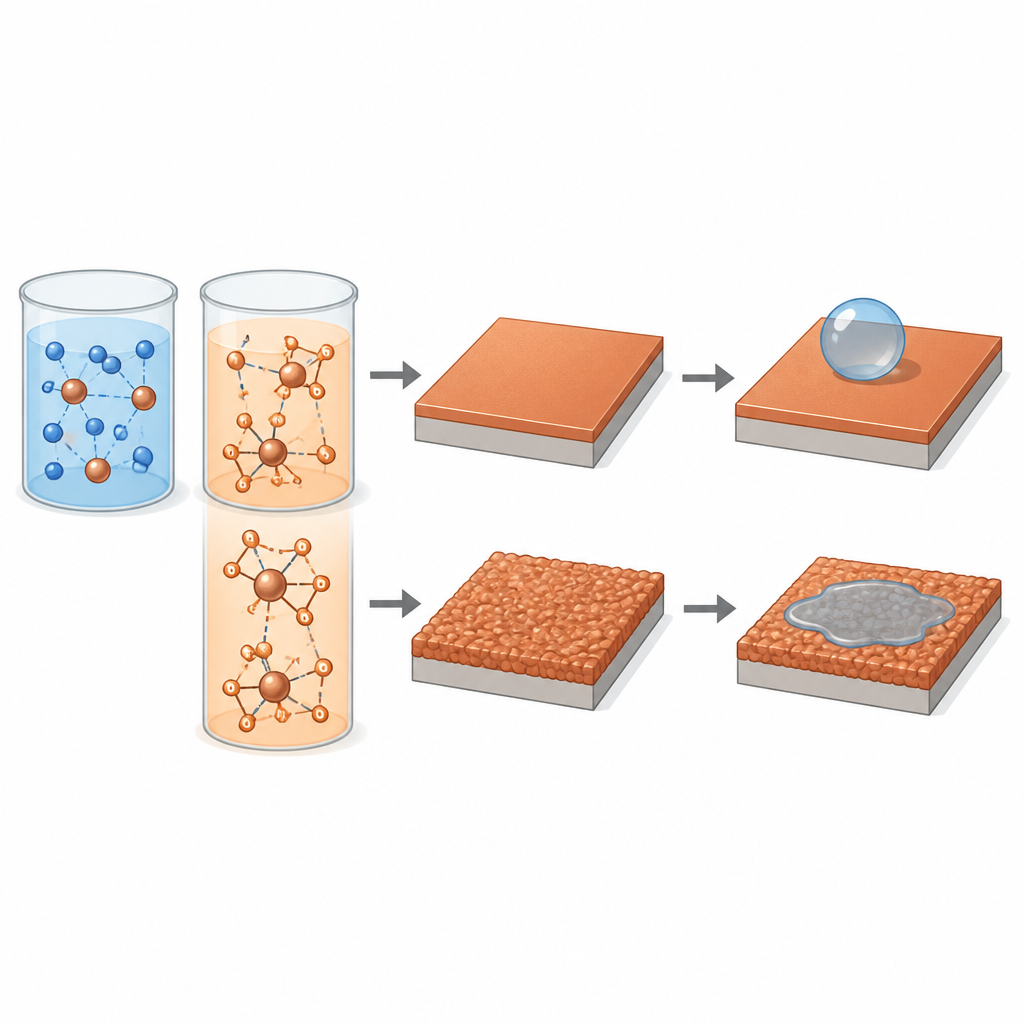
To tackle this, the team replaced conventional complexing agents with two simple sugars: glucose and fructose. These sugars can gently grab copper ions, keep them dissolved, and guide them toward the plastic surface, while later breaking down more easily in nature. The scientists prepared two types of chemical baths, one based on glucose and the other on fructose, and added small amounts of azole additives, aminopyrazole and tolytriazole, to fine-tune how fast copper deposits. They carefully cleaned and activated epoxy pieces, then immersed them in these baths under controlled pH and temperature, letting copper build up for a fixed time.
Looking closely at the tiny copper grains
After deposition, the coatings were examined with powerful microscopes and surface probes. Scanning electron microscopy showed that baths containing glucose produced much smaller, more uniform copper grains, while fructose-based baths led to larger, rougher, gravel-like structures. Atomic force microscopy confirmed this difference: glucose coatings had low surface roughness, whereas fructose coatings were significantly rougher. X-ray analysis revealed that the copper formed well-ordered crystals, and that tolytriazole in particular helped refine the grain size even further, giving especially smooth, fine-grained copper layers.
Testing how the coatings behave in action
To see how these differences matter in practice, the team used electrochemical tests that mimic how the coatings conduct electricity and withstand corrosive conditions. Cyclic voltammetry showed that glucose-based baths, especially those with tolytriazole, created coatings with high electroactive surface area and efficient electron transfer. Impedance and polarization measurements linked these electrical traits directly to surface structure: smooth, closely packed grains allowed electrons to move easily, while coarse, uneven surfaces slowed them down and made the coatings less stable. At the same time, the additives changed corrosion behavior, revealing a trade-off between very fast electron transfer and long-term protective performance.
What this means for cleaner electronics
In simple terms, the study shows that replacing traditional, persistent chemicals with everyday sugars can yield copper coatings that are both smoother and more effective. Glucose, in particular, proved to be a strong partner for copper, helping it form tight, even layers on otherwise reluctant plastic surfaces, while tolytriazole sharpened this effect by further refining the grain structure. Together, they create copper films that conduct well and adhere strongly, while pointing toward a more environmentally responsible way to manufacture metal-coated plastics. For consumers, this kind of chemistry could support electronics and protective components that are not only high performing but also kinder to the environment.
Citation: Jayalakshmi, S., Venkatesan, R., Surya, S. et al. Chelator-engineered nano-electroless copper coatings on epoxides: surface and electrochemical properties. Sci Rep 16, 15495 (2026). https://doi.org/10.1038/s41598-026-52242-y
Keywords: electroless copper, epoxy coatings, green chemistry, glucose chelator, surface morphology