Clear Sky Science · en
Effect of biological and agricultural foaming agents on concrete waste for the preparation of porous ceramic materials
Turning old concrete into useful new materials
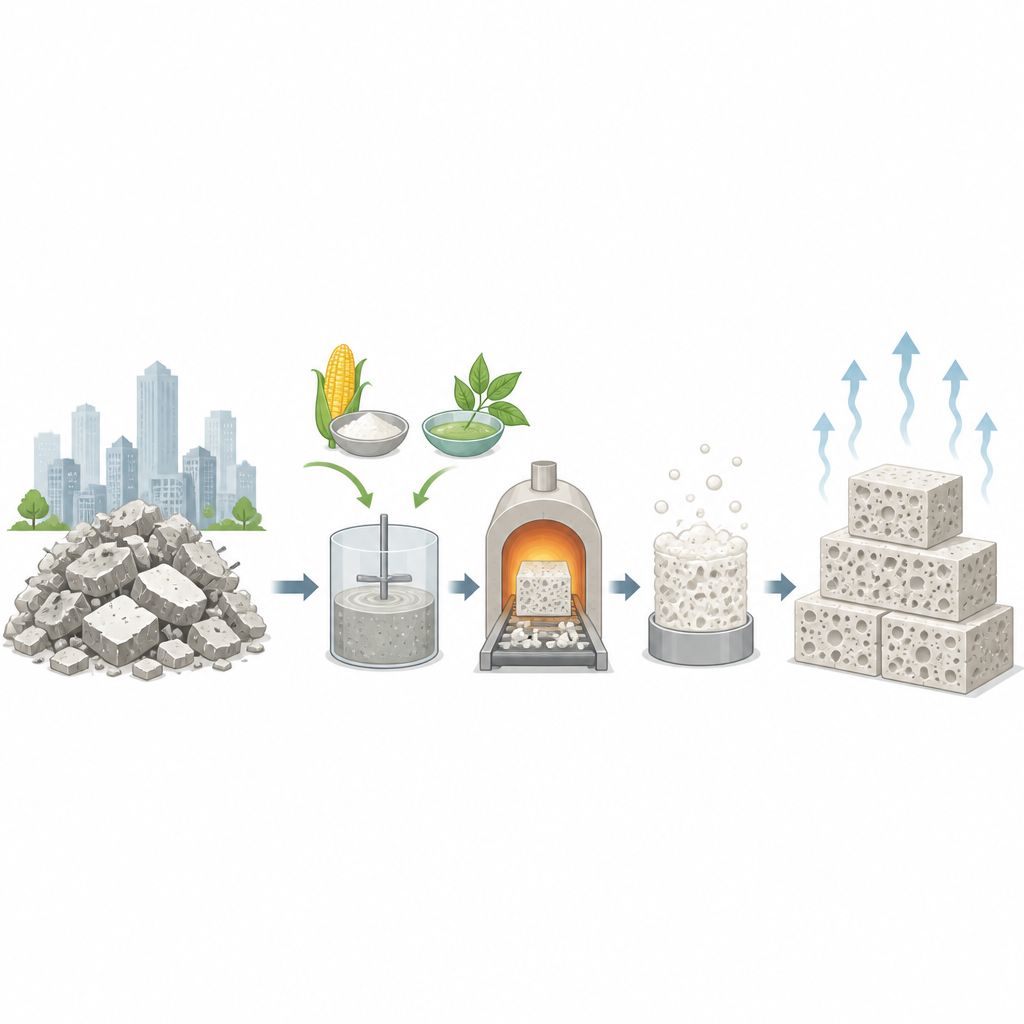
Across the world, cities are growing fast, and with that growth comes a rising tide of broken concrete from demolished buildings. Much of this rubble ends up in landfills, wasting space and natural resources. This study explores a creative way to turn that unwanted concrete into lightweight, porous ceramic blocks that can help keep buildings warm or cool, using everyday materials like flour, yeast, sawdust, and wheat straw as part of the process.
Why pores and holes can be a good thing
The researchers focus on a special type of ceramic that is full of tiny pores. These pores can be open and connected, allowing gases and liquids to pass through, or more closed, trapping air inside. Such materials are attractive for uses like filters, gas burners, and insulation panels because the trapped or guided air slows heat flow and can filter out particles. By starting with crushed waste concrete and adding simple organic ingredients, the team aims to build a porous structure without relying on expensive synthetic chemicals.
Cooking with waste concrete and kitchen staples
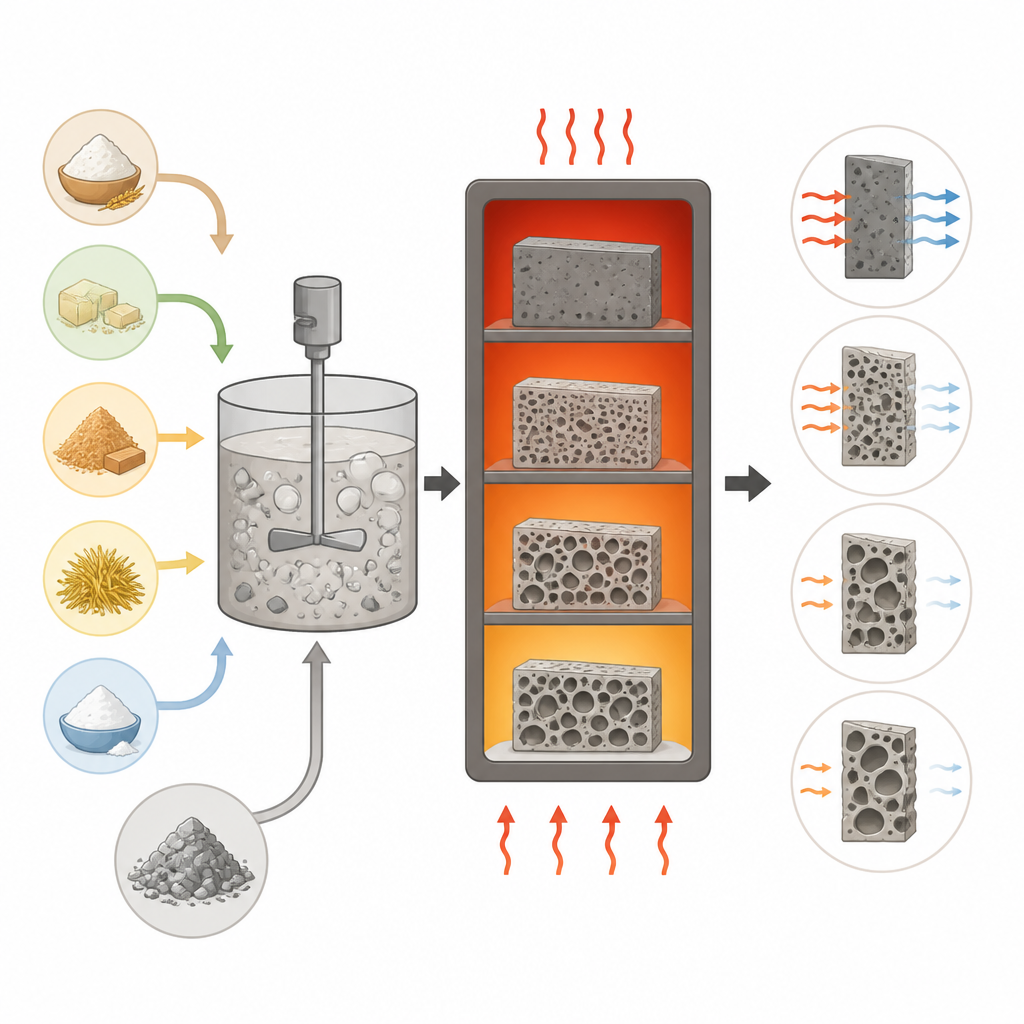
To make these materials, the team dried and crushed old concrete, mixed it with sand, water, and corn starch, and then added one of several foaming helpers: wheat flour, yeast, baking powder, sawdust, or wheat straw. Starch acts as both glue and a source of gas; when heated, it swells, burns away, and leaves empty spaces behind. The added foaming helpers create extra gas or burn out during firing, carving out additional pores. The mixture is stirred into a slurry, gently warmed to let bubbles grow and set, then fired first at 900 °C and finally at higher temperatures of 1200 °C, 1250 °C, or 1300 °C to harden and strengthen the blocks.
How the choice of foaming helper shapes the material
Tests showed that temperature and foaming helper together control how dense, strong, and insulating the finished ceramics become. As the firing temperature rose, pores tended to shrink or partially close, so most samples became less porous but denser and stronger. Flour and yeast created highly porous materials, with flour-based samples reaching porosity above half their volume while still forming a solid network of connected pores. Sawdust and straw, which contain larger particles, led to bigger and more uneven pores but still maintained high overall porosity. In contrast, baking powder created relatively small pores and, at the highest temperature, encouraged glassy phases that reduced porosity more than in other samples.
Balancing strength, lightness, and heat flow
The mechanical and thermal tests highlight important trade offs. Samples with more pores generally had lower crushing strength, but the exact pore size and shape also mattered. Sawdust-based ceramics stood out for their strength, reaching over 5 megapascals at 1300 °C while still keeping roughly 38 percent of their volume as pores. Flour-based ceramics offered slightly lower strength but very good porosity and the lowest measured heat transfer, making them promising for insulation. Measurements of thermal transmittance and thermal conductivity showed that all organic additives reduced heat flow compared to a simple concrete-based sample, with flour, yeast, and sawdust performing best as natural insulation enhancers.
From building debris to future insulation and filters
Overall, the study shows that broken concrete can be turned into useful porous ceramics using common biological and agricultural byproducts instead of costly industrial chemicals. By adjusting the firing temperature and the type of foaming helper, it is possible to tune the balance between strength, weight, and insulation. The resulting materials have the potential to serve in gas burners, filtration units, and heat resistant linings, while also reducing landfill waste and demand for fresh raw minerals. For non specialists, the key message is that everyday ingredients like flour, yeast, and sawdust can help transform building rubble into smarter, more sustainable construction materials.
Citation: Khattab, R.M., Abo-Almaged, H.H., Ali, .M. et al. Effect of biological and agricultural foaming agents on concrete waste for the preparation of porous ceramic materials. Sci Rep 16, 15463 (2026). https://doi.org/10.1038/s41598-026-52176-5
Keywords: porous ceramics, concrete recycling, thermal insulation, sawdust and straw, foaming agents