Clear Sky Science · en
Experimental and numerical investigation of the axial compressive behavior of GFRP-reinforced concrete walls under concentric and eccentric loading
Why safer concrete walls matter
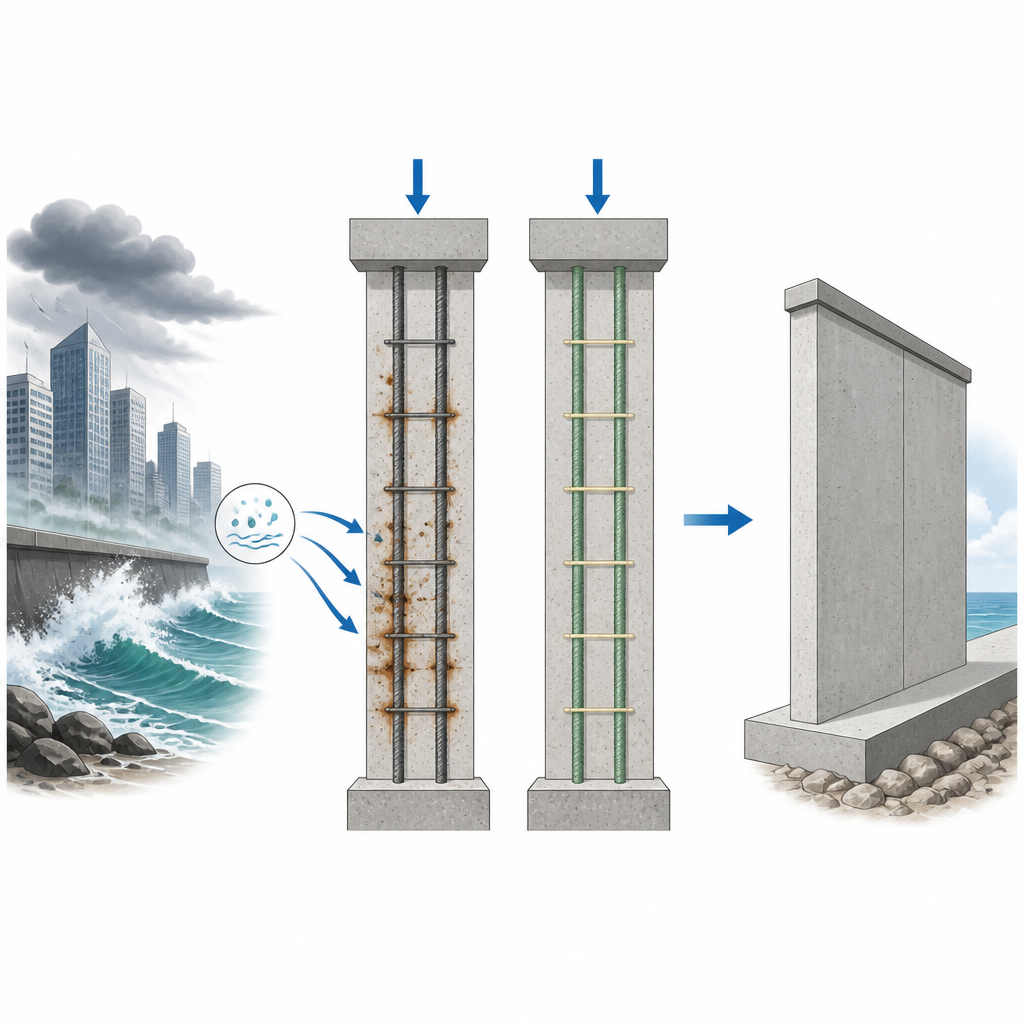
Many everyday structures from apartment towers to coastal bridges rely on thick concrete walls to carry the weight of the building and stand up to wind, waves, and earthquakes. These walls are usually laced with steel bars hidden inside the concrete. Over time, however, steel can rust, especially in salty or chemically aggressive environments, which weakens the structure and shortens its life. This study explores whether glass fiber bars, which do not rust, can safely replace steel inside such walls without sacrificing too much strength or safety.
From rusty steel to rust free glass fibers
Inside a reinforced concrete wall, the hidden bars are as important as the concrete itself. Traditional steel bars are strong and ductile, meaning they can stretch before breaking, but they are vulnerable to corrosion when water and salts reach them through cracks. Glass fiber reinforced polymer (GFRP) bars offer a different trade off: they are light, strong in tension, and immune to rust, but they are stiffer in a different way and fail in a more brittle manner. Design codes today mostly treat such glass fiber bars as if they add little or nothing when they are in compression, because their behavior in compressed walls is not yet well understood. The authors set out to fill this gap by testing concrete walls with GFRP bars head to head against identical walls with steel bars.
How the walls were built and tested
The team cast six squat wall specimens about one meter high and 15 centimeters thick using a high performance concrete mix. Each wall had a mesh of internal bars running vertically and horizontally. Two main variables were changed: the type of reinforcement (steel or GFRP) and the way the load was applied. In one group, the vertical compressive load was applied straight through the center of the wall, simulating a uniform weight from above. In the second group, the same load was shifted off center, introducing bending as well as compression, which is closer to many real world situations. Sensors measured how the walls shortened, bent, cracked, and finally failed, while the researchers tracked both the first visible crack and the ultimate load each wall could carry.
What happened when the walls were pushed
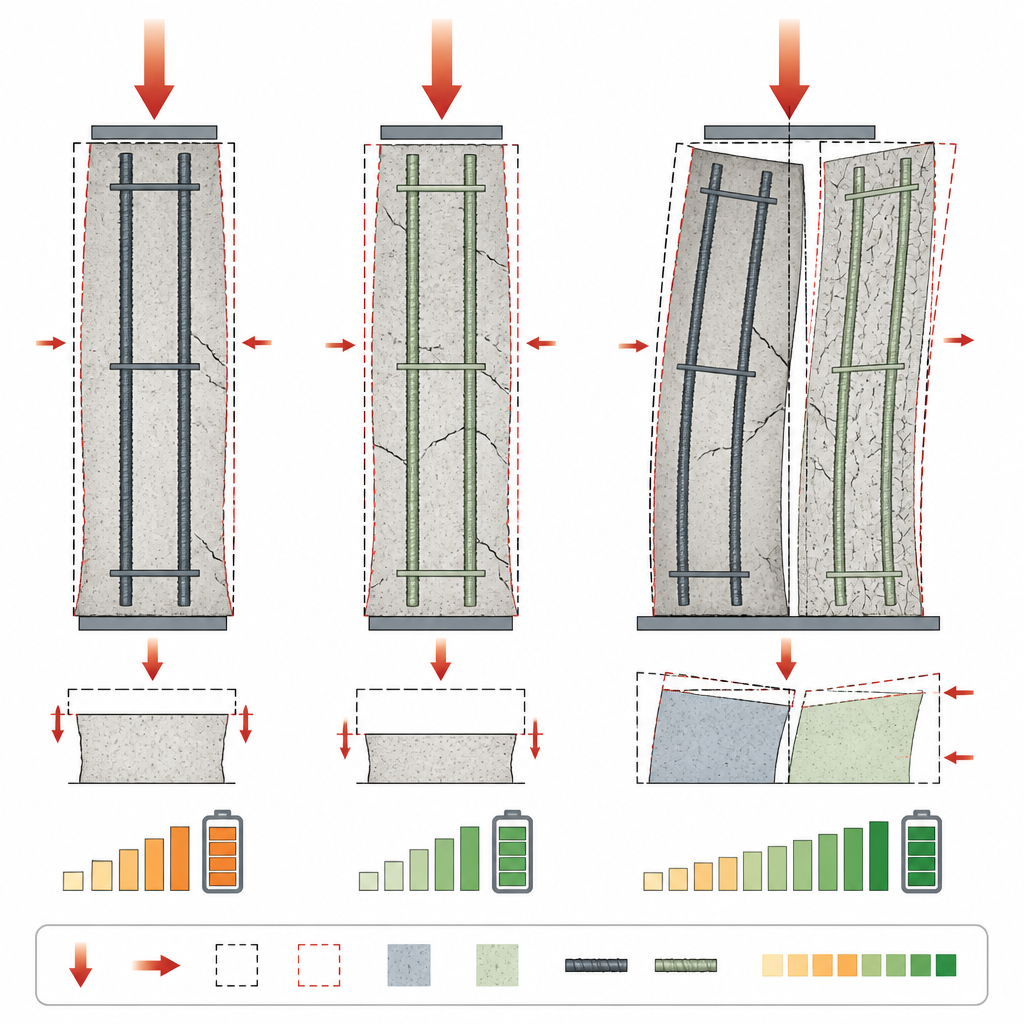
Walls with GFRP bars carried somewhat less vertical load than their steel counterparts but behaved in a stable and predictable way. Under central loading, replacing steel with GFRP reduced the maximum load the walls could support by roughly 11 to 13 percent. Under off center loading, the loss ranged from about 6 to 14 percent. At the same time, GFRP reinforced walls showed slightly higher ductility ratios, a measure of how much they could deform beyond the first serious softening before failure. Steel reinforced walls tended to fail through crushing and spalling of concrete near the compression edge after the steel had yielded, while GFRP walls developed more evenly spread cracks and then failed more abruptly when the glass fiber bars ruptured. The energy each wall could absorb before failure, calculated from the area under the load displacement curve, was highest for the steel reinforced specimens but still substantial for GFRP reinforced ones.
Computer models that mirror real world cracks
To see whether engineers can rely on advanced simulation tools rather than testing every wall type in the lab, the authors built detailed computer models of the walls using a technique called nonlinear finite element analysis. In this virtual setup, the concrete was allowed to crack and crush, while the embedded steel or GFRP bars carried tension and compression according to their measured properties. When the simulated walls were loaded concentrically or eccentrically, the predicted ultimate loads, stiffness changes, and crack patterns matched the experiments closely, with differences in strength usually under about 12 percent. The study also compared the experimental results with several existing design formulas and building code methods, showing that some guidelines tend to overestimate the capacity of GFRP reinforced walls and suggesting a simple correction factor to improve accuracy.
What this means for future buildings
For a non specialist, the key message is that concrete walls reinforced with glass fiber bars can provide a viable rust free alternative to steel, especially in harsh environments such as coastal regions and industrial sites. These walls do give up a modest portion of their load carrying capacity and energy absorption, but they maintain a steady post cracking response and acceptable ductility, while avoiding the long term damage associated with steel corrosion. With careful design that accounts for their slightly lower strength, and with the aid of validated computer models, GFRP reinforced concrete walls could help engineers build more durable and sustainable structures that need less repair over their lifetime.
Citation: El-Sayed, T.A., Ibrahim, M.M., Shanour, A.S. et al. Experimental and numerical investigation of the axial compressive behavior of GFRP-reinforced concrete walls under concentric and eccentric loading. Sci Rep 16, 15338 (2026). https://doi.org/10.1038/s41598-026-52146-x
Keywords: GFRP reinforced concrete, axial compressive behavior, structural walls, corrosion resistant reinforcement, finite element modeling