Clear Sky Science · en
Open circuit fault localization in dual active bridge based simultaneous battery charging systems using multi label classification
Why smart charging needs smart fault detection
As electric vehicles become more common, charging stations must safely charge many batteries at once without wasting energy or damaging costly hardware. This study shows how modern pattern recognition can spot subtle electrical faults in a type of fast, compact charger before they grow into serious failures, using only voltage signals and a trained computer model.
How one converter charges two batteries at once
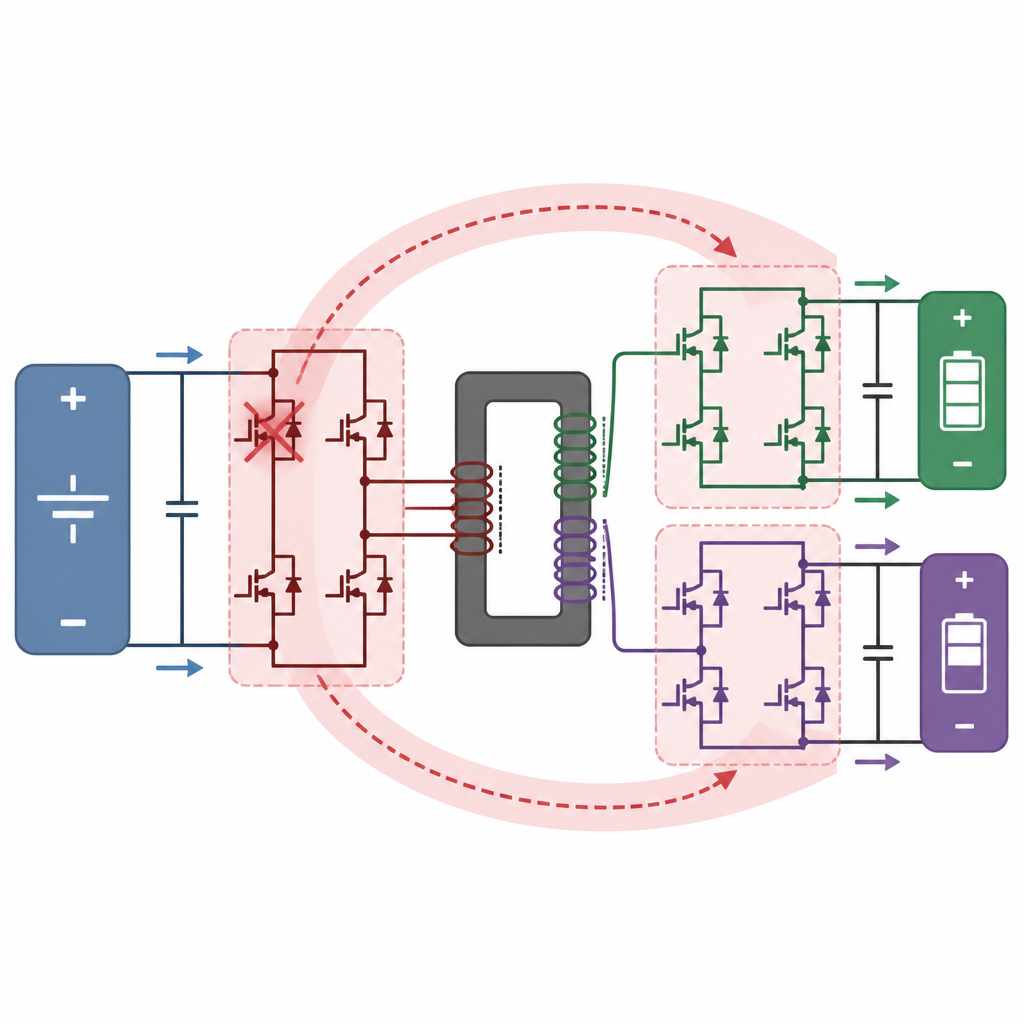
Modern high power chargers often rely on a device called a dual active bridge converter to move energy between a direct current source and multiple batteries. In the three port design studied here, one side of the converter feeds two separate battery ports through a shared high frequency transformer. Groups of electronic switches turn on and off in carefully timed patterns so that both batteries can be charged from the same link while staying electrically isolated for safety.
Why open switch faults are tricky to catch
These electronic switches can fail in different ways. When a switch sticks open, the converter often keeps running, but currents and voltages become unbalanced and can stress other parts until a second, more damaging fault occurs. Because the three ports are magnetically tied together, a problem in one bridge can ripple through the others. Traditional fault detection methods either require very accurate circuit models or struggle when the load changes or when control delays distort the waveforms. They also usually assume only one fault at a time, even though combined faults are common in multiport hardware.
Turning voltage ripples into pictures for a neural network
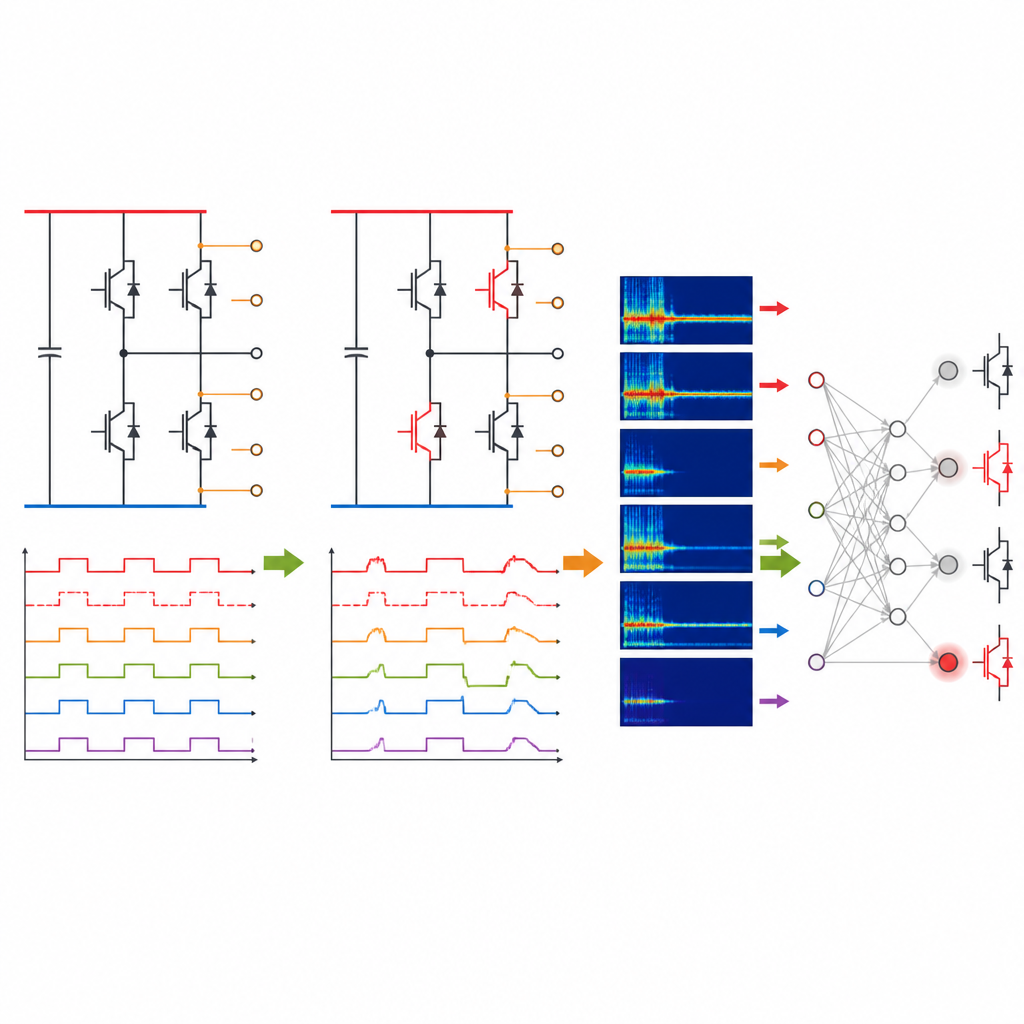
To tackle this challenge, the authors measure voltages at the midpoints of each switch leg, six points in total that are especially sensitive to how each pair of switches behaves. They convert these fast voltage traces into time–frequency images using a mathematical tool similar to a musical spectrogram. Each image shows how the strength of different frequency components changes over a short time window. The six images from the six sensors are then stacked like the color channels in a photo, creating a rich picture that encodes how a given fault pattern distorts the converter’s behavior across the whole system.
Teaching the model to recognize many faults at once
The team adapts a known image recognition network, ResNet‑18, so that instead of choosing a single fault category, it can mark any combination of the twelve switches as faulty at the same time. They build a large simulated dataset that covers all single and double open switch cases, a range of battery charge levels, and many different times at which faults appear within the switching cycle. Training and testing on unseen operating points show that the model correctly detects and pinpoints faults with F1 scores above 99 percent, and it even handles unseen three switch fault combinations with about 85 percent accuracy. Compared with a more conventional single label classifier, the multi label design captures simultaneous faults more reliably and with better balance across all switches.
Robust under noise, delays, and fewer sensors
Real systems rarely behave exactly like ideal simulations, so the authors also test how the method holds up when conditions are less perfect. They introduce realistic delays between switch control signals, add electrical noise to the voltage measurements, and then remove some of the sensors altogether. The model maintains high accuracy across these tests, keeping F1 scores above 93 percent even at relatively low signal quality and above 92 percent when using only two sensors. A timing analysis shows that, in its current software form, the full diagnosis from data capture to decision takes about 0.14 seconds, fast enough for online health monitoring in charging systems.
What this means for future charging systems
In simple terms, this work shows that by turning raw voltage ripples into images and feeding them to a carefully designed neural network, a multiport battery charger can not only tell that something is going wrong but also quickly identify which switches are affected, even when several fail together. The approach remains reliable under noisy, delayed, or reduced measurements and runs fast enough for practical use, suggesting a promising path toward safer and more resilient charging stations for the growing electric vehicle fleet.
Citation: El-Naeem, K.S.A., Nayel, M.A., Abdelrahem, M. et al. Open circuit fault localization in dual active bridge based simultaneous battery charging systems using multi label classification. Sci Rep 16, 15354 (2026). https://doi.org/10.1038/s41598-026-52101-w
Keywords: dual active bridge, battery charging, fault diagnosis, deep learning, power converters