Clear Sky Science · en
Fascicle lengthening during a large torque reduction subsequently decreases dorsiflexion torque steadiness
Why this study matters for everyday movement
When you stand, walk, or balance on one leg, your ankle muscles quietly keep you steady. This study looked at what happens inside one of those key muscles when people lower the force they are producing, and how that history of tension affects how smoothly they can hold their ankle steady. The findings help refine how scientists think muscles work in real life and may guide better models for sports training, rehabilitation, and movement science.
How muscles quietly control your ankle
Your ankle muscles do more than simply push and pull. Their fibers shorten and lengthen within stretchy tendons, and the force they produce depends not only on how much they are activated by nerves, but also on what they have just been doing. Earlier work showed that after a muscle actively shortens or lengthens, its force at a fixed length can stay slightly depressed or enhanced compared with a simple hold. These history effects make it hard to estimate true muscle force from joint torque alone and are often ignored in computer models of movement.
A fresh look at muscle fibers during controlled force drops
The researchers focused on the tibialis anterior muscle on the front of the lower leg, which lifts the foot toward the shin. Volunteers lay prone with one foot strapped to a dynamometer that held the ankle still while measuring torque. Using ultrasound, the team tracked the tiny muscle fascicles inside the tibialis anterior while surface sensors measured electrical activity. Participants followed torque targets on a screen, first ramping up to a higher force, then reducing to a lower level, and finally holding steady. Across two experiments, the team changed either how fast people reduced force or how large that drop was, so that the internal muscle fibers would lengthen by different amounts and speeds as the tendon recoiled. 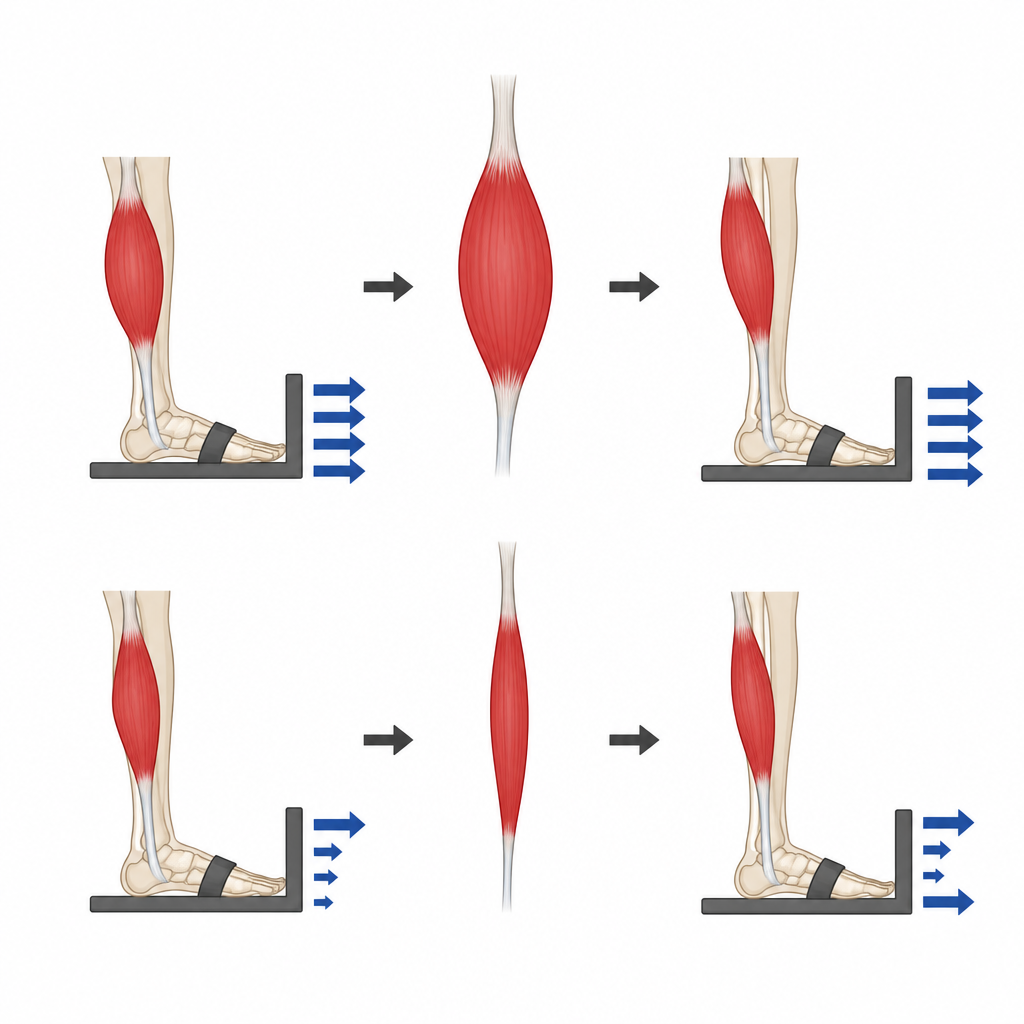
What happened inside the muscle
As expected, faster or larger drops in ankle torque led to faster or larger lengthening of the tibialis anterior fascicles, even though the ankle joint itself did not move. However, when the new steady force level was reached, the electrical activity needed to hold that level did not decrease compared with reference trials that had no prior fiber lengthening. In other words, the muscle did not seem to take advantage of a history based boost in force that might have allowed it to work with less neural drive. The one clear change was in how steady the torque was: when fascicles lengthened by roughly eight percent or more during a large torque reduction, the resulting ankle torque became measurably more variable, although the average level stayed the same.
Why torque steadiness, not effort, was affected
The team had expected that lengthening the fibers during a force drop might trigger mechanisms known from animal and human studies where stretching an active muscle can enhance later force or lower the required activation. Instead, they found that the main legacy of a big force reduction was shakier torque, not lower effort. The authors suggest that the explanation may lie more in the nervous system than in the muscle tissue itself. After a large drop in effort, the spinal motor neurons may keep firing in an uneven way, or the common input to many motor units may fluctuate more, which would make the ankle torque less smooth. Because detailed recordings of individual motor units were not taken here, this idea remains a testable hypothesis for future studies. 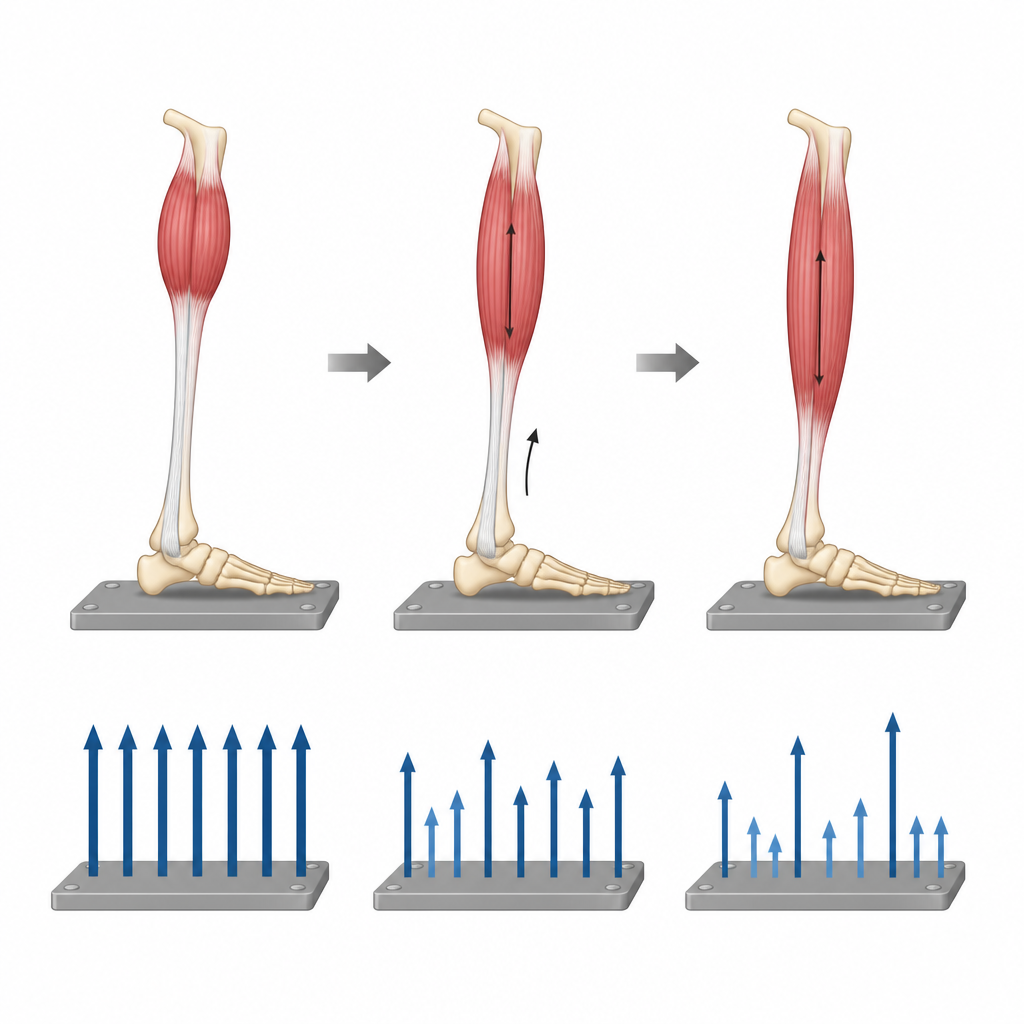
What this means for muscle models and real-world movement
For scientists who build computer models of how muscles contribute to movement, these results suggest that, in this kind of fixed ankle task, the main history effect to worry about is the loss of force following prior shortening, not any hidden gain following fiber lengthening during a force drop. The mechanical aftereffects of such lengthening did not make the muscle more efficient in terms of activation, but they did make ankle torque less steady when the lengthening was large. For a layperson, that means that after a strong effort followed by a big easing off, your ankle muscle may hold the same average force but with slightly more wobble, likely due to how your nervous system continues to drive the muscle.
Citation: Raiteri, B.J., De Lorenzo, R., Kraul, M. et al. Fascicle lengthening during a large torque reduction subsequently decreases dorsiflexion torque steadiness. Sci Rep 16, 16285 (2026). https://doi.org/10.1038/s41598-026-52001-z
Keywords: muscle torque steadiness, ankle dorsiflexion, muscle contraction history, tibialis anterior, residual force depression