Clear Sky Science · en
A novel ANN-based approach for fault detection and classification in modern TCSC-compensated transmission lines integrated with DFIG-based wind farms utilizing WST
Why keeping the lights on is getting harder
As more electricity comes from wind farms, our power grid becomes cleaner but also more complicated to protect. Devices that boost the capacity of transmission lines and the special generators used in modern wind farms can change how electrical faults look to protective relays. This study explores a new way to spot and classify such faults quickly and reliably, helping to prevent blackouts and equipment damage in a grid rich in renewable power.
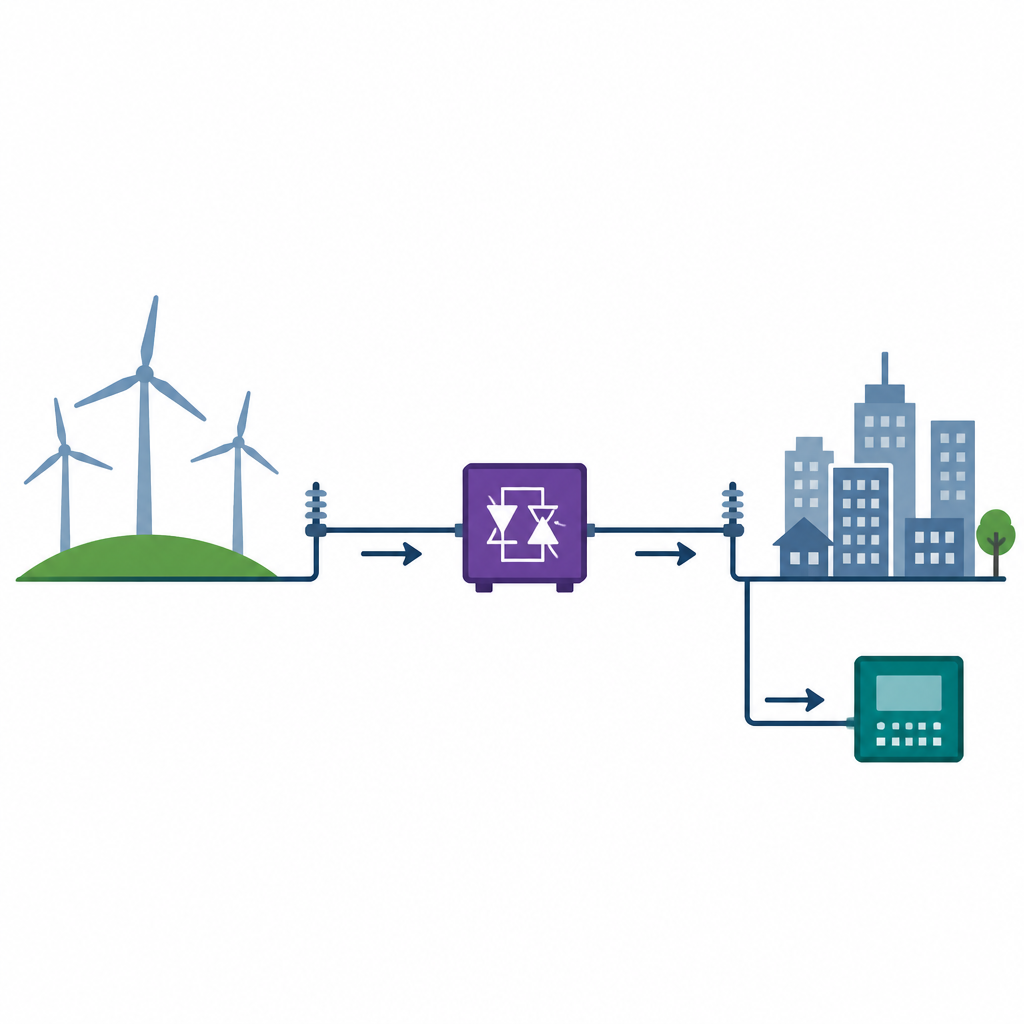
Wind power and smart hardware on the line
The work focuses on long high voltage lines that both carry power from a wind farm and are equipped with a series device called a thyristor controlled series capacitor. This device lets operators adjust how much power the line can carry by changing its effective electrical stiffness. At the same time, the wind farm uses a generator type that allows fine control of power but produces fault currents that differ from those of traditional power plants. Together, these features make faults on the line harder to recognize using classic protection methods that assume more stable, predictable behavior.
Why old fault detectors struggle
Traditional digital protection often relies on tools that dissect signals into frequency bands, such as the discrete wavelet transform. In practice these methods can be fragile. Their performance depends on choices like sampling rate and number of levels, and they are sensitive to exactly when in the voltage cycle a fault begins. In a system where wind speed changes, the series capacitor is constantly adjusted, and switching operations or noise disturb the signals, these detectors can misjudge which phase is faulty or even miss a dangerous event. Many existing schemes also need measurements at both ends of the line and a communication link, raising cost and complexity.
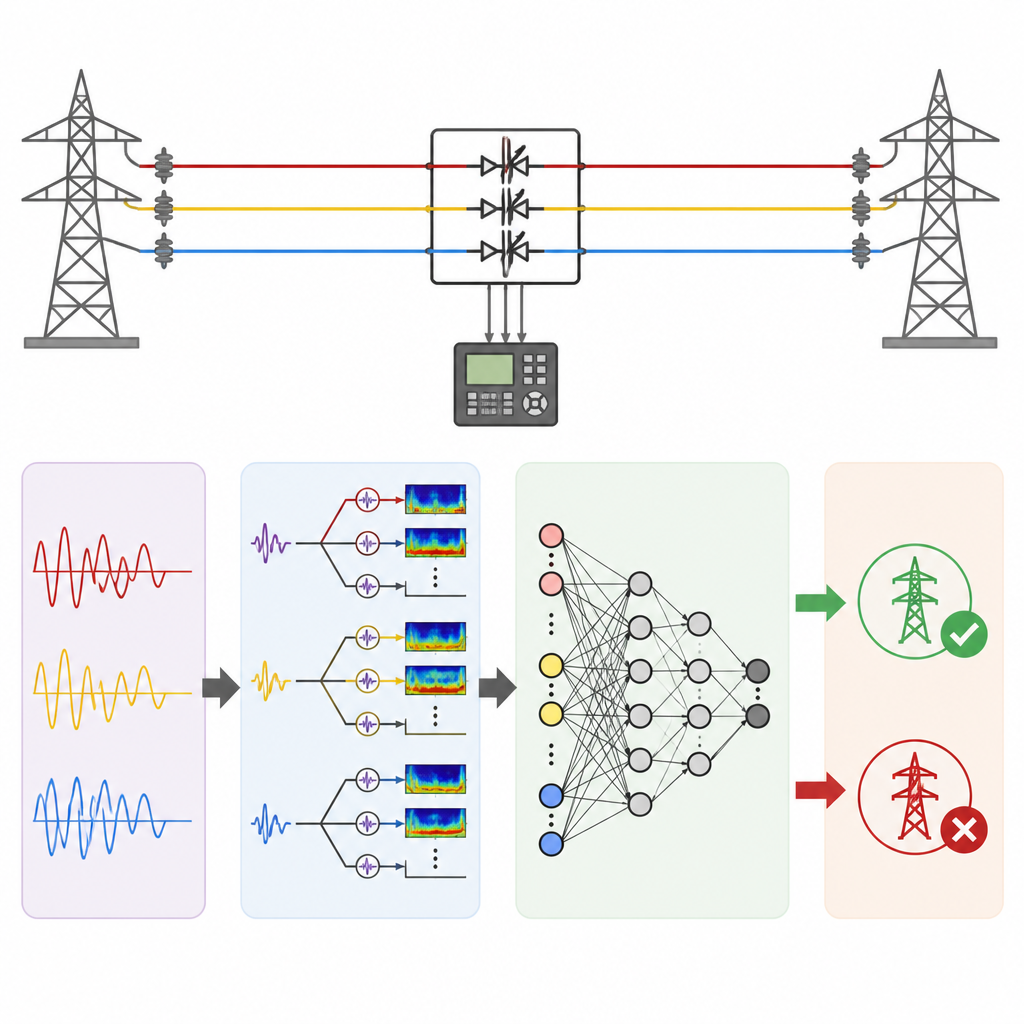
A new way to listen to the grid
The authors propose a different approach that listens only to the three phase currents and the ground current at a single point on the grid side. They apply a signal processing tool called the wavelet scattering transform, which builds a layered description of how the current waveform changes over time and frequency. Unlike older methods, its features are designed to be stable when signals shift in time, and robust to noise and small distortions. From the many scattering outputs, the method selects a compact set of the most informative values, greatly reducing the amount of data while keeping the key patterns that reveal what kind of fault has occurred.
Teaching a neural network to name the fault
These distilled features are then fed into a feed forward neural network that has been trained to recognize ten common fault types, including different combinations of phases and connections to ground. To test the idea, the researchers built a detailed computer model of a 100 kilometer, 120 kilovolt line with a realistic wind farm and series capacitor, and simulated more than three thousand fault cases. They varied fault location, resistance, starting angle, wind speed, and the level of compensation, and later tested the trained network on hundreds of new cases, including switching events, noisy measurements, and very weak faults that produce small currents.
How well the new scheme performs
When they compared their approach to more conventional methods that use wavelet coefficients as features, the difference was stark. The older schemes reached at best around 98 percent success in simply deciding that a fault exists, and dropped to roughly half that rate when asked to label the exact type of fault. In contrast, the scattering based features allowed the neural network to reach perfect accuracy for both detection and classification across all test scenarios. The method also distinguished clearly between real faults and harmless events such as load changes or capacitor switching, and it remained reliable even when the current transformers were saturated or strong noise was added.
What this means for future power grids
For non specialists, the key message is that the study offers a smarter ear for the grid, one that can pick out the sound of trouble in a busy, noisy environment shaped by renewable power. By combining a robust way of describing current waveforms with a trained neural network, the method provides fast and accurate fault decisions using measurements at a single location. This could help utilities protect complex transmission corridors that include both advanced compensation devices and large wind farms, making it easier to keep the lights on as the energy transition accelerates.
Citation: Oda, E.S., Habib, A.M.M., Elnaghi, B.E. et al. A novel ANN-based approach for fault detection and classification in modern TCSC-compensated transmission lines integrated with DFIG-based wind farms utilizing WST. Sci Rep 16, 15707 (2026). https://doi.org/10.1038/s41598-026-51960-7
Keywords: power system protection, wind farm integration, transmission line faults, neural network classifier, wavelet scattering transform