Clear Sky Science · en
Electronic mechanism of sub-100-fs demagnetization induced by a femtosecond light pulse
Why ultrafast magnets matter
Modern technologies, from computer hard drives to future quantum devices, rely on how quickly and reliably we can turn magnetism on and off. This study looks at how a very short flash of light, lasting just a few quadrillionths of a second, can weaken the magnetism in metals like cobalt and nickel. Understanding this extreme speed limit of magnetic change is key for designing faster, light-controlled magnetic switches and next-generation data storage.
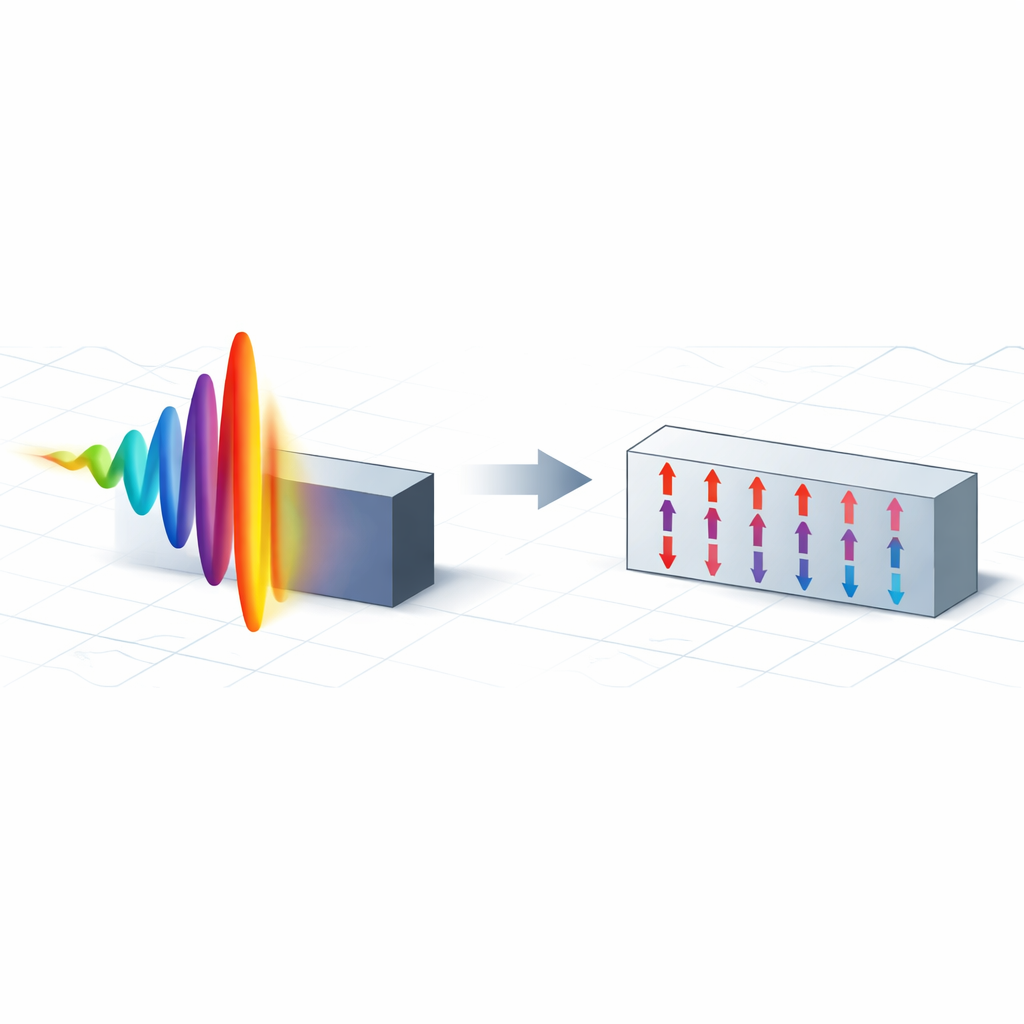
Light pulses that flip tiny magnets
When a powerful light pulse hits a magnetic metal, it can disturb the tiny magnetic moments of its electrons and reduce the material’s overall magnetization. Experiments have shown that such demagnetization happens on astonishingly short timescales, below 100 femtoseconds, for both optical and X-ray radiation. Yet it has remained unclear which microscopic processes are actually responsible at these speeds. The authors focus on a single magnetic domain, a region where all tiny magnets are initially aligned, and ask what happens inside it immediately after a brief light pulse of varying color and duration.
A digital lab for ultrafast magnet changes
To answer this, the team used a dedicated simulation tool called XSPIN, which models how electrons in a magnetic metal respond to a light pulse under strongly non-equilibrium conditions. They studied cobalt and nickel and exposed them, in silico, to pulses lasting from 2 to 70 femtoseconds, with photon energies ranging from the visible region up to soft X-rays. Crucially, they held the absorbed energy dose per atom fixed and low enough to avoid structural damage. This allowed them to compare how magnetization changes depend on the color and timing of the light, rather than on how much energy is pumped into the material.
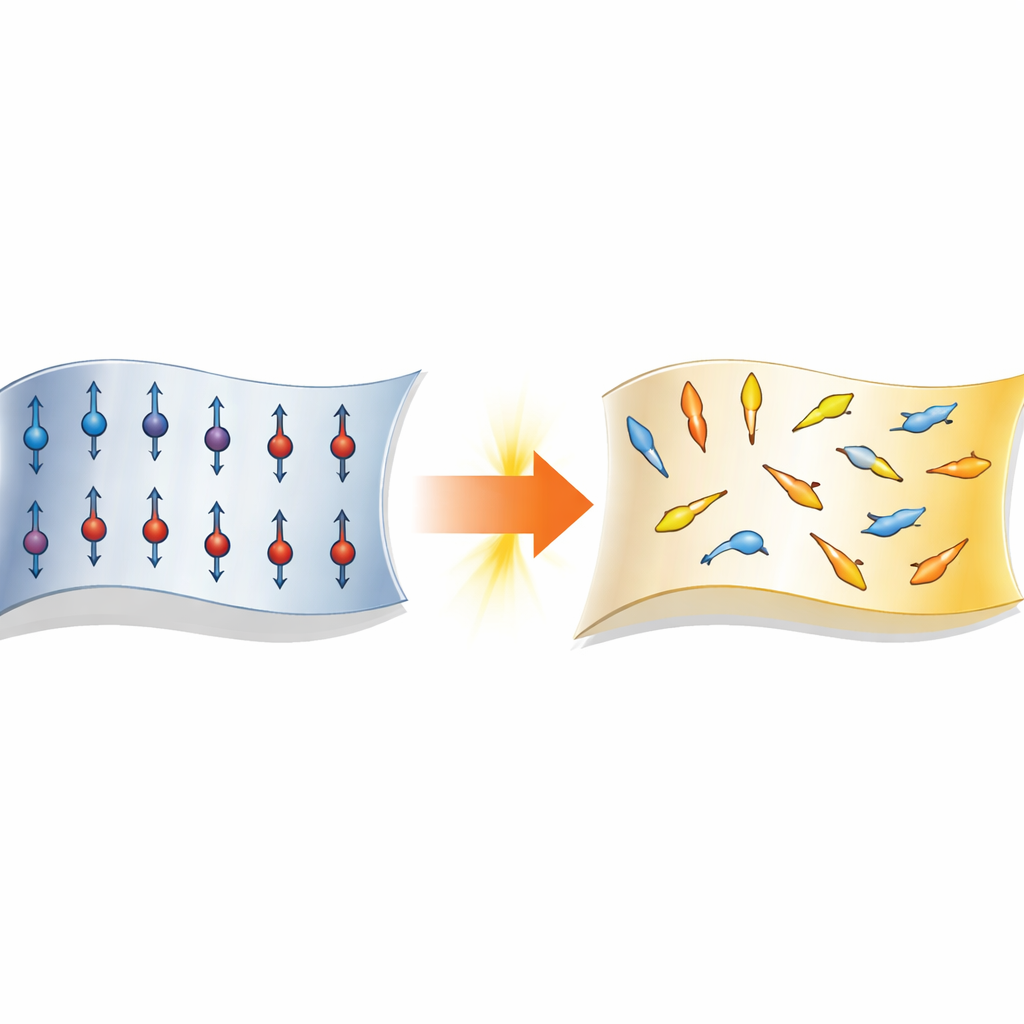
Electrons reshuffle faster than the lattice can react
The simulations track several ingredients at once: the number of energetic electrons created, how they lose energy and join the lower energy “sea” of electrons, the transient electronic temperature, and the resulting magnetization. The key result is that, for all tested pulse colors from optical to X-ray, the materials lose a large fraction of their magnetization within less than 100 femtoseconds. This rapid change is driven almost entirely by electronic excitation and the subsequent redistribution of electrons between spin-up and spin-down states in the magnetically sensitive band. Slower processes, such as vibrations of the atomic lattice or interactions between different magnetic sites, are simply too sluggish to matter on this timescale.
Same final state, different paths
An important insight is that, for a fixed absorbed dose, the final magnetic state of a single domain is nearly independent of the photon energy. Whether the pulse is optical or X-ray, the system ends up with similar electronic temperatures and similar reduced magnetization. Differences appear mainly in the timing: for very short pulses, the chain of electron collisions triggered by a high-energy X-ray photon can take several femtoseconds to unfold, slightly delaying the onset of demagnetization compared with optical pulses. In cobalt and nickel alike, the model shows that when the pulse is much longer than this cascading time, the temporal profile of the pulse itself largely dictates how quickly the magnetization falls.
What this means for future magnetic devices
In plain terms, the authors conclude that the earliest, sub-100-femtosecond loss of magnetization is governed by how the light pulse reshuffles electrons, not by slower lattice motion or complex spin textures. The amount of magnetization lost depends mainly on how much energy per atom is absorbed, while the exact color of the light mostly affects the detailed timing. This understanding offers a roadmap for controlling ultrafast magnetic responses with carefully shaped light pulses, a step toward reliable, radiation-driven magnetic switches that work at the ultimate speed limits set by electron motion.
Citation: Kapcia, K.J., Tkachenko, V., Capotondi, F. et al. Electronic mechanism of sub-100-fs demagnetization induced by a femtosecond light pulse. Sci Rep 16, 14705 (2026). https://doi.org/10.1038/s41598-026-51949-2
Keywords: ultrafast demagnetization, femtosecond light pulses, magnetic materials, cobalt and nickel, electron dynamics