Clear Sky Science · en
Exploiting quantum chaos diagnostics in QAOA for enhanced hybrid quantum classical deep learning classification
Why chaos can help computers see
Modern computers are getting help from quantum physics to recognize patterns in data such as handwritten digits. But quantum circuits can behave in surprisingly wild ways, with tiny changes in their settings leading to big changes in their output. This study asks a simple question: instead of fighting that wild, “chaotic” behavior, can we measure it and turn it into a useful signal that helps a hybrid quantum–classical system classify images more accurately?
A new twist on a popular quantum algorithm
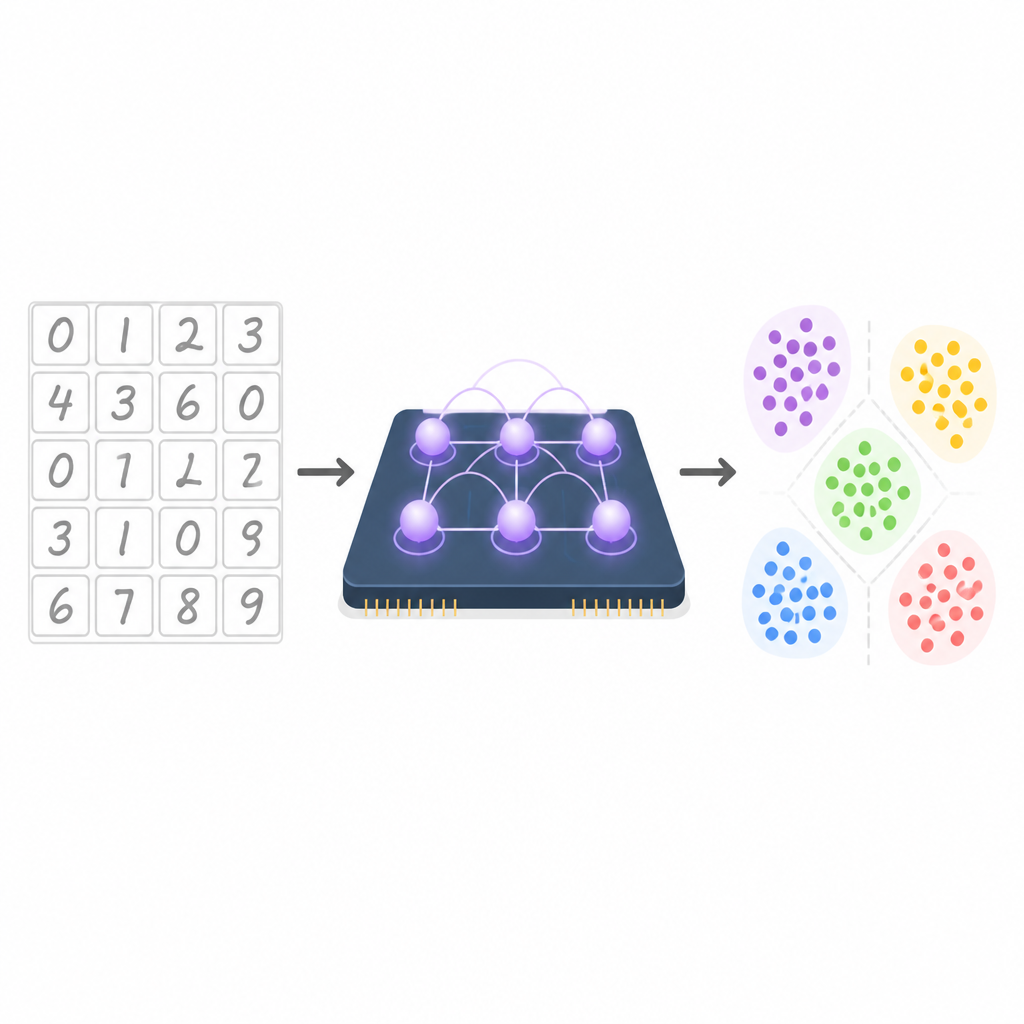
The researchers build on the Quantum Approximate Optimization Algorithm, or QAOA, which was originally designed to solve tricky math puzzles called optimization problems. Here, QAOA is repurposed as a kind of quantum lens that turns ordinary data into a richer quantum pattern before a classical neural network makes the final prediction. Because QAOA layers shuffle and entangle quantum bits in a structured but complex way, the resulting circuit can behave much like a chaotic dynamical system, where small tweaks to the control angles strongly affect the final state. Instead of treating this as a nuisance, the authors study it in depth and try to capture it in a single numerical feature that can be fed into a learning algorithm.
Listening to chaos in a quantum circuit
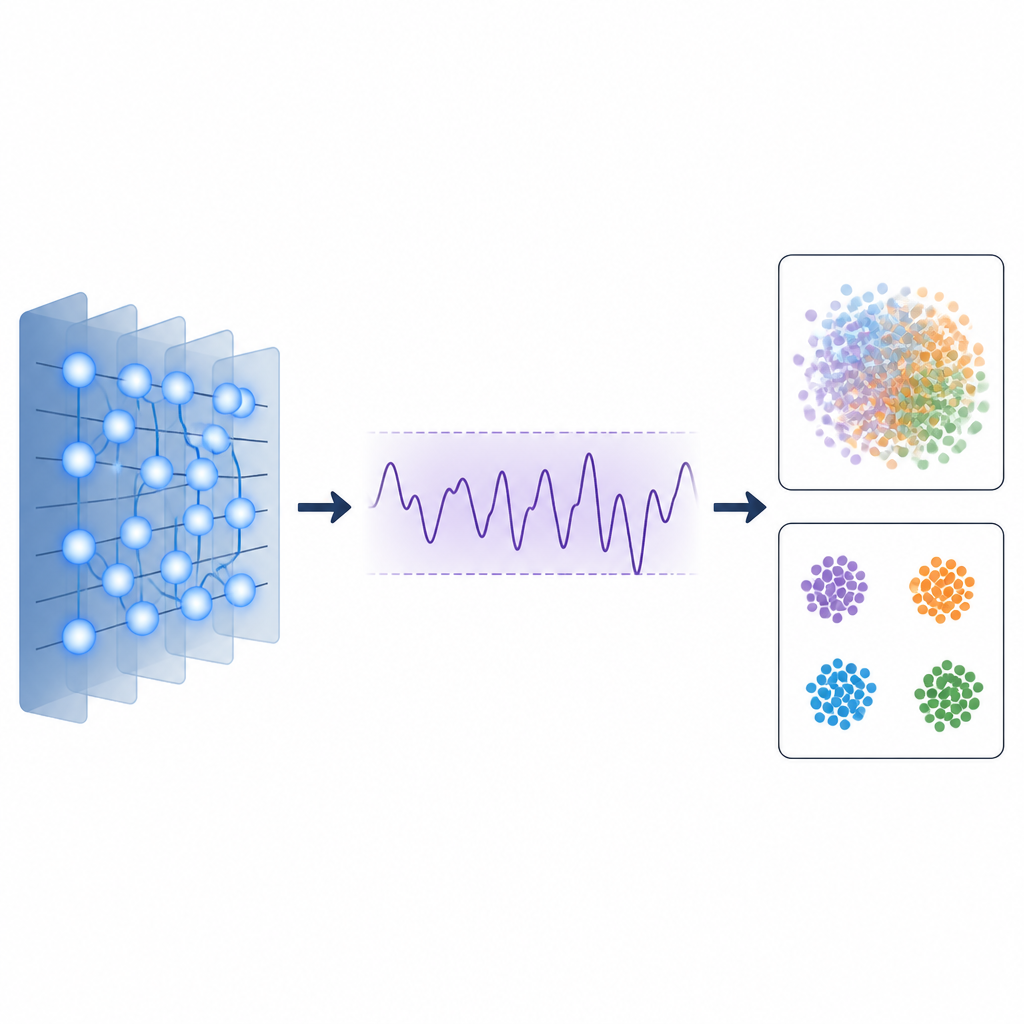
To “listen” to the chaotic behavior, the team uses a tool from quantum physics called an out-of-time-ordered correlator. In simple terms, it tracks how a small, local poke to one part of the circuit spreads and scrambles information throughout the system. The authors vary the overall strength of the QAOA angles along a one-dimensional line and record how this scrambling measure wiggles up and down. The positions of the dips in this curve act like landmarks of sensitivity: where the dips are close together, the circuit is highly responsive to tiny changes. By studying the spacing between many such dips across depths and parameter choices, they find a characteristic statistical pattern that follows a “lognormal” shape, a hallmark of multiplicative, chaos-like growth processes.
Turning a chaos signal into a learning feature
Building on this analysis, the authors design two hybrid models to classify a small, balanced set of MNIST handwritten digit images. In the standard design, images are compressed to a few numbers, passed through a shallow QAOA circuit on 4, 6, 8, or 10 qubits, and the average measurement from each qubit becomes input to a classical neural network. In the chaos-aware design, they add one more ingredient: from the scrambling curve of the trained circuit, they compute the typical spacing between its sensitivity dips and then convert that spacing into a standardized “chaos score” using their pre-fitted lognormal model. This score, a single number summarizing how delicately tuned the circuit is, is appended to the usual quantum features before classification.
Finding a quantum “Goldilocks” zone
The two models are compared carefully using repeated, matched training runs so that only the presence or absence of the chaos score differs. For smaller circuits with 4, 6, or 8 qubits, the chaos-aware version consistently yields higher test accuracy, improving performance by about 1.6 to 1.8 percentage points and winning in the vast majority of paired runs. The best results appear for 8-qubit circuits, which reach about 90 percent accuracy on the test set with the chaos feature and win every comparison. However, when the circuit width is pushed to 10 qubits, the added chaos score begins to hurt, and accuracy drops relative to the standard model. This pattern suggests a “Goldilocks” regime where the circuit is expressive enough to benefit from chaos feedback, but not so sensitive that it becomes unstable.
What this means for future quantum learning machines
For non-specialists, the key message is that chaos in quantum circuits is not just a threat to control; it can also be a resource if measured and used wisely. By distilling complicated scrambling behavior into a single, calibrated number, the authors give hybrid quantum–classical models an extra dial that helps match circuit richness to data complexity. In modest, noise-free simulations, this extra dial improves image classification without changing the overall architecture. As real quantum devices grow but remain imperfect, such chaos-aware diagnostics could become practical tools for tuning circuit depth and size, designing more robust error strategies, and ultimately making quantum-enhanced learning systems more reliable.
Citation: Villalba-Díez, J., Losada-González, J.C. Exploiting quantum chaos diagnostics in QAOA for enhanced hybrid quantum classical deep learning classification. Sci Rep 16, 15744 (2026). https://doi.org/10.1038/s41598-026-51870-8
Keywords: quantum machine learning, QAOA, quantum chaos, hybrid quantum classical, image classification