Clear Sky Science · en
Valorization of domestic wastes into Cu-MOF-derived CuO@ZnO nanocomposites for sustainable photocatalytic degradation of methylene blue and rhodamine B dyes
Turning Trash into Clean Water Tools
Every day, we throw away plastic bottles and old electrical wires without a second thought. At the same time, many rivers and lakes are stained with bright industrial dyes that are hard to remove and can harm people and wildlife. This study shows how common household waste can be transformed into tiny cleaning agents that use light to strip dangerous colors out of water, offering a double win for both pollution and waste.
The Problem of Stubborn Dyes
Textile, leather, and printing factories rely on intensely colored dyes such as methylene blue and rhodamine B. These dyes do not break down easily in nature and some are linked to cancer and nerve damage. Traditional treatment methods like chlorination, filtration, or ozone can be expensive, slow, and may create new waste that still needs disposal. Scientists have been exploring “photocatalysis” instead, where light-activated materials help turn harmful chemicals into harmless ones, mainly water and carbon dioxide, without leaving toxic leftovers.
Recycling Bottles and Wires into Smart Powders
The research team set out to build an effective light-driven cleaner using things most households discard. They first recovered a key chemical, terephthalic acid, by breaking down used plastic drink bottles made of PET. They then dissolved scrap copper wires to obtain copper salts. These ingredients were assembled into a highly ordered structure known as a metal–organic framework, which served as a template. By heating this framework in air and combining it with zinc oxide, they created a composite powder called CuO@ZnO: tiny particles where copper oxide and zinc oxide are tightly joined together, forming what is known as a heterojunction that helps charges move efficiently when light strikes. 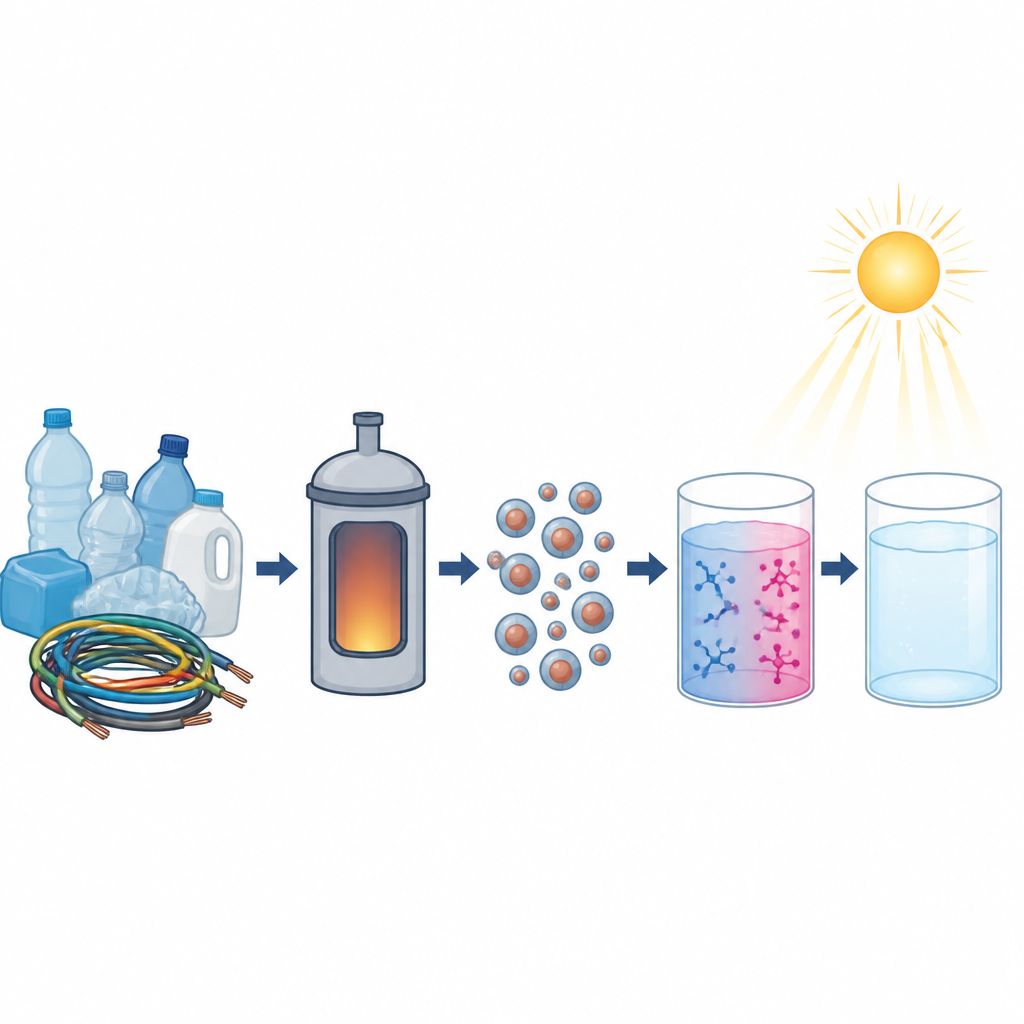
How the Light-Driven Cleaning Works
When these powders are mixed into dyed water and exposed to ultraviolet and visible light, they behave like miniature solar-powered reactors. Light energy shakes loose electrons inside the material, leaving behind positively charged “holes.” At the joined interface between copper oxide and zinc oxide, these charges separate instead of quickly canceling each other out. The separated charges react with water and oxygen to create highly reactive forms known as radicals, particularly hydroxyl radicals. These species are strong oxidizers that attack the dye molecules, cutting them into smaller fragments that are eventually mineralized into harmless substances. The team’s tests support a so-called Z-scheme pathway, where charge flow is arranged to keep both strong oxidizing and reducing power, making the cleaning action more effective. 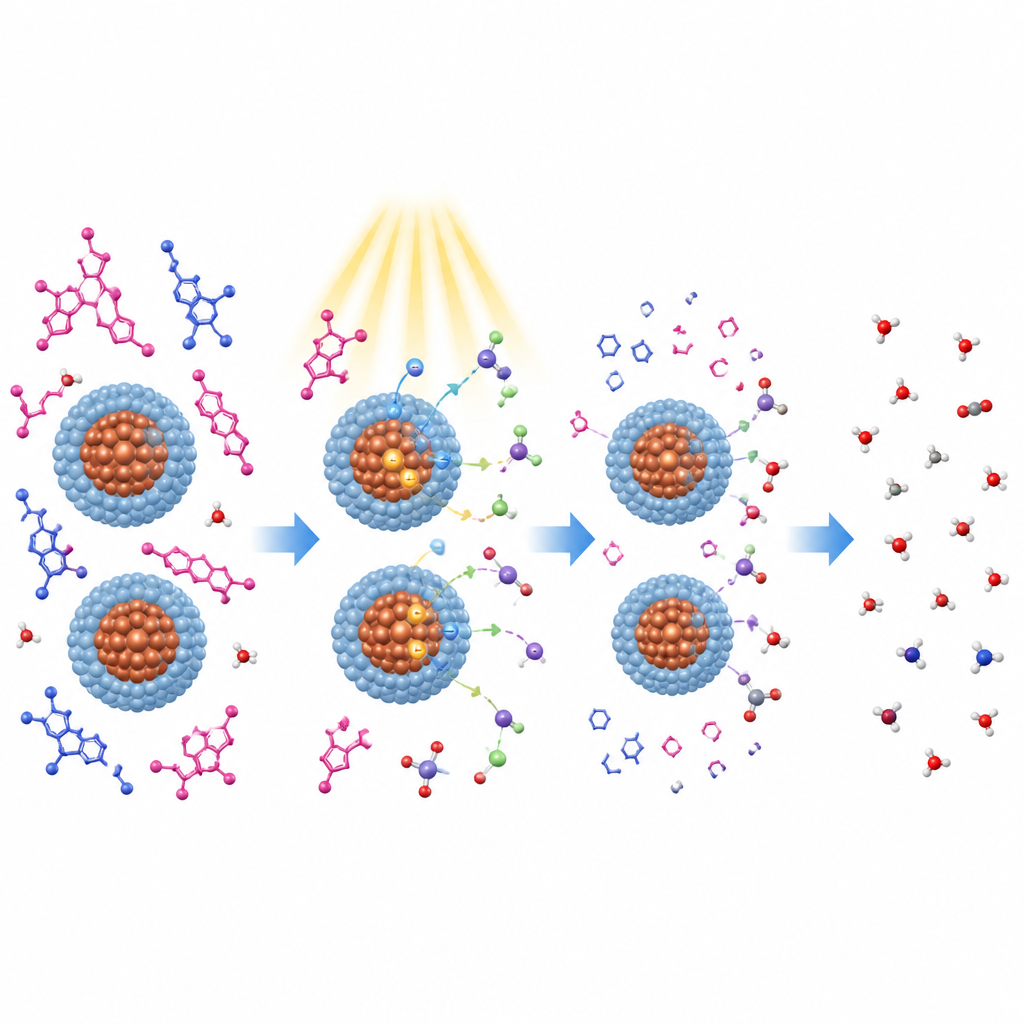
Testing Performance and Durability
The scientists compared pure zinc oxide with several versions of the new composite containing different amounts of copper oxide. The blend with about one quarter copper oxide by weight performed best, removing roughly 99 percent of methylene blue and 97.7 percent of rhodamine B in two hours under lab lighting. It also absorbed more visible light and showed slower recombination of charges, which is key for photocatalytic power. The team explored how dye concentration, powder dose, water acidity, and the presence of hydrogen peroxide affected results. Under favorable conditions, the treatment was faster and more complete. Importantly, the same powder could be collected, washed, and reused at least six times with only a slight drop in efficiency, and its crystal structure stayed stable.
From Lab Concept to Greener Water Treatment
In simple terms, this work turns low-value household waste into high-value cleaning powders that use light to scrub toxic dyes from water. By carefully joining copper oxide and zinc oxide at the nanoscale, the researchers built a material that captures more of the light spectrum and channels that energy into breaking down pollutants rather than wasting it. While this study focuses on two common dyes, the approach could be extended to other colored contaminants and adapted for future devices in water treatment and even solar energy applications. It offers a glimpse of how smart chemistry can convert everyday trash into a tool for healthier water and a cleaner environment.
Citation: Samy, M.S., Abou El Nadar, H.M., Gomaa, E.A. et al. Valorization of domestic wastes into Cu-MOF-derived CuO@ZnO nanocomposites for sustainable photocatalytic degradation of methylene blue and rhodamine B dyes. Sci Rep 16, 15042 (2026). https://doi.org/10.1038/s41598-026-51864-6
Keywords: photocatalytic water treatment, dye degradation, waste recycling, CuO ZnO nanocomposite, domestic plastic waste