Clear Sky Science · en
Preparation and characterization of antibacterial fibrous membranes composites based on green synthesized nanoparticles loaded on electrospun polyacrylonitrile fibrous membranes
Clean water for everyone
Many communities still struggle to access safe drinking water, and traditional treatment plants can be expensive or out of reach. This study explores a simple, low-cost filter material that can both trap and kill harmful bacteria in water using tiny particles made in an environmentally friendly way, pointing toward household and small-scale solutions for cleaner drinking water.
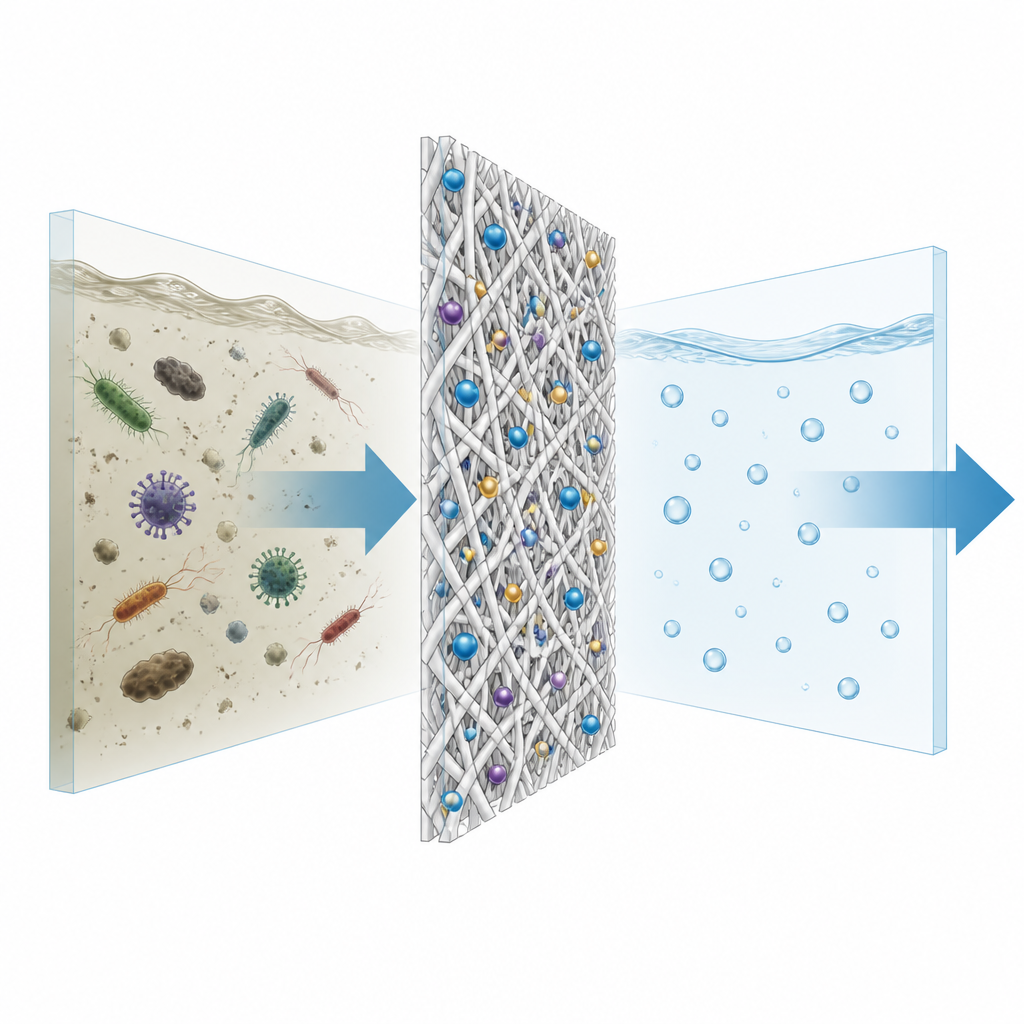
Tiny fibers as powerful sieves
The researchers focused on ultra-thin plastic fibers made from a material called polyacrylonitrile, or PAN, which can be spun into mats that look like dense spiderwebs. Because these nanofibers have very small pores and a huge surface area, they are already good at catching particles and microbes as water flows through them. By adjusting the spinning process, the team tailored the thickness and smoothness of the fibers to make even, stable membranes suitable for use as filters in a simple lab-made filtration unit.
Green-made metal particles
To give these fiber mats germ-killing power, the scientists added three types of microscopic metal-based particles: silver, zinc oxide, and copper oxide. Instead of relying on harsh chemicals, they created zinc oxide and copper oxide nanoparticles using an extract from sumac fruits, whose natural plant molecules helped reduce and stabilize the particles. Silver nanoparticles were formed by shining ultraviolet light on a silver salt solution. Tests using electron microscopes, light absorption measurements, and crystal structure analysis confirmed that the particles were tiny, well formed, and in the case of silver, only a few billionths of a meter across.
Building stronger, smarter filters
These green-synthesized nanoparticles were then mixed into the PAN solution and spun into fibrous membranes so that the metals became embedded within and on the surface of the fibers. Microscopy showed that the loaded fibers became rougher and less uniform than plain PAN, indicating that particles were well distributed in the web. Mechanical testing revealed that adding any of the three nanoparticles increased the strength and stretchiness of the membranes compared with plain PAN, making them more robust for repeated use. Measurements of metal release into water over ten days showed an initial burst followed by slower release, suggesting a long-lasting supply of active metal ions that can support extended antibacterial action.
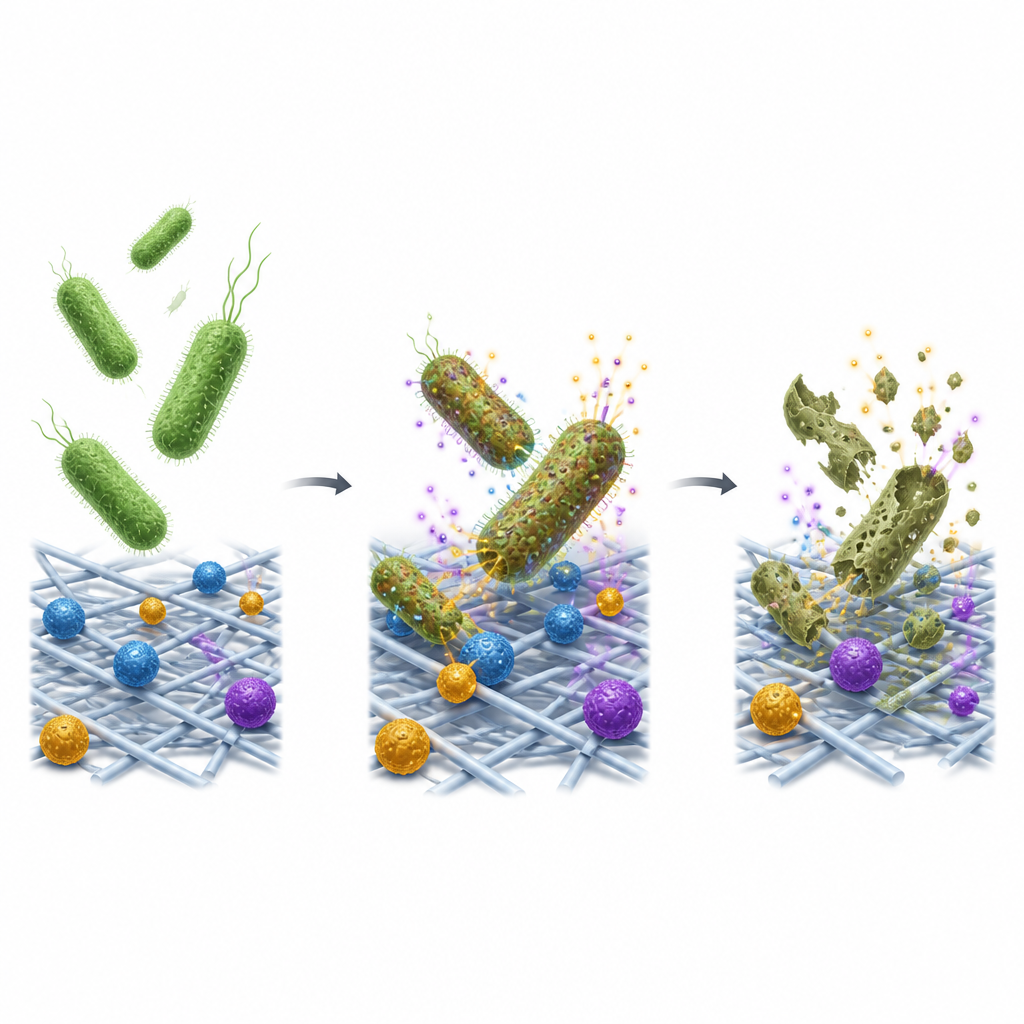
Stopping bacteria in their tracks
The team then challenged the hybrid membranes with water spiked with Escherichia coli, a common indicator of fecal contamination. First, the membranes physically held back the bacteria thanks to their tiny pores. Next, the embedded nanoparticles went to work. Silver, zinc, and copper particles can release metal ions and trigger highly reactive oxygen species that damage bacterial cell walls, proteins, and DNA. In filtration tests, plates that grew bacteria after contact with plain membranes showed heavy colonies, while plates from water passed through nanoparticle-loaded membranes showed almost no surviving bacteria. Silver-containing fibers were the most effective, followed by copper oxide and zinc oxide, but all three types displayed clear antibacterial activity.
What this means for safer water
In plain terms, this study shows that thin plastic fiber mats laced with plant-made metal nanoparticles can both filter out and kill germs in contaminated water, while also standing up mechanically to use. The silver-loaded version works best, but all versions reduce E. coli to nearly undetectable levels and release enough metal ions over time to keep working. Although more testing is needed on flow, long-term performance, and other microbes, these simple, green-fabricated membranes point toward affordable, compact filters that could help turn unsafe water into safer drinking water, especially where large treatment plants are not available.
Citation: Shalaby, T.I., Mahmoud, O. & El kader, A.A. Preparation and characterization of antibacterial fibrous membranes composites based on green synthesized nanoparticles loaded on electrospun polyacrylonitrile fibrous membranes. Sci Rep 16, 15397 (2026). https://doi.org/10.1038/s41598-026-51833-z
Keywords: water disinfection, nanofiber membrane, silver nanoparticles, green synthesis, antibacterial filtration