Clear Sky Science · en
Structural, optical, electrical conductivity, and thermal properties of some mononuclear and mixed metal complexes of diethyldithiocarbamate
Why tiny metal building blocks matter
Electronics, solar cells, and sensors all rely on materials that can control light, heat, and electricity in precise ways. This study looks at a family of sulfur rich chemical building blocks that can grab onto metal atoms like silver, copper, manganese, and selenium. By understanding how these small units assemble into porous, sponge like solids and how they behave under light, heat, and electric fields, the researchers explore new paths toward safer, tunable ingredients for future semiconductors and functional devices.
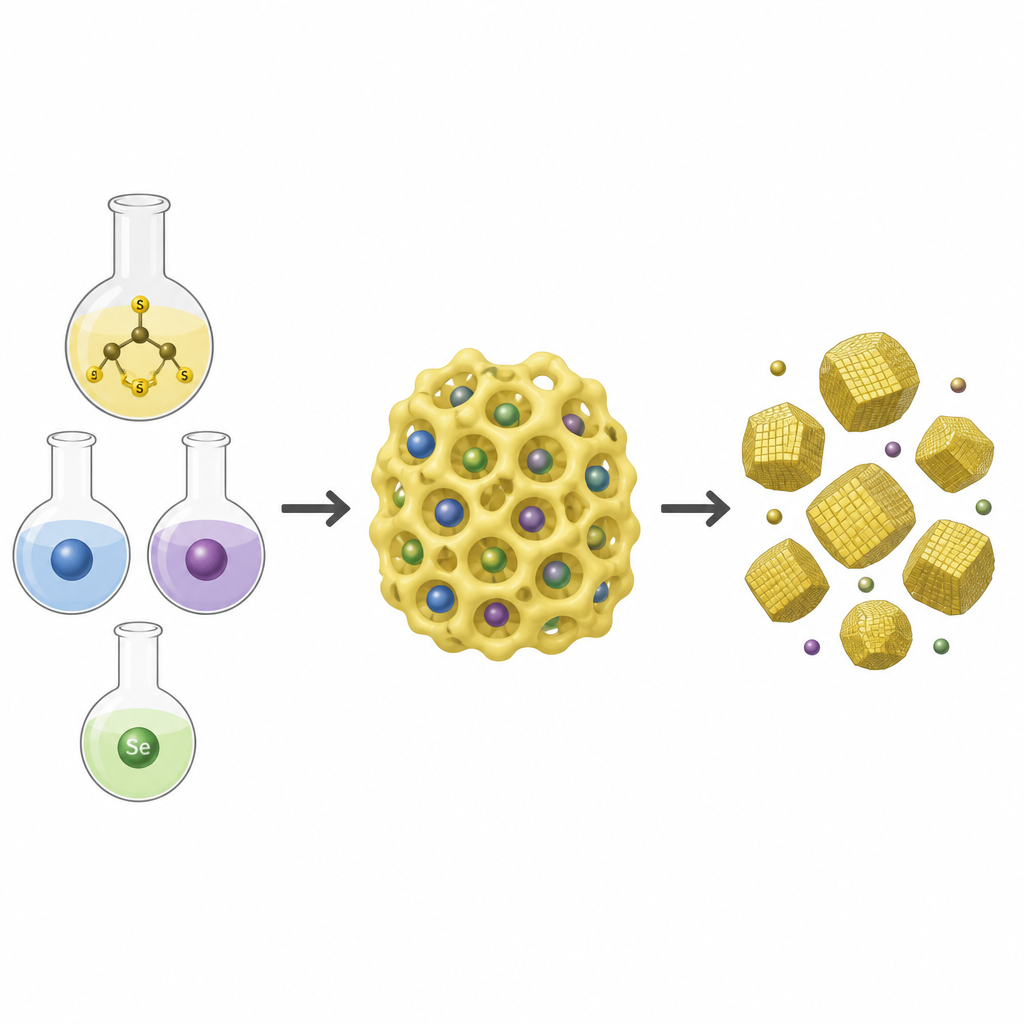
From simple salts to porous metal sponges
The team started with a versatile sulfur containing molecule called diethyldithiocarbamate, which can cling tightly to many metals. They reacted it with silver, copper, manganese, and a selenium source to make both single metal and mixed metal compounds. Careful control of mixing and heating conditions allowed the ligand to act not only as a connector but also as a gentle reducing agent for selenium, shifting it between oxidation states. X ray measurements showed that the products form tiny crystals only a few billionths of a meter across. Electron microscopy revealed that most of these crystals pack into irregular, sponge like grains, while one selenium rich compound formed more regular hexagonal particles.
How they bend light and glow
Because these materials may serve as small scale light handlers, the authors measured how they absorb and transmit ultraviolet and visible light. All of the compounds strongly absorb light in the near ultraviolet region and become highly transparent above roughly 320 nanometers, with up to 99 percent transmission. By analyzing these spectra, they estimated energy gaps between 1.95 and 4.15 electron volts, which is typical of semiconductors. Models of how the refractive index changes with wavelength revealed how easily the electron clouds in the materials can be distorted by light. When excited with higher energy light, the compounds gave off blue to green fluorescence at several distinct colors, signaling charge transfer between the metal centers and the sulfur based ligands.
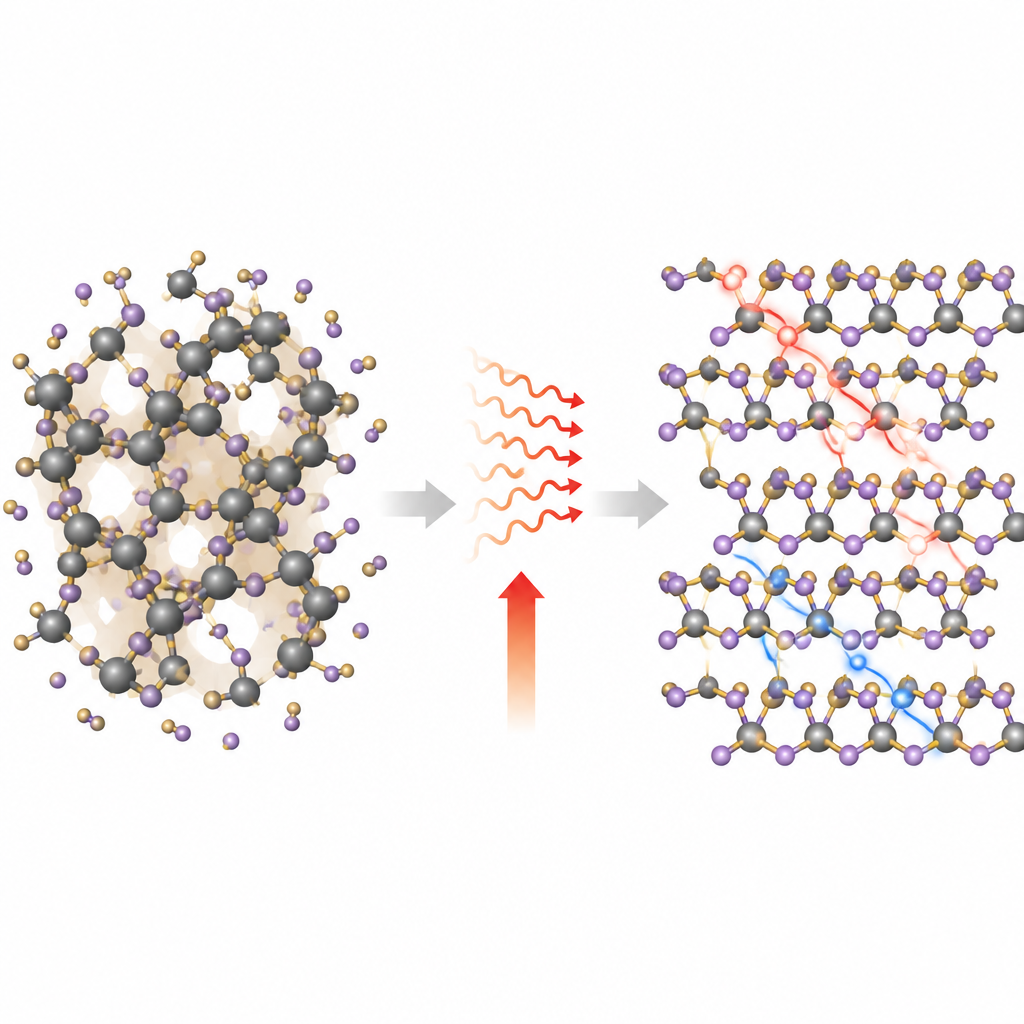
Electric behavior under heat and frequency
To probe how charges move through these solids, the researchers placed pressed samples between electrodes and applied alternating current over a wide range of temperatures and frequencies. The electrical conductivity increased with temperature, a hallmark of semiconducting behavior, with values spanning from about ten millionths to a tenth of a siemens per meter. Analysis of how conductivity and dielectric properties changed with both temperature and frequency suggested that several hopping based mechanisms are at work, where charge carriers jump between localized sites separated by energy barriers that shrink or grow as the solid warms. The materials also showed pronounced changes in their ability to store and dissipate electric energy, hinting at subtle structural shifts and phase transitions upon heating.
Surviving heat to become useful sulfides
Thermal analysis tracked how the compounds break apart as they are heated in an oxygen free atmosphere. After losing water and organic fragments, the metal containing cores convert at higher temperatures into metal sulfides, sometimes mixed with selenium species. The fact that these final sulfide residues form only after substantial heating shows that the original complexes are thermally robust. At the same time, their clean breakdown into nanoscale sulfides confirms that they can act as single source precursors, meaning each molecule carries all of the necessary elements in the right ratio for forming a semiconductor grain when heated.
What this means for future devices
In everyday terms, the study demonstrates that a single, sulfur rich organic molecule can organize different metals into porous, nanostructured solids whose light, electrical, and thermal responses can be finely tuned. These complexes behave like modest semiconductors, glow under ultraviolet light, and reliably turn into tiny metal sulfide particles when heated. Such features make them promising starting materials for thin films, coatings, and composite systems in optoelectronic, dielectric, catalytic, and sensing technologies, where control over structure at the nanoscale translates into adjustable performance at the device level.
Citation: Emara, R., Masoud, M.S., Abboudy, S. et al. Structural, optical, electrical conductivity, and thermal properties of some mononuclear and mixed metal complexes of diethyldithiocarbamate. Sci Rep 16, 15465 (2026). https://doi.org/10.1038/s41598-026-51751-0
Keywords: metal dithiocarbamate complexes, semiconducting metal sulfides, optical properties, electrical conductivity, thermal stability