Clear Sky Science · en
Expired dapagliflozin as a promising corrosion inhibitor for copper in 1.0 M nitric acid: experimental and computational validation
Turning pill waste into metal protection
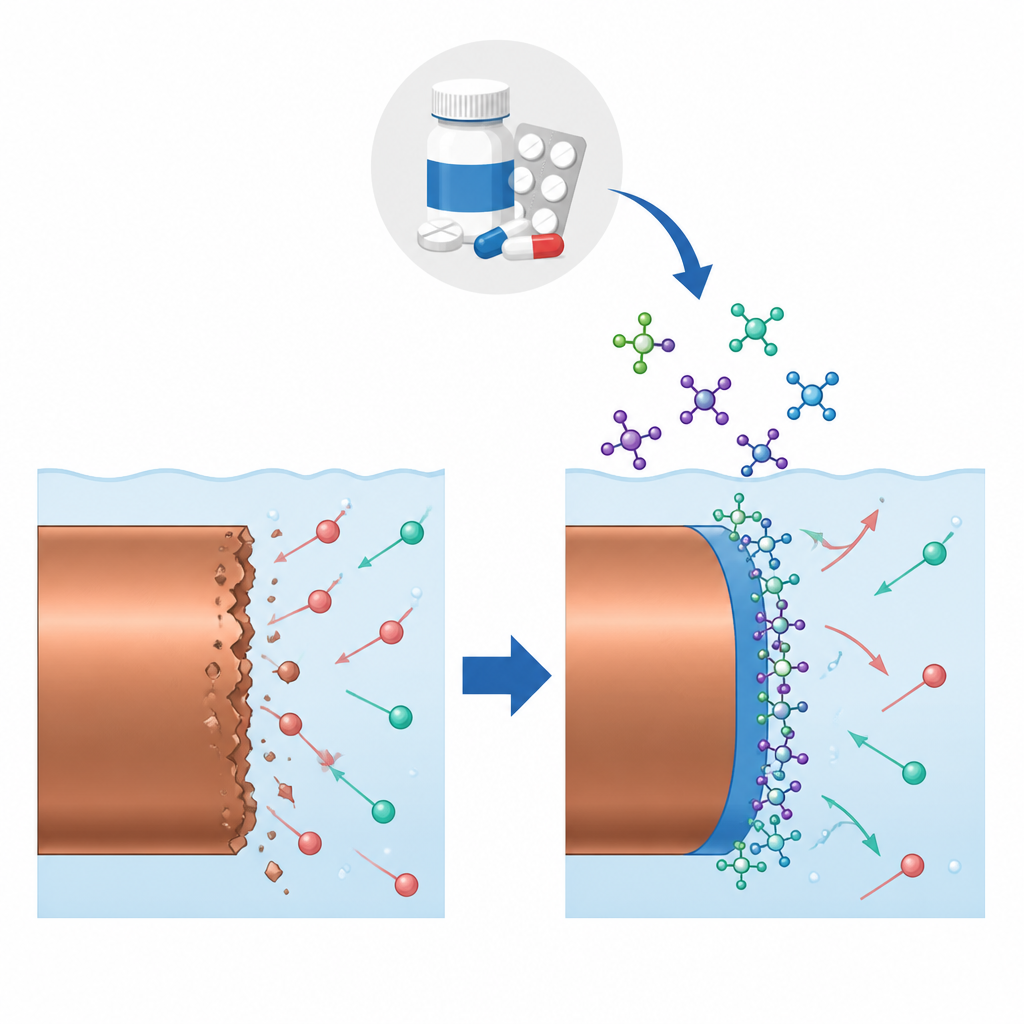
Most of us think of expired medicines as trash that should be thrown away. This study explores a very different idea: using an out‑of‑date diabetes drug, dapagliflozin, to shield copper from strong acid. Copper is found in everyday items from wiring to heat exchangers, and when it corrodes it can cause costly failures and safety risks. The researchers show that expired dapagliflozin can form a protective film on copper in harsh nitric acid, cutting damage while also giving a second life to a discarded pharmaceutical.
Why copper needs guarding in harsh fluids
Copper is widely used in industry because it carries both heat and electricity extremely well. However, in acidic settings such as pickling baths, cleaning solutions, and chemical reactors, copper gradually dissolves. In nitric acid this attack is especially aggressive and can even create tiny pits that eat deep into the metal. Engineers often add small amounts of special organic chemicals to the liquid to slow this process, but many of these inhibitors are costly or not environmentally friendly. The authors asked whether expired dapagliflozin tablets, no longer suitable for patients, could instead serve as an inexpensive, safer shield for copper equipment.
Testing a drug as a metal shield
To probe this idea, the team placed carefully polished pieces of copper into nitric acid with and without dissolved expired dapagliflozin at different doses and temperatures. They weighed the samples before and after soaking to see how much metal was lost, and used electrical methods to track how fast corrosion reactions occurred at the surface. In all of these tests, adding the drug sharply reduced the rate at which copper dissolved. Protection grew stronger as the drug concentration increased, reaching about 90 percent at the highest dose, but became weaker at higher temperatures, hinting that the protective film relies in part on relatively gentle, reversible sticking of the molecules to the metal.
How the protective layer forms
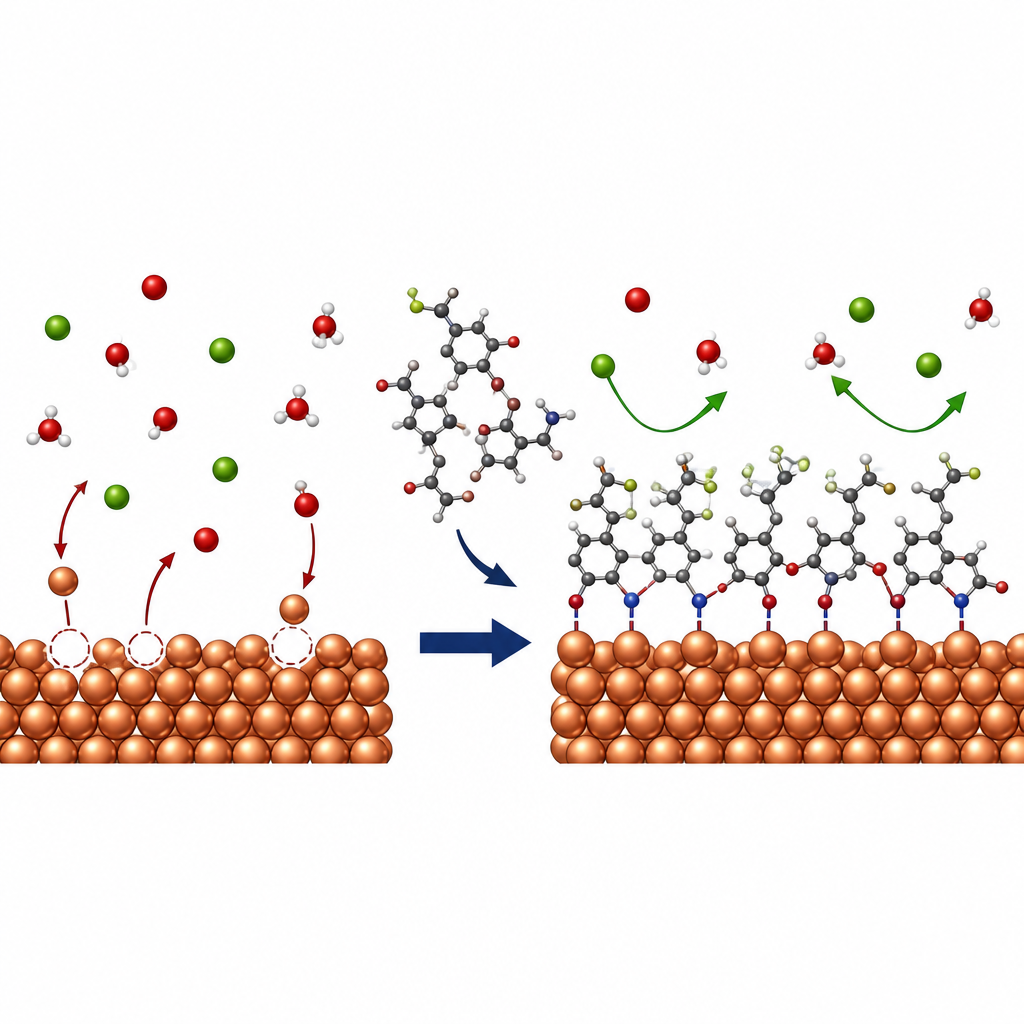
Electrical measurements showed that dapagliflozin slows both the loss of copper atoms and the reactions that consume acid, classifying it as a "mixed" inhibitor that restrains damage on more than one front. The drug also pushed the onset of pitting corrosion to more positive voltages, meaning the surface resisted deep localized attack. Other tests revealed that copper ions and dapagliflozin combine in solution in a simple 1:1 ratio, forming a stable complex that can settle onto the metal. As this complex and related species spread out over the surface, they displace water and create a compact barrier that blocks aggressive nitric acid and chloride ions from reaching bare copper sites.
Peering into the molecule’s behavior
To understand why this expired drug clings so well to copper, the researchers turned to computer calculations based on quantum mechanics. These calculations mapped where electrons are concentrated within the dapagliflozin molecule and showed that its many oxygen‑rich groups and ring systems act as natural hooks for binding to copper atoms. The numbers indicated that the molecule is a good electron donor that can form coordination bonds with copper while also accepting some electron density back, stabilizing the adsorbed layer. The way the drug’s coverage on copper fits a simple Langmuir adsorption pattern suggests that it forms a single, fairly uniform layer rather than thick, uneven deposits.
What this means for real‑world use
Viewed in plain terms, the study shows that an expired pill can behave like a rust‑proofing paint for copper immersed in strong acid. By forming a thin, ordered film and stable copper–drug complexes at the surface, expired dapagliflozin greatly slows both general and pitting corrosion, especially at room temperature and with sufficient concentration. While the exact mix of breakdown products in an expired tablet may vary, the shared electron‑rich features of these molecules appear to be enough to build an effective barrier. This work points to a practical way to reuse pharmaceutical waste while protecting valuable metal equipment, linking cleaner chemistry with better resource management.
Citation: Abdallah, M., Guesmi, N.E., Al-Gorair, A.S. et al. Expired dapagliflozin as a promising corrosion inhibitor for copper in 1.0 M nitric acid: experimental and computational validation. Sci Rep 16, 15346 (2026). https://doi.org/10.1038/s41598-026-51683-9
Keywords: copper corrosion, corrosion inhibitor, expired drugs, nitric acid, dapagliflozin