Clear Sky Science · en
A human-centric fuzzy decision support system for medical diagnosis using fuzzy cognitive maps
Why this new medical tool matters
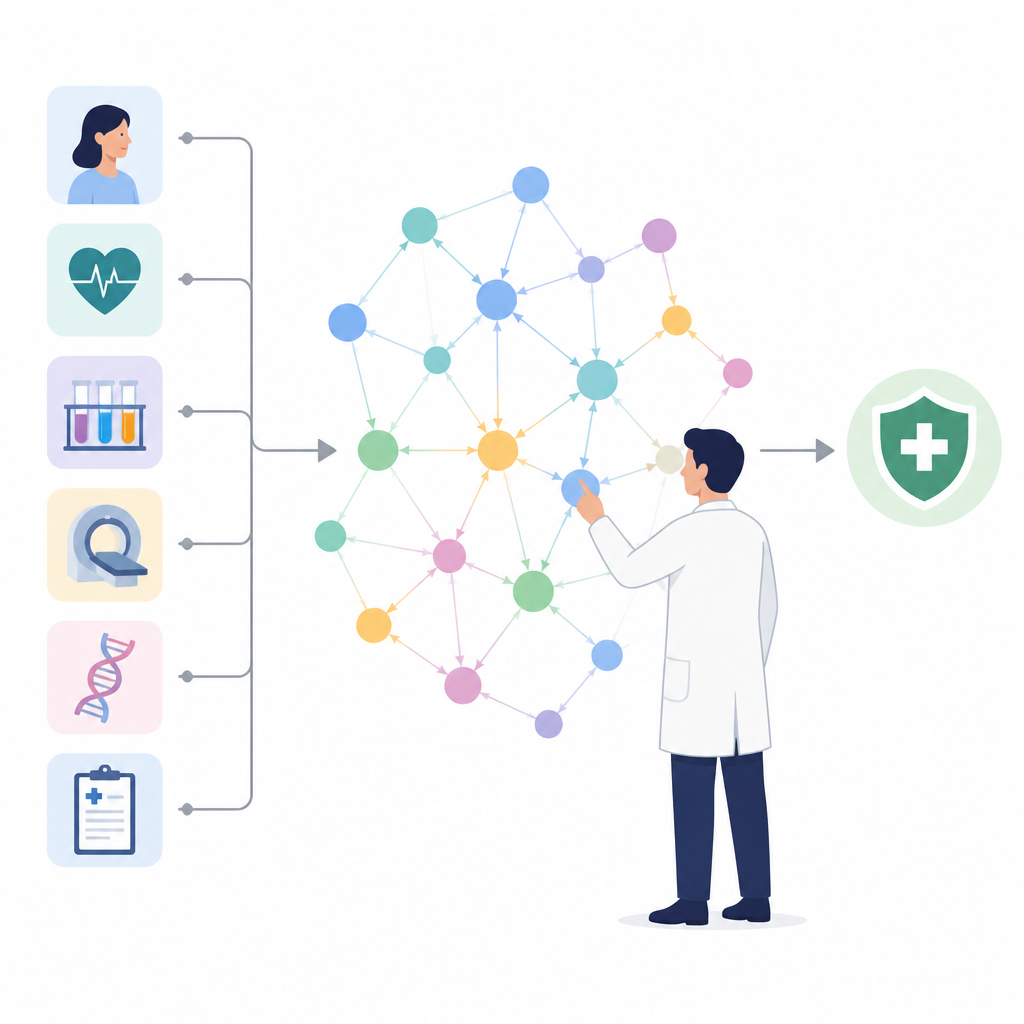
When doctors decide whether a patient might have heart disease, cancer, or another serious condition, they juggle many clues at once: numbers from lab tests, descriptions of pain, scan results, and years of experience. Many computer programs can spot patterns in these data, but they often work like sealed boxes whose inner logic is hard to see or question. This paper introduces a decision support tool that tries to think more like a clinician does, using fuzzy shades of risk instead of rigid yes or no rules, while staying open enough that medical experts can inspect and adjust its inner workings.
Blending soft logic with medical reasoning
The study builds on two ideas from artificial intelligence. The first is fuzzy logic, which allows statements like "blood pressure is high" to be partly true instead of forcing a sharp cutoff. The second is a fuzzy cognitive map, a kind of concept network where nodes stand for clinical ideas such as symptoms, test findings, or disease risk, and arrows show how one concept pushes another up or down. In medicine, such maps are attractive because they mirror how clinicians talk and reason, and because the connections between concepts can be shown and debated. But traditional maps are usually fixed once experts choose the connections, which makes them slow to adapt when guidelines, data, or patient populations change.
Letting data learn while experts stay in control
The proposed Human-Centric Fuzzy Decision Support System (HCFDSS) tries to balance expert knowledge with learning from data. It separates the process into two loops. In the inner loop, the model takes a patient’s fuzzified features, runs them through the concept network, and settles on a stable pattern of activations that represents a diagnostic suggestion. In the outer loop, the strengths of the connections between concepts are gently adjusted to fit clinical data better, while remaining within sensible limits. Crucially, doctors can review specific connections and suggest corrections, and the system then blends these human adjustments with the data-driven update instead of blindly overwriting one with the other.
A simple heart disease example
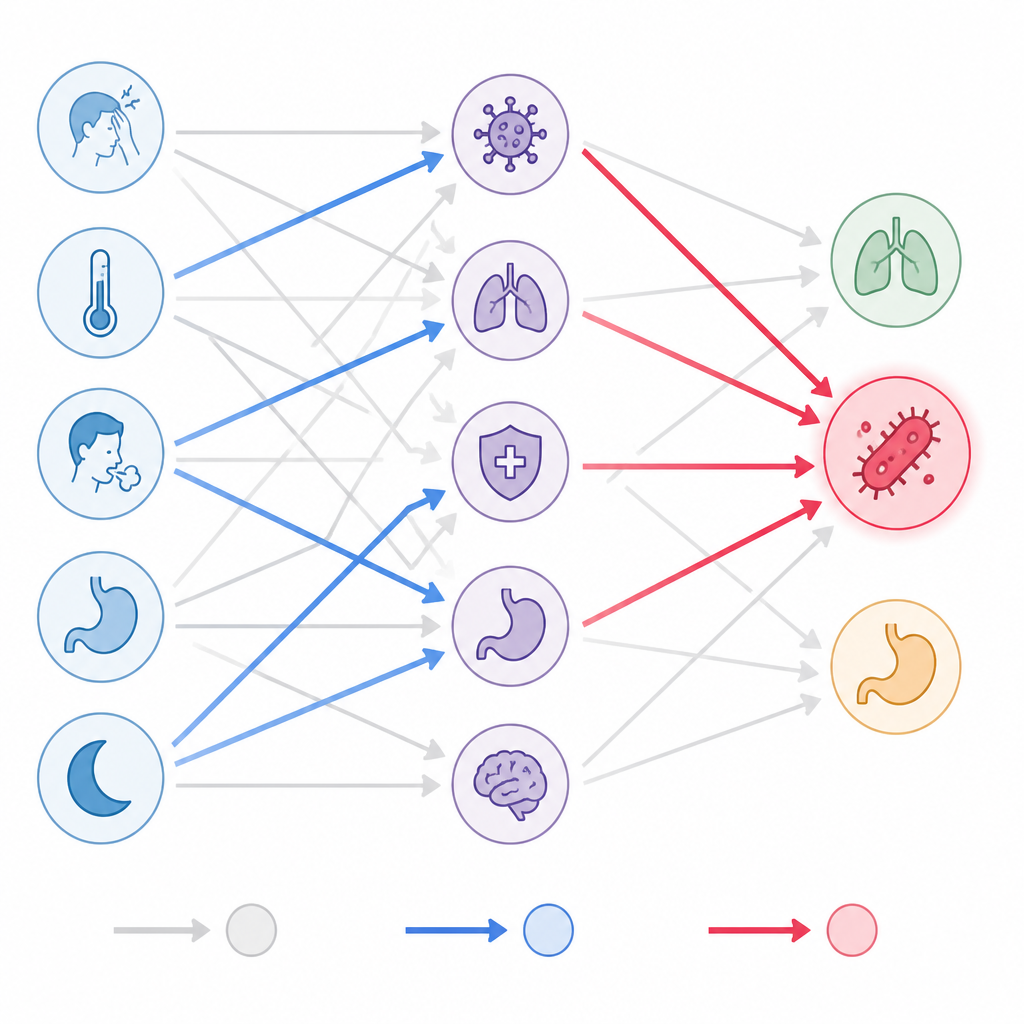
To show how this works, the paper presents a small three-concept example with high blood pressure, chest pain, and heart disease. The network starts with expert-chosen connections that say, for instance, that chest pain contributes to the chance of heart disease. When a sample patient is processed, the model predicts a certain disease activation level. A physician then inspects the map and decides that the link from chest pain to heart disease should be a bit stronger than the data-only learning suggested. After the expert nudges that single connection upward, the network is run again and the heart disease activation rises slightly, possibly tipping the decision from negative to positive. This change is easy to trace and justify, because it follows a visible path through named concepts rather than hidden numerical features.
Testing the system on real and simulated data
Beyond the toy example, the author designs a careful evaluation plan using both simulated clinical scenarios and three well-known public datasets on heart disease, breast cancer, and Parkinson’s disease. The system’s predictions are compared with several benchmarks, including fixed expert maps, learned maps without expert guidance, and common machine learning methods such as logistic regression, support vector machines, random forests, gradient boosting, nearest neighbors, and neural networks. The study also tests how robust the approach remains when some data are missing, when the classes are imbalanced, and when the expert influence is dialed up or down. A special score tracks how often the learned connections keep the same medical meaning and direction as the original expert design.
What this means for future medical support tools
The results show that while the new system does not always beat standard machine learning models in raw accuracy, it usually comes close while keeping a fully inspectable structure. In particular, it preserves the expert’s intended sign and role of each active connection, even as it learns from data. For a layperson, the takeaway is that this framework is less about building a perfect automatic diagnostician and more about creating a clear, editable map that doctors and computers can share. It offers a way for clinicians to see how a model reaches its suggestions, to check whether that reasoning matches medical understanding, and to gently steer the system when new evidence or experience suggests that certain relationships should change.
Citation: Zakaria, A. A human-centric fuzzy decision support system for medical diagnosis using fuzzy cognitive maps. Sci Rep 16, 15336 (2026). https://doi.org/10.1038/s41598-026-51590-z
Keywords: fuzzy cognitive maps, medical decision support, interpretable AI, expert-in-the-loop, clinical diagnosis