Clear Sky Science · en
Process based assessment of wastewater quality and rinse water reuse potential in denim finishing: a scalable framework for circular water management
Why denim and water belong in the same story
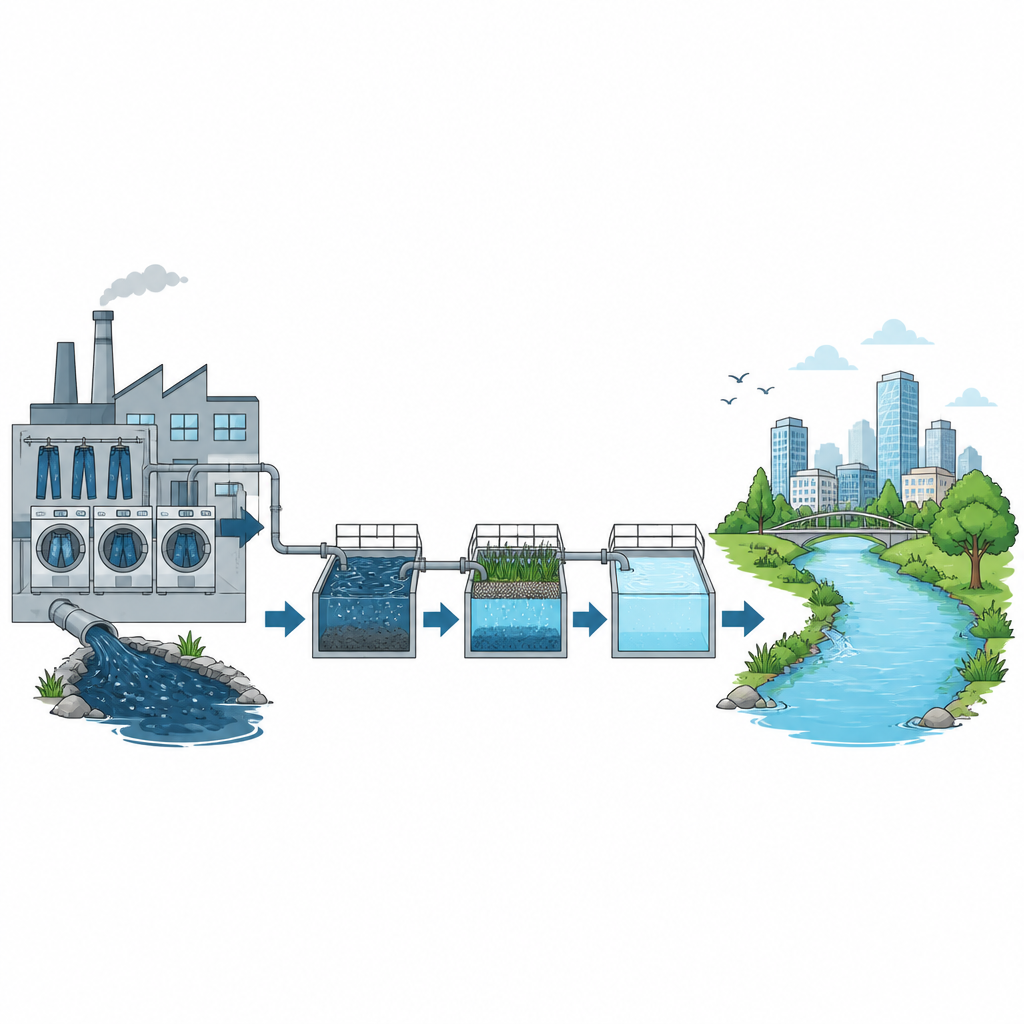
Most of us think about how our jeans look and feel, not how much water they use or pollute. Yet every faded crease and worn-in patch on a pair of denim comes from wash steps that consume large amounts of freshwater and send colored, chemical-rich wastewater down the drain. This study looks inside a real denim factory in Tunisia to find out where the dirtiest water is produced, how its quality changes at each step, and how much of that water could be cleaned enough through simple rinsing and smart reuse to cut the factory’s thirst for freshwater.
Following water through the denim line
The researchers tracked wastewater through six key stages of denim finishing: preparing garments for dyeing, dyeing, stonewashing, bleaching, neutralizing leftover bleach, and final soaping. At each stage they collected samples over several weeks and measured basic indicators such as acidity, cloudiness, dissolved salts, organic pollution, and color. Instead of treating all wastewater as one mixed stream, they treated each step as its own source, recognizing that what comes out of a dye bath is very different from what leaves a bleach or stonewash drum. This process-by-process view allowed them to pinpoint which parts of the line produced the biggest pollution spikes and which already generated relatively clean water.
Turning many measurements into one clear signal
To make sense of all the numbers, the team adapted a tool called the Water Quality Index, which combines several water measurements into a single score. Lower scores indicate cleaner water and higher scores point to water that is too dirty to reuse without heavy treatment. They selected five key indicators that matter most for factory reuse and local regulations: organic load, suspended particles, acidity, and salt content. For most stages a single number captured how far the water strayed from recommended limits, and the researchers also grouped scores into simple bands ranging from excellent to unsuitable. For bleach water, one ingredient interfered with the usual lab test for organic pollution, so the index there relied on the remaining, reliable measurements and was interpreted with care.
Where the wastewater hits hardest
The factory measurements revealed that not all denim steps are equal in their impact. Water from preparation for dyeing was surprisingly clean, falling into a category the authors classed as good quality and suitable for direct reuse or safe discharge. By contrast, stonewashing, bleaching, neutralization and soaping often produced highly colored and saltier streams with organic loads well above national limits. Neutralization, used to remove leftover chlorine after bleaching, stood out as the main pollution hotspot, with water quality scores in the worst category even after rinsing. These findings show that targeting a few critical stages can deliver much larger benefits than treating all factory water in the same way.
Rethinking rinse water as a resource
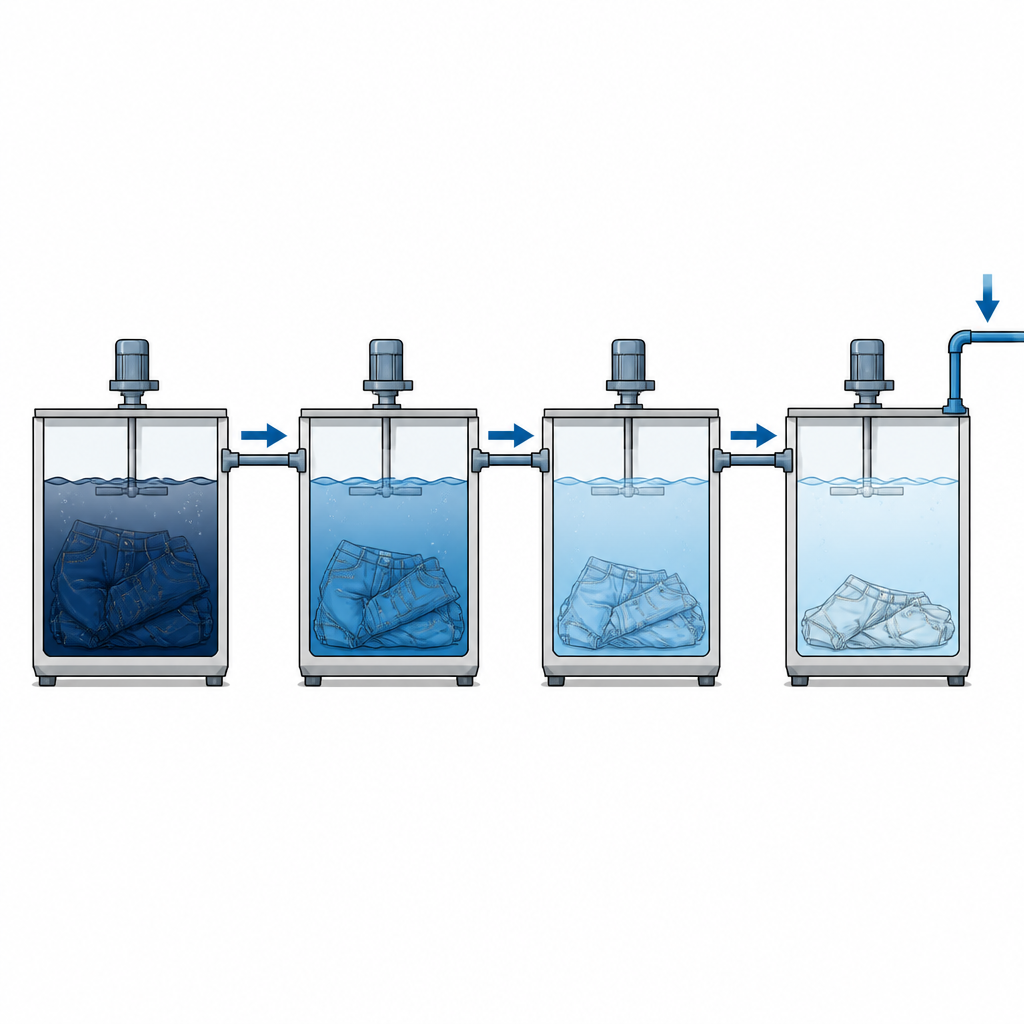
Because each wet treatment step is followed by one or two rinses, the team next examined how water quality changed before and after these rinses. Across most stages, pollutant levels dropped sharply from the main bath to the first rinse and again to the second, sometimes cutting the combined pollution score by around 70 percent. In several cases the second rinse water reached quality levels judged good or at least acceptable for reuse. Building on this, the authors sketched a “cascading” scheme in which relatively clean rinse water from one step is fed into the next compatible step, while fresh water is added only where product quality demands it. Their calculations suggest that such a scheme could trim the denim plant’s freshwater use by nearly two thirds, while also shrinking the volume of wastewater flowing to external treatment.
What this means for your next pair of jeans
For non-specialists, the main message is that a large share of the water used to finish denim does not need to be used only once. By carefully measuring water quality at each stage, and re-routing the cleaner rinse waters back into the process, factories can keep the same level of product performance while drawing much less from rivers and aquifers. The study offers a practical roadmap that other denim and textile plants can adapt, especially in dry regions, to move toward a circular model where water is used, cleaned within the factory, and used again instead of being quickly discarded.
Citation: Hamdi, R., Mahjoubi, N. Process based assessment of wastewater quality and rinse water reuse potential in denim finishing: a scalable framework for circular water management. Sci Rep 16, 14710 (2026). https://doi.org/10.1038/s41598-026-51562-3
Keywords: denim wastewater, rinse water reuse, textile industry, water quality index, circular water