Clear Sky Science · en
Seasonal optimization and analysis of an Off-grid hybrid renewable energy system for a coastal hotel
Powering a Beach Hotel with Clean Energy
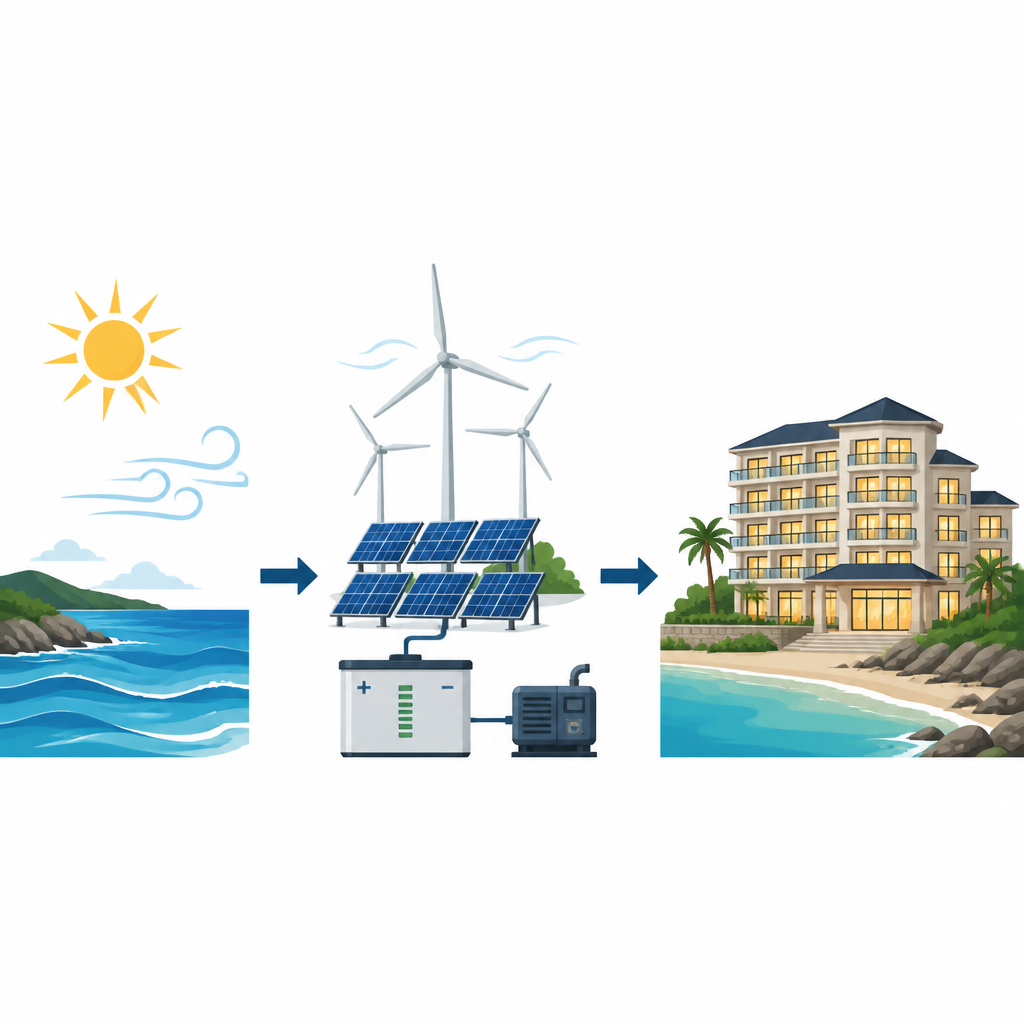
Picture a luxury hotel on Egypt’s Red Sea coast that runs almost entirely on sunshine and sea breezes instead of trucked-in fuel. This study explores how such a hotel can keep lights, air-conditioning, kitchens, and pools running around the clock using a mix of solar panels, wind turbines, and batteries, backed up only lightly by a diesel generator. For readers interested in tourism, climate, and practical clean energy, it offers a detailed look at what it really takes to cut fuel costs and emissions without sacrificing comfort.
Why Remote Hotels Need Smarter Power
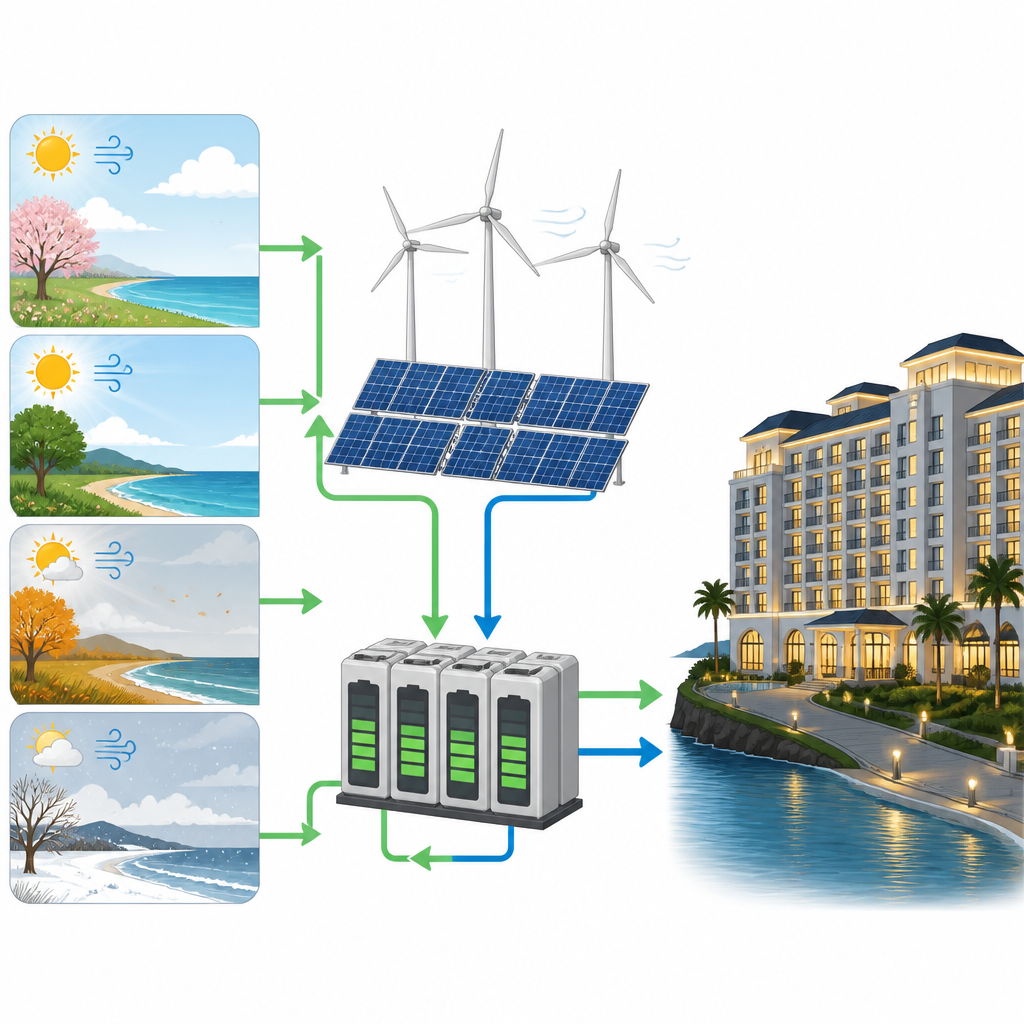
Remote coastal resorts often sit far from strong power grids and must rely on diesel fuel that is expensive to deliver and polluting to burn. At the same time, they have large and highly variable electricity needs, especially for cooling and guest services. The authors focus on a five-star, 500-room hotel in Safaga on Egypt’s Red Sea coast, where demand peaks on hot summer evenings and drops during the night and in cooler months. Instead of treating the hotel’s energy use as a single yearly average, the study follows the load hour by hour for a full year and looks at each season separately, because both the weather and occupancy change over the year.
Building a Mixed Clean Energy System
The team designs an off-grid power system that blends several technologies so that one source can pick up when another falters. Large fields of solar panels capture intense daytime sunlight, while wind turbines tap coastal breezes that are often stronger at night or in different seasons. Excess electricity charges a bank of lithium-ion batteries, which then feed power back when the sun or wind is low. A diesel generator stands by only for rare emergencies or life-safety needs, so that the hotel is not stranded if the weather is unusually calm and cloudy. All components are linked through converters and inverters that move electricity between direct and alternating current so that it can match the hotel’s equipment.
Letting Algorithms Find the Best Mix
Designing such a system is a balancing act: too much equipment drives up costs, while too little risks blackouts. To search for the best compromise, the authors use four modern computer search methods, inspired by ideas from evolution, animal behavior, and fungal growth. These methods try many different combinations of solar panels, turbines, batteries, and electronics, and score each option by two main measures: how cheap the electricity is over the system’s 25-year life and how reliably it meets the hotel’s demand. Reliability is tracked by how often the system fails to supply enough power; in the successful designs this failure rate drops to zero, meaning all demand is met throughout each season.
How Seasons Shape Costs and Equipment
By running the optimization separately for autumn, winter, spring, and summer, the study shows how much the “best” design depends on the time of year. Summer has the highest energy use but also strong sun and wind, allowing the system to deliver power at the lowest cost, around 0.099 USD per kilowatt-hour. Spring performs almost as well, while winter is slightly more expensive. Autumn stands out as the toughest period: middling weather and demand that do not line up neatly push the cost to about 0.160 USD per kilowatt-hour, making it the season that drives the strictest design. Among the search methods, the fungal-inspired algorithm offers a good balance, reaching nearly the same low costs as its rivals but with shorter computer run times than some alternatives.
Testing Reliability and Money Factors
Real equipment can fail, so the authors model random outages of panels, turbines, batteries, and the central inverter, using a repeated trial method to see how often the hotel would still receive full power. Even with such failures, the system keeps reliability above roughly 97 to 99 percent across all seasons, and performs best in spring and summer. The study also tests how sensitive the energy cost is to changing prices and financial conditions. It finds that the price of wind turbines and the level of interest rates affect costs the most, while solar panel prices mainly shift the preferred size of the solar field and inflation has only a modest effect.
What This Means for Clean Coastal Tourism
Overall, the work shows that a large coastal hotel can realistically run on a carefully sized mix of solar, wind, and battery storage, using diesel only as a backup, while keeping power both reliable and reasonably priced. By paying attention to seasonal patterns instead of averages, designers can better match equipment to real-world demand and local weather. For travelers and operators alike, this points to a future where high-end seaside stays can be powered with far less fuel and fewer emissions, supporting both comfort and environmental goals.
Citation: Hafez, H.S.A., Saleh, S.M. & Said, M. Seasonal optimization and analysis of an Off-grid hybrid renewable energy system for a coastal hotel. Sci Rep 16, 15048 (2026). https://doi.org/10.1038/s41598-026-51538-3
Keywords: hybrid renewable energy, off grid hotel, solar and wind power, battery energy storage, seasonal energy analysis