Clear Sky Science · en
Advanced receiver design for AF-FD cooperative schemes
Why better wireless links matter
From video calls to self-driving cars and huge machine networks, our world depends on wireless links that are fast, reliable, and able to share crowded airwaves. This article explores a new way to design the "ears" of a wireless receiver so it can turn what normally looks like signal clutter into an advantage, improving reliability without demanding extra radio channels or heavy coordination.
Turning a relay into a smarter helper
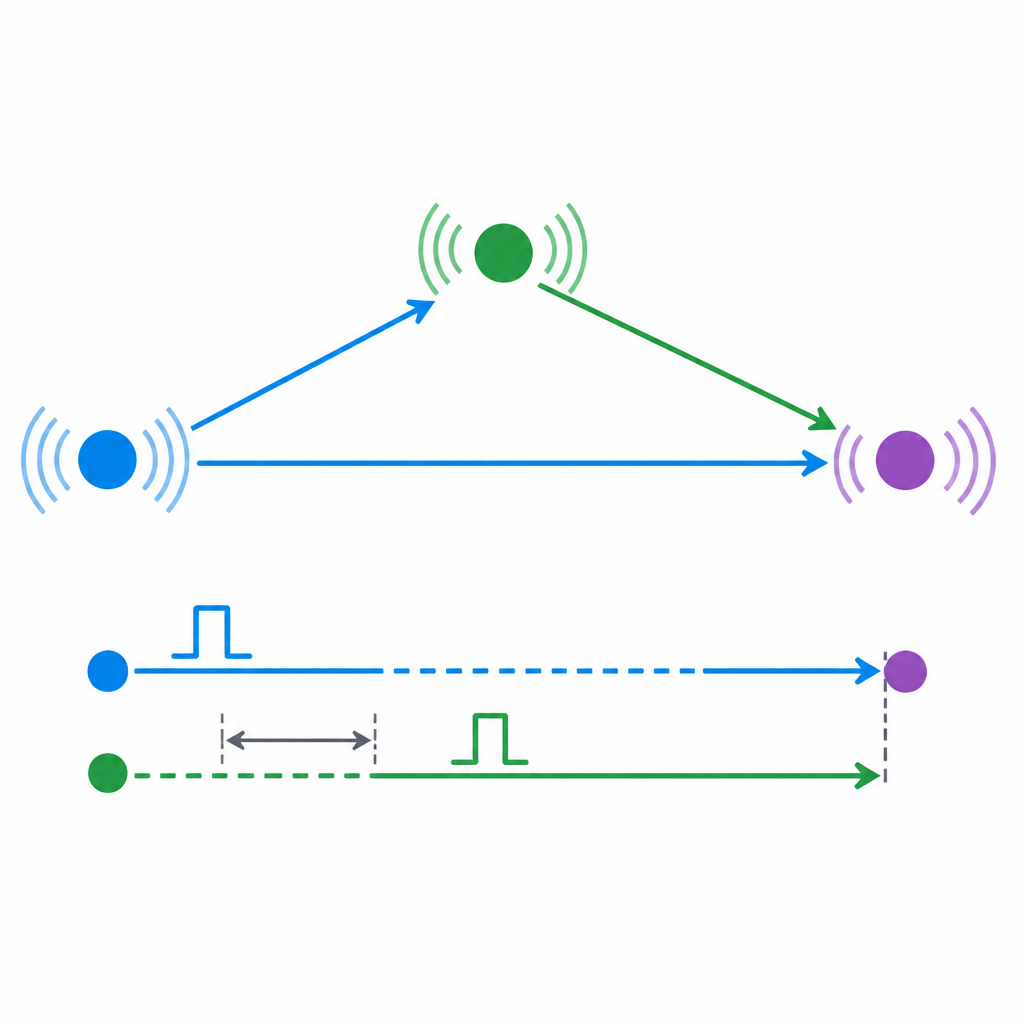
Modern wireless systems often use a relay, a helper device that listens to a signal from a source and immediately passes it on to a destination. In full-duplex mode, this relay can listen and talk at the same time on the same frequency, which boosts data rates but also creates self-interference, because the relay risks hearing its own transmission instead of the source. Past work mostly tried to cancel or ignore this interference and often treated the direct path from source to destination as weak or unimportant. The authors revisit this picture and ask whether the collision of signals from the direct and relay paths can be used in a positive way.
Using delay as a built-in safety net
The key idea is to introduce a deliberate time delay at the relay before it forwards the signal. As a result, the destination receives two versions of each piece of data: one directly from the source and another slightly later from the relay. Over time, this creates a pattern similar to a simple error-correcting code, where each new symbol depends on both current and past data. In effect, the air itself acts like a coding device, giving the receiver several differently distorted views of the same information. This extra variety, known as diversity, makes it easier for the receiver to recover the original message in the presence of fading, noise, and leftover self-interference at the relay.
Smarter listening with two levels of effort
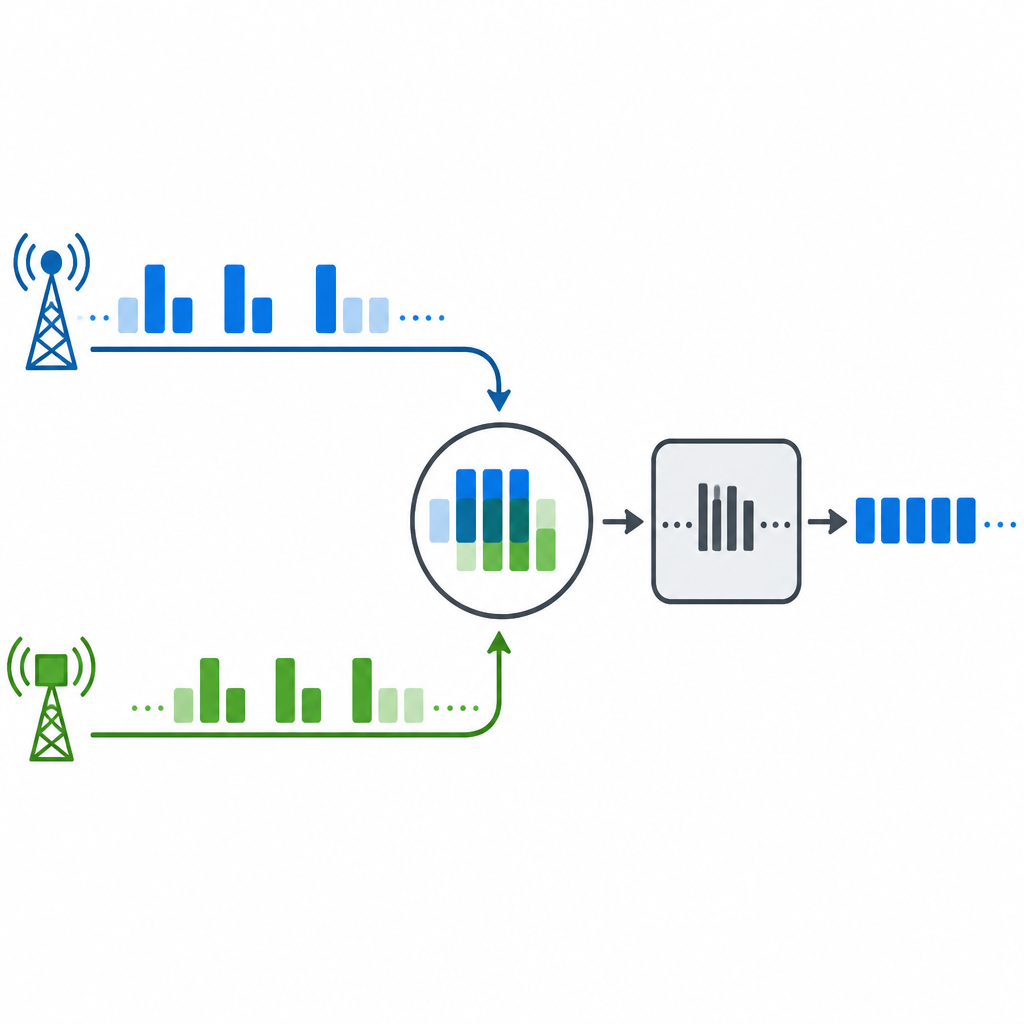
To exploit this structure, the authors design two types of detectors at the destination. The first is an optimal detector that looks at the entire received sequence at once and searches for the most likely transmitted data pattern, using a method related to the Viterbi algorithm widely used in digital communications. This approach can use the full memory created by the relay delay, giving excellent error performance, but it requires storing whole frames and performing a large number of calculations, especially when the delay is long or the modulation format is rich.
Fast, practical detection and learning the channel
The second detector is a more practical, sub-optimal method that decides on one symbol at a time. It uses two key signal samples for each decision, one from the direct path and one from the delayed relay path, and then subtracts the effect of already detected symbols to clean up future observations. This greatly reduces delay and complexity and makes real-time operation feasible, at the cost of some sensitivity to error propagation. To support both detectors, the authors also develop a joint procedure to estimate the unknown channel conditions and the artificial delay itself using a small set of known pilot symbols. This single-step estimator avoids separate, specialized calibration stages and is designed to work even when the direct path is strong and the timing between links is not perfectly aligned.
How well the new design performs
The paper provides mathematical expressions that approximate the chance of bit errors for both detectors and uses them as performance benchmarks. Through extensive computer simulations, the authors show that the optimal detector comes close to its theoretical lower bound and improves steadily as the relay delay is increased, since it can exploit a longer memory of past symbols. The sub-optimal detector, while simpler, still tracks its own analytical lower bound closely at moderate and high signal-to-noise ratios and benefits less from very large delays because it mainly uses short observation windows. The study also compares the proposed methods with several existing channel estimation and detection schemes in a variety of scenarios, including strong and weak direct links, timing mismatches, and different levels of self-interference. In almost all realistic cases, the new receiver design and estimator outperform traditional methods, particularly when timing is imperfect or the direct path cannot be ignored.
What this means for future networks
In plain terms, the study shows that by adding a small, carefully chosen delay at a full-duplex relay and redesigning the receiver to take advantage of the resulting signal pattern, interference and timing offsets can be turned from obstacles into useful structure. The proposed combination of smart delay, optimal and low-latency detectors, and joint parameter estimation delivers lower error rates and better use of spectrum than conventional amplify-and-forward relaying. This makes the approach attractive for future wireless systems that must connect many devices reliably while reusing scarce bandwidth.
Citation: Al-Hattab, M., Mostafa, H. & Marey, M. Advanced receiver design for AF-FD cooperative schemes. Sci Rep 16, 16019 (2026). https://doi.org/10.1038/s41598-026-51473-3
Keywords: full duplex relaying, wireless receiver design, cooperative communication, interference exploitation, channel estimation