Clear Sky Science · en
Integrating nano crystal sensor with explainable deep learning for nutrients and microplastic-toxicity detection
Why cleaner soil matters
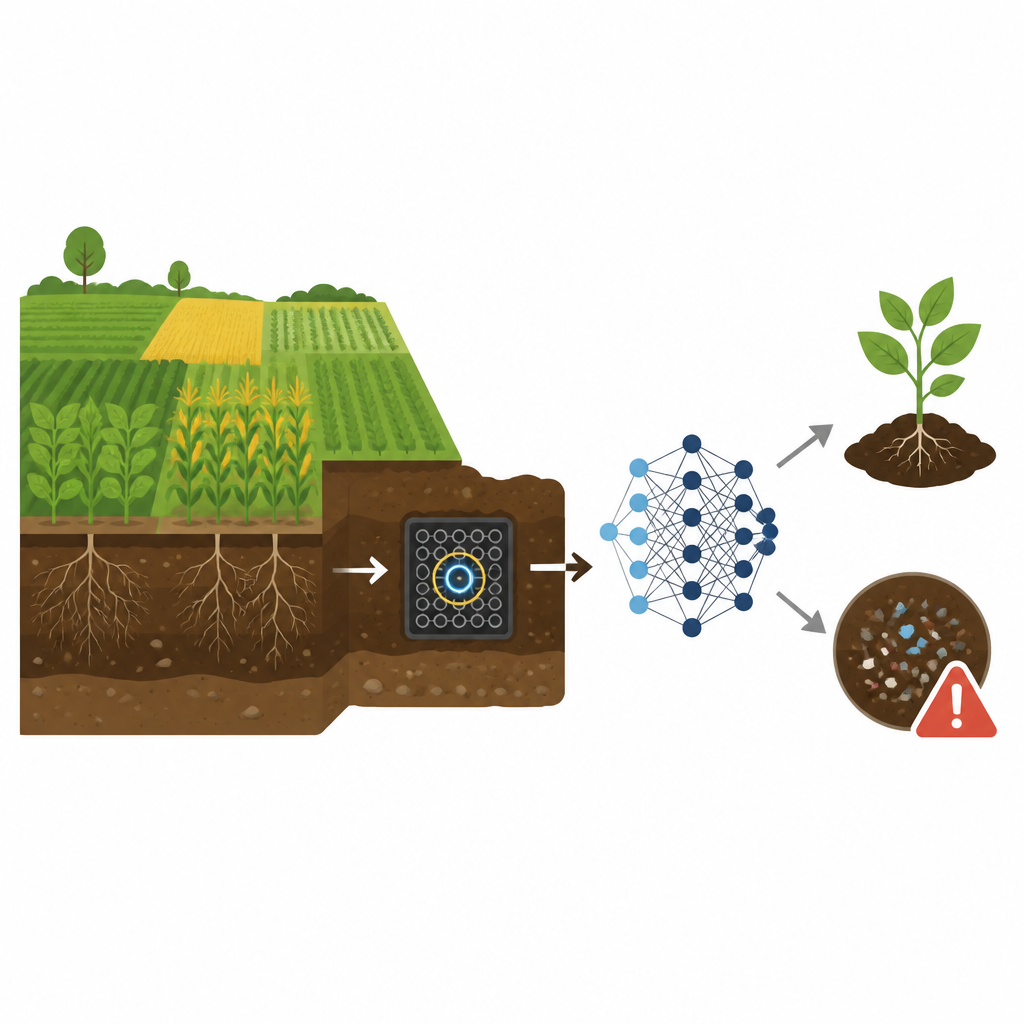
Healthy soil is the quiet engine behind our food supply, but it is under pressure from two sides: crops that constantly draw out nutrients and tiny plastic fragments that quietly build up in the ground. This study explores a compact sensor, working together with artificial intelligence, that could one day check soil in near real time for both essential plant nutrients and harmful microplastics, without hauling buckets of dirt back to a lab.
A tiny light-based soil tester
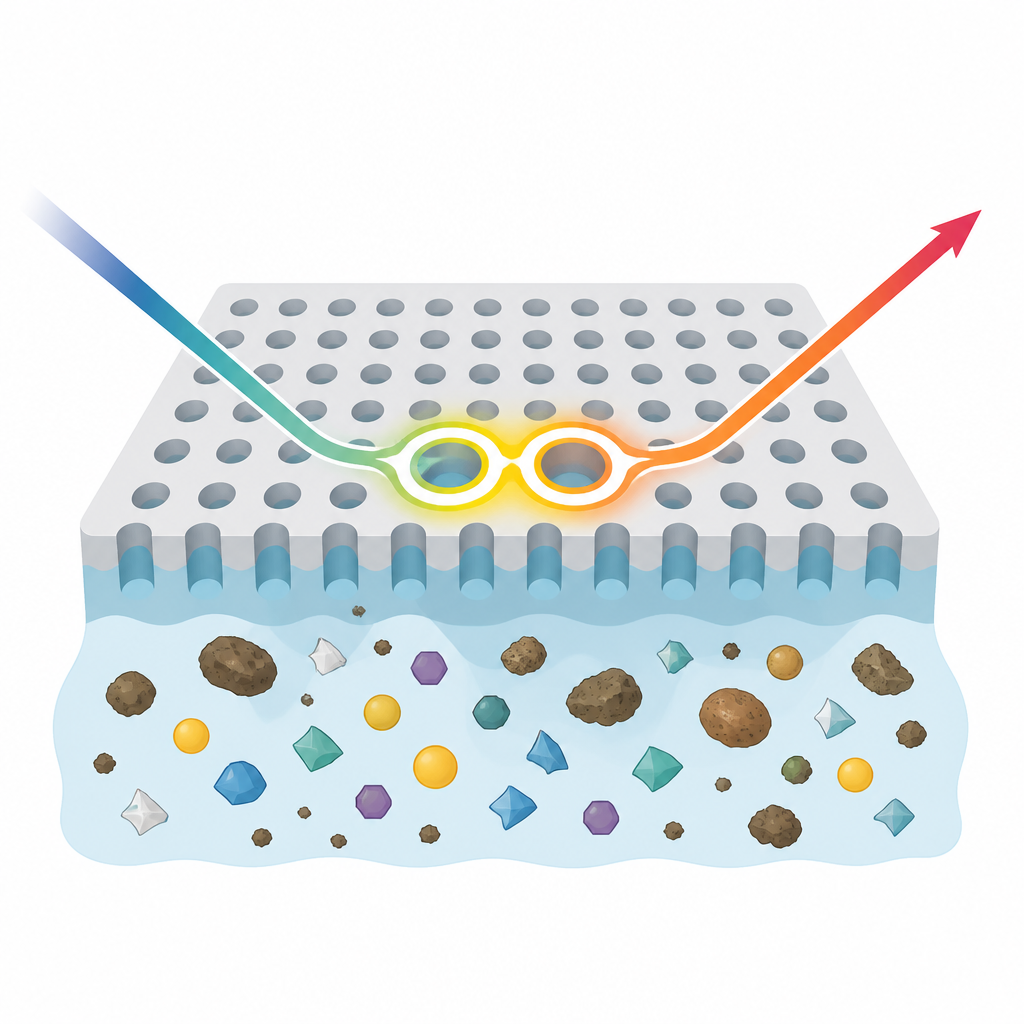
At the heart of the work is a nanoscale device that controls light in a very precise way. The researchers design a two dimensional pattern of silicon and germanium rods with a special double ring cavity in the center. When a laser passes through this pattern, most wavelengths are blocked, but certain colors slip through depending on what fills the tiny gaps between the rods. If soil with dissolved nutrients or bits of plastic surround the cavity, they subtly change how light resonates inside it. By measuring exactly which color peaks appear in the outgoing light, the sensor captures a kind of optical fingerprint of what is in the soil.
Reading the soil’s hidden pattern
Each nutrient, such as nitrogen, phosphorus, potassium, or micronutrients like zinc and iron, slightly shifts the color and sharpness of the light peak in its own way. Even low density polyethylene microplastics, common in farm films and packaging, leave their own optical trace. The team runs thousands of computer simulations, sweeping through realistic values for how these materials bend light. They tune the geometry of the dual ring cavity so that the light becomes strongly confined and very selective. In this optimized design, tiny changes in the soil sample produce noticeable shifts in the spectrum, while the device remains stable when its dimensions or temperature vary within levels expected from real fabrication and outdoor use.
Letting artificial intelligence sort the signals
Although the sensor produces rich and sensitive spectra, many soil components look deceptively similar, especially when their concentrations are close. To untangle this, the authors use a deep learning model called a Deep and Cross Network. Instead of feeding it only a single number, they supply whole slices of the spectrum together with key optical traits, such as how sharp the resonance is and how efficiently light passes. The network is designed to capture complex interactions among these features, learning which combinations uniquely point to nitrogen, or to manganese, or to microplastic contamination. Trained on the simulated data, the model correctly identifies ten different soil related classes with accuracy above 99 percent.
Opening the black box of AI
To make sure the AI is not relying on spurious patterns, the study uses explainable AI tools that show which parts of the input matter most to each decision. One method, SHAP, assigns an importance score to every feature across many samples, revealing that traits such as the quality factor of the resonance and the figure of merit are the most influential. Another method, LIME, zooms in on individual predictions and highlights which changes in the spectrum push the model toward, for example, labeling a sample as potassium rather than calcium. These checks confirm that the AI is basing its choices on physically meaningful aspects of the light response, rather than random noise.
From simulations to smarter fields
The work ends with a look toward practical devices that could sit in a compact probe, shine light through soil samples, and run the trained model on a small embedded processor. While the current study relies on simulations and assumes carefully prepared soil, it shows that combining a well engineered light based sensor with transparent AI can reliably flag both nutrient levels and microplastic pollution. For growers, this points to a future where checking soil health could be as quick as scanning a barcode, helping them use fertilizer more wisely and keep plastic waste from silently degrading the ground that feeds us.
Citation: Magdy, A., Abd-Elsamee, S. & Altantawy, D.A. Integrating nano crystal sensor with explainable deep learning for nutrients and microplastic-toxicity detection. Sci Rep 16, 15179 (2026). https://doi.org/10.1038/s41598-026-51368-3
Keywords: soil nutrients, microplastics, photonic crystal sensor, deep learning, smart agriculture