Clear Sky Science · en
Subtractive color filters based coaxial metasurface structures with high saturation and brightness
Why tiny structures can paint vivid colors
From phone screens to security labels, modern life depends on bright, stable colors. Traditional dyes fade with light and heat, and they can be environmentally harmful. This study explores a very different way to create color using ultra small patterns carved into metal films, opening paths to sharper, longer lasting color for displays, printing, imaging, and data storage. 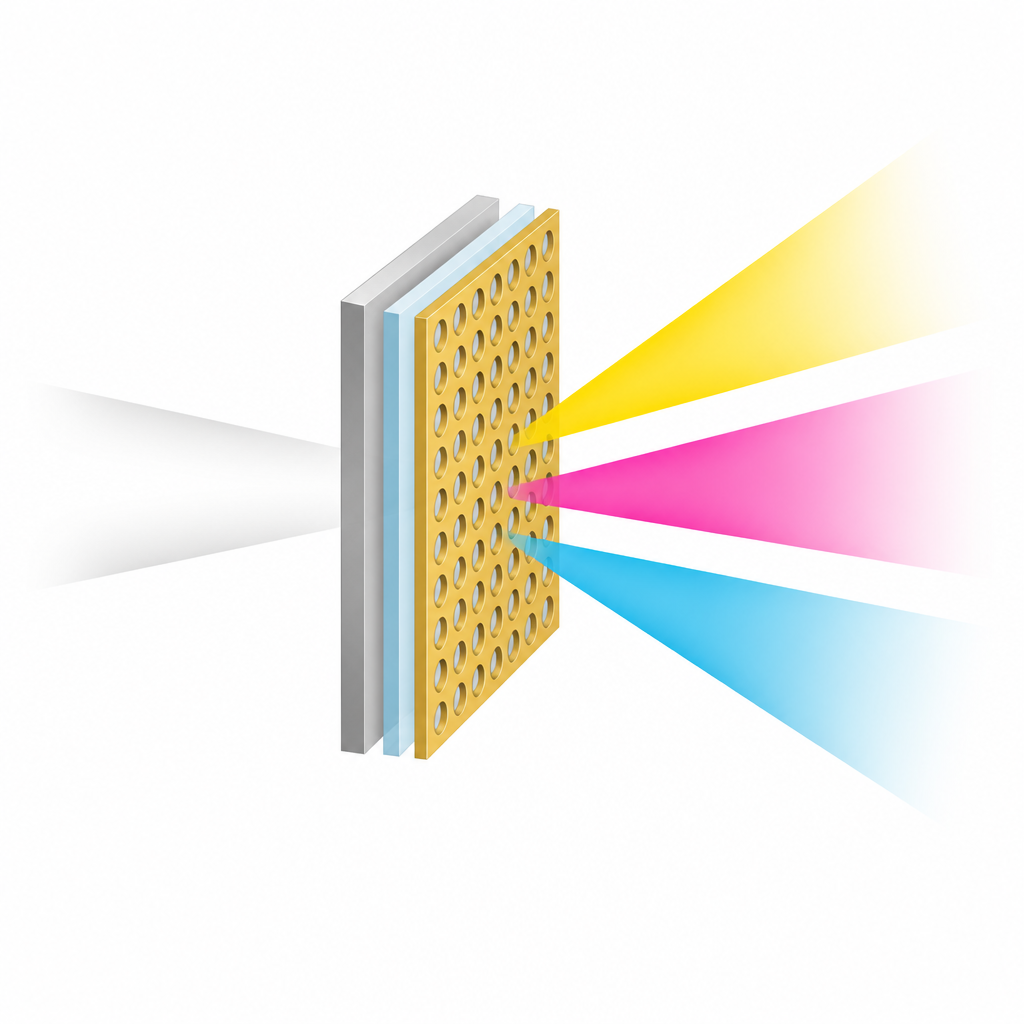
Colors from structure not from ink
Instead of using colored chemicals, the researchers design "structural" color filters. These filters are made from a thin silver film patterned with tiny ring shaped openings, stacked above a transparent spacer layer and a silver mirror. When white light hits this layered surface, only certain parts of the spectrum are strongly absorbed while the rest are reflected. By carefully choosing the shape and size of the rings, the device removes (or subtracts) specific bands of blue, green, or red light so that the remaining mix appears as cyan, magenta, or yellow to the human eye.
How metal rings tame light
The key to the filters lies in how light waves cling to metal surfaces at the nanoscale. In the ring shaped openings, light can swirl around the inner walls and also skim along the flat metal surface, forming intense standing waves. These two kinds of motion interact and reinforce one another, trapping light at very narrow wavelength bands until it is almost completely absorbed. The team’s computer simulations show absorption levels above 99.9 percent at the chosen wavelengths, which means very deep notches in the reflected spectrum and therefore highly saturated subtractive colors with strong brightness.
Shaping light with different patterns
The authors go beyond simple circles and test elliptical, square, and rectangular ring patterns etched in silver. Each geometry offers a different handle on the way light behaves. Circular and square designs respond almost the same way no matter how the incoming light is polarized, which is useful for general viewing conditions. Elliptical and rectangular designs, by contrast, respond differently along their long and short directions, allowing the color to change with polarization and enabling switchable optical elements. The study also maps out how changing key dimensions such as the spacer thickness and ring depth shifts the absorbed wavelength smoothly across the visible range, giving designers an easy toolkit for picking any target color. 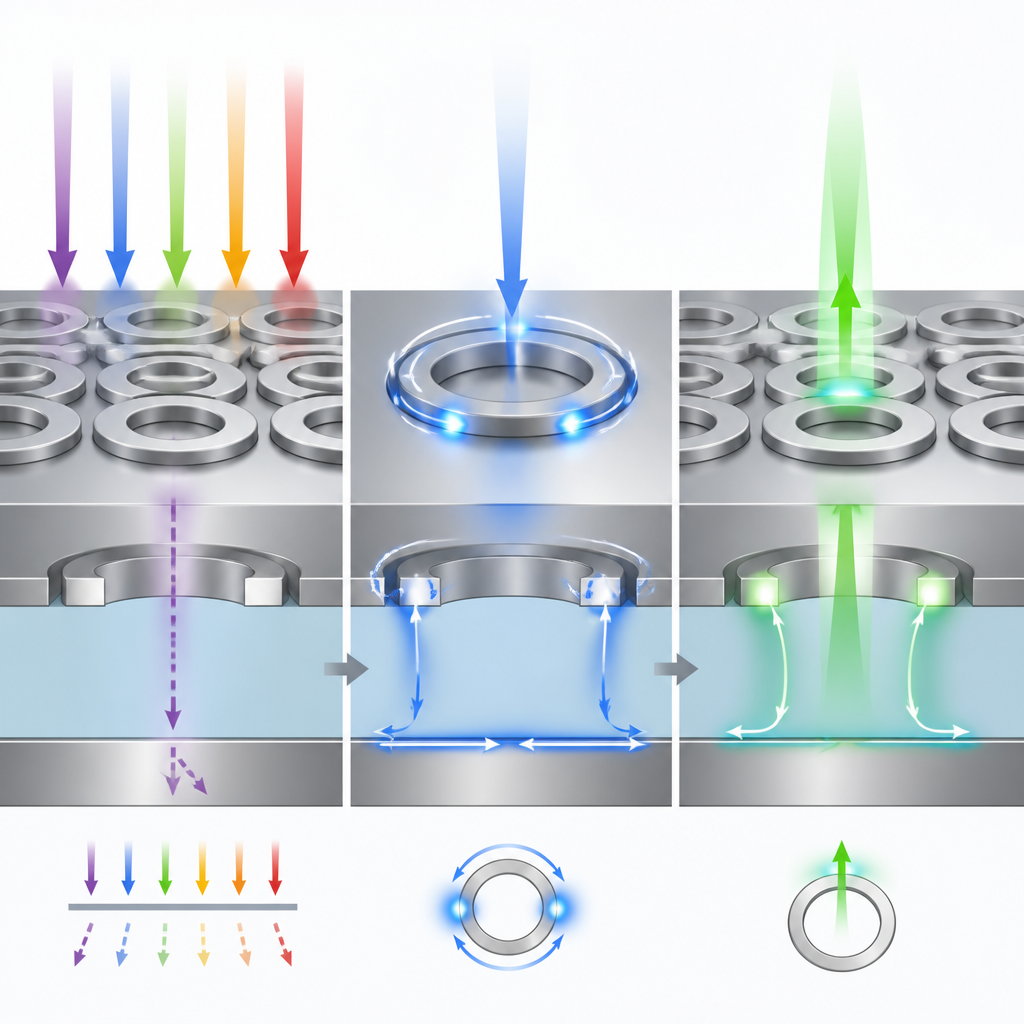
Stable colors over angles and conditions
For real devices, it is not enough to get the right color only at one viewing angle. The team tests how the filters behave when light comes in at different tilts. They find that the color remains nearly unchanged for modest angles, with only a slight shift for larger tilts, which is acceptable for most reflective displays and imaging systems. Using standard color charts, they show that their structures reach high color purity and cover a useful portion of the normal display color space, while keeping the background bright. They also provide simple mathematical formulas that link the geometry of the layers directly to the resulting color, so future engineers can skip repeated heavy simulations.
What this means for future devices
In simple terms, the work shows that carefully patterned silver films can act as highly selective mirrors that strip out chosen slices of the rainbow with near perfect efficiency, leaving vivid subtractive colors behind. Because the effect comes from the shape and arrangement of the nanostructures rather than fragile dyes, these color filters promise greater stability, compactness, and design freedom. This approach could power next generation color printing, ultra high resolution displays, secure imaging, sensors, and optical data storage, all built on the subtle dance between light and metal at scales far smaller than the width of a human hair.
Citation: Ali, A., Sayed, H., Mobarak, M. et al. Subtractive color filters based coaxial metasurface structures with high saturation and brightness. Sci Rep 16, 15037 (2026). https://doi.org/10.1038/s41598-026-51341-0
Keywords: structural color, metasurface, subtractive color filter, plasmonic nanoapertures, color printing