Clear Sky Science · en
The effect of steel waste addition as a cement replacement on the mechanical and radiation shielding properties of sustainable concrete
Turning Steel Scraps into Safer Concrete
Modern life depends on both concrete and radiation technology, from hospitals to power stations. This study explores a way to make concrete that not only reuses steel industry waste but also does a better job of blocking harmful radiation. By folding leftover steel particles and iron ore into concrete, the researchers aim to create sturdier buildings and safer shielding while cutting down on industrial waste.
Why Rethink What Goes into Concrete
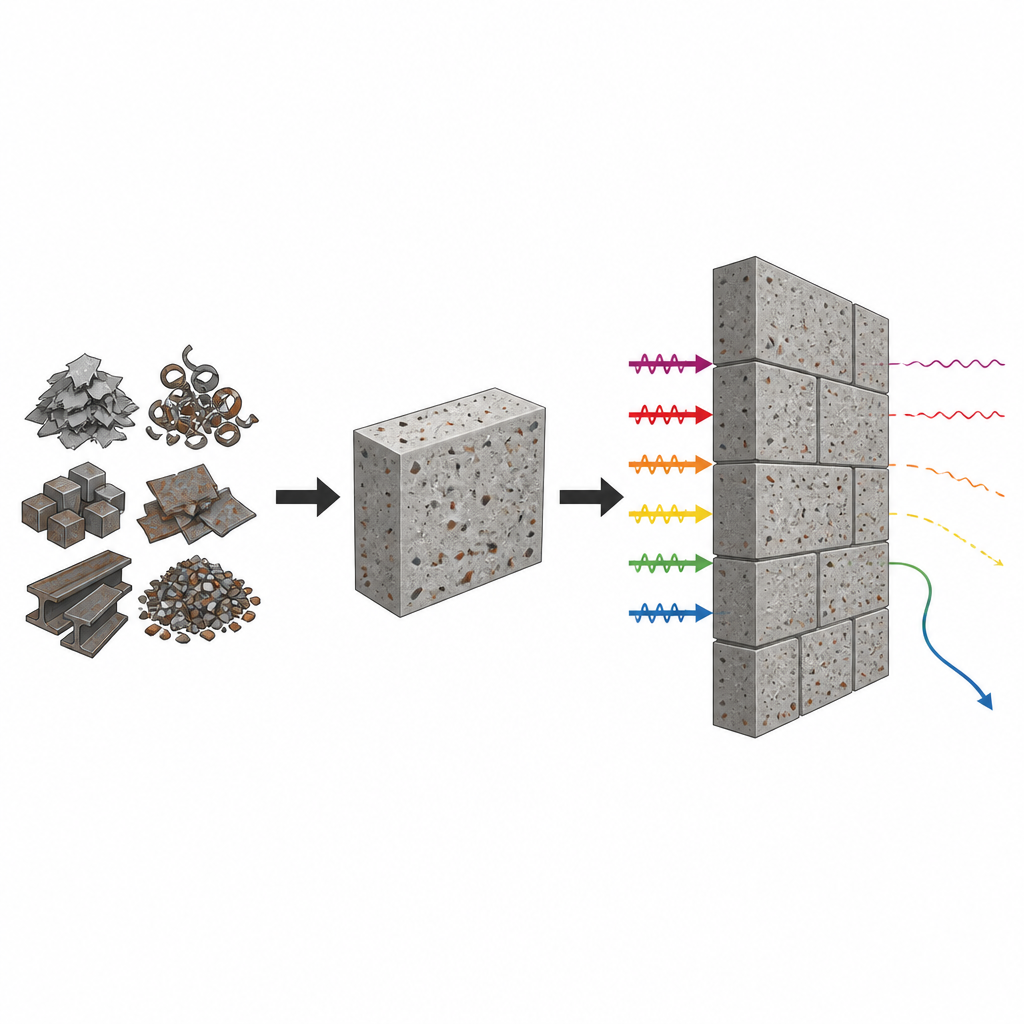
Traditional concrete relies heavily on cement and natural rock, which take a toll on the environment when they are mined and produced. At the same time, steel factories generate large amounts of waste, such as fine scales, filings, and worn brake parts, that often end up in landfills. The team behind this study asked a simple question: could these heavy, iron-rich leftovers replace part of the cement in concrete and turn a disposal problem into a useful ingredient, especially for structures that need protection from radiation?
Building Test Mixes from Industrial Leftovers
To find out, the researchers prepared thirteen types of concrete. In every mix, the coarse stones usually used in concrete were replaced by steel slag, a by-product from steel making. Then, they swapped out different amounts of cement for four steel-based additives: waste brake lining, rolling mill scale, iron filings, and hematite, a dense form of iron oxide. Each additive was tried at three levels, replacing 10, 20, or 30 percent of the cement. The team measured how easily each mix flowed when fresh, how strong it became after hardening, and how well it blocked gamma rays at three typical energies. They also used powerful microscopes to look inside the concrete and see how the tiny particles were arranged.
Stronger, Denser, and Less Porous Concrete
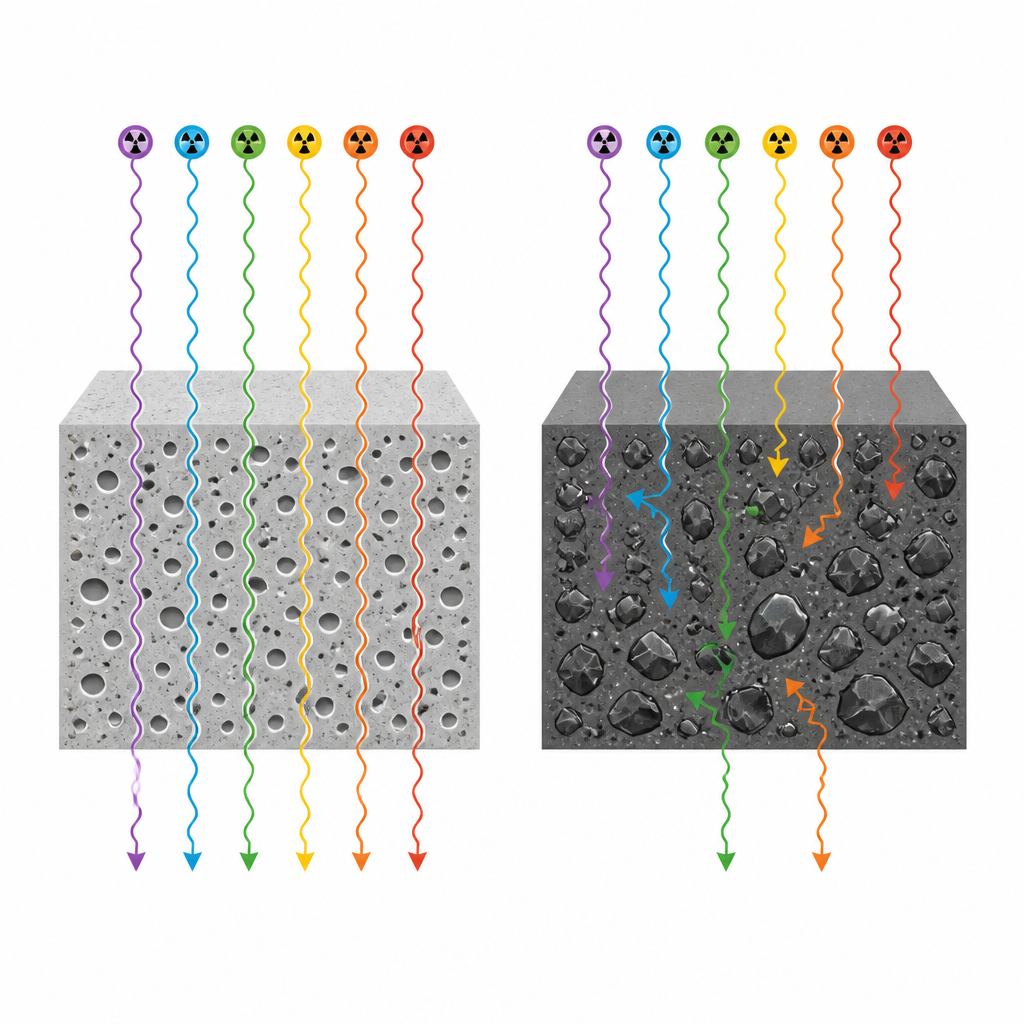
The results showed that, in most cases, swapping in steel-based additives made the concrete stronger. Compressive and tensile strengths at 28 days generally rose compared with ordinary concrete made with the same amount of cement and slag, especially when hematite was used. A mix with 10 percent hematite gave one of the best balances, boosting both types of strength noticeably. Microscopic images revealed why: the heavy, fine particles filled gaps between cement grains and helped form a tighter, more uniform inner structure. Compared with the control mix, samples containing steel waste had fewer and smaller pores, meaning the material was denser and less likely to contain weak spots.
How the Concrete Blocks Radiation
When gamma rays pass through matter, some of their energy is absorbed or scattered, a process known as attenuation. The scientists measured how quickly radiation intensity dropped as it traveled through discs of each concrete type. All mixes containing steel waste or hematite shielded better than the control concrete, thanks to their higher density and iron content. The hematite mixes, again, performed best, reaching the highest attenuation values. In practical terms, this means a wall made from these heavy, iron-rich concretes can reach the same level of protection with less thickness than a wall made from ordinary concrete. As expected, higher-energy gamma rays were harder to stop, but the improved mixes still outperformed the standard one at every tested energy.
What This Means for Future Buildings
For a non-specialist audience, the key takeaway is that smart use of steel waste can turn concrete into a more sustainable and more protective building material. By partially replacing cement with selected iron-rich powders, the study found that concrete can become stronger, denser, and better at blocking harmful radiation, all while helping keep steel scraps out of landfills. The authors highlight a mix with 10 percent hematite as especially promising, though they note that long-term durability, cost, and performance under harsh conditions still need to be explored before such recipes are widely used in real-world construction.
Citation: Mukhtar, S., Sallam, H.ED.M. & Elsadany, R.A. The effect of steel waste addition as a cement replacement on the mechanical and radiation shielding properties of sustainable concrete. Sci Rep 16, 15036 (2026). https://doi.org/10.1038/s41598-026-51323-2
Keywords: sustainable concrete, steel waste, radiation shielding, hematite, gamma attenuation