Clear Sky Science · en
Neodymium magnetic field meets nanocatalysis: a sustainable route to novel azines and condensed heterocycles
Why tiny magnets matter for future medicines
Chemists are always searching for cleaner ways to make the complex ring-shaped molecules that underlie many modern drugs. This study shows how combining a strong neodymium magnet with iron oxide nanoparticles can speed up these reactions at room temperature, cut energy use, and avoid harsh chemicals, while still producing important building blocks for pharmaceuticals.
New way to build useful ring structures
The researchers focused on a family of nitrogen-rich rings called heterocycles, which appear in most prescription medicines. They targeted several well-known members of this family, including pyrimidines, benzimidazoles, quinoxalines, and benzodiazepines. These rings play key roles in controlling how drug molecules interact with the body, so finding a cleaner way to make them could have broad impact across medicine and materials science.
Magnet and nanoparticles working together
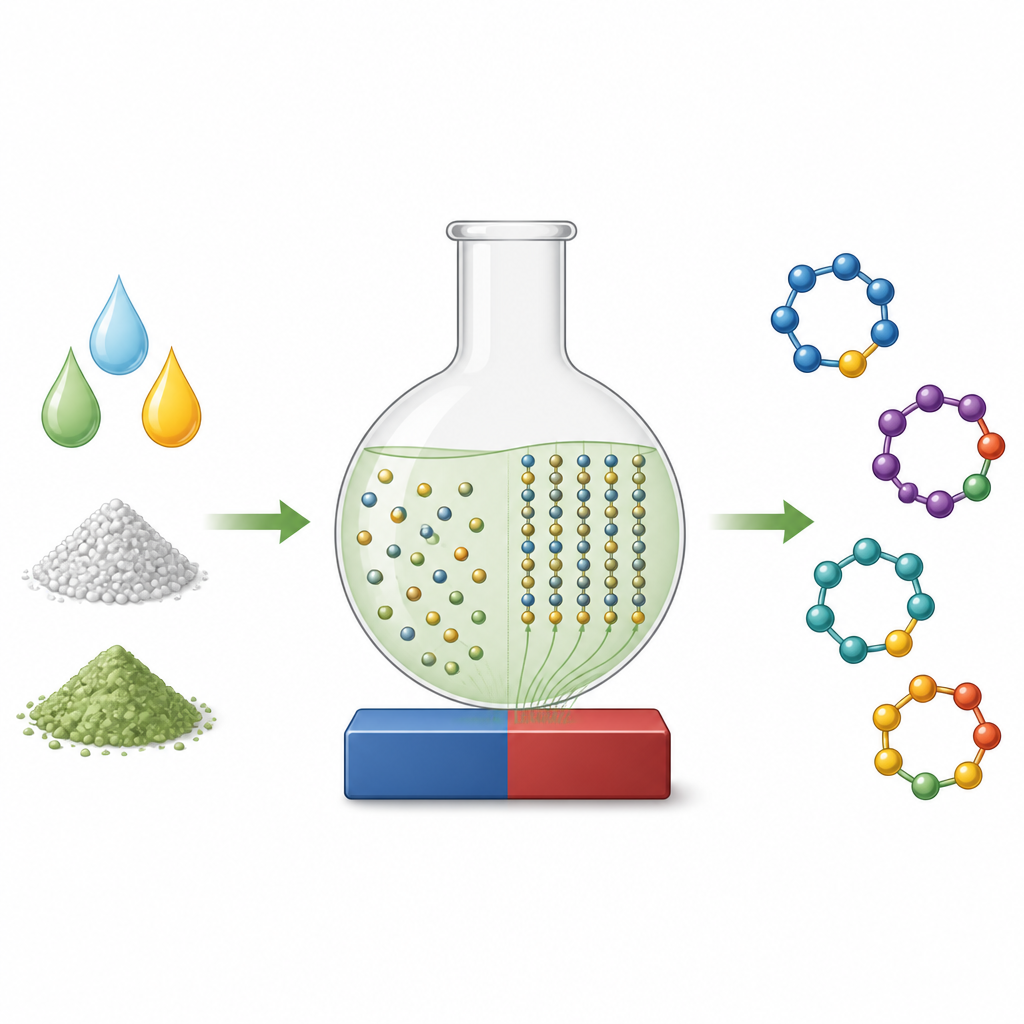
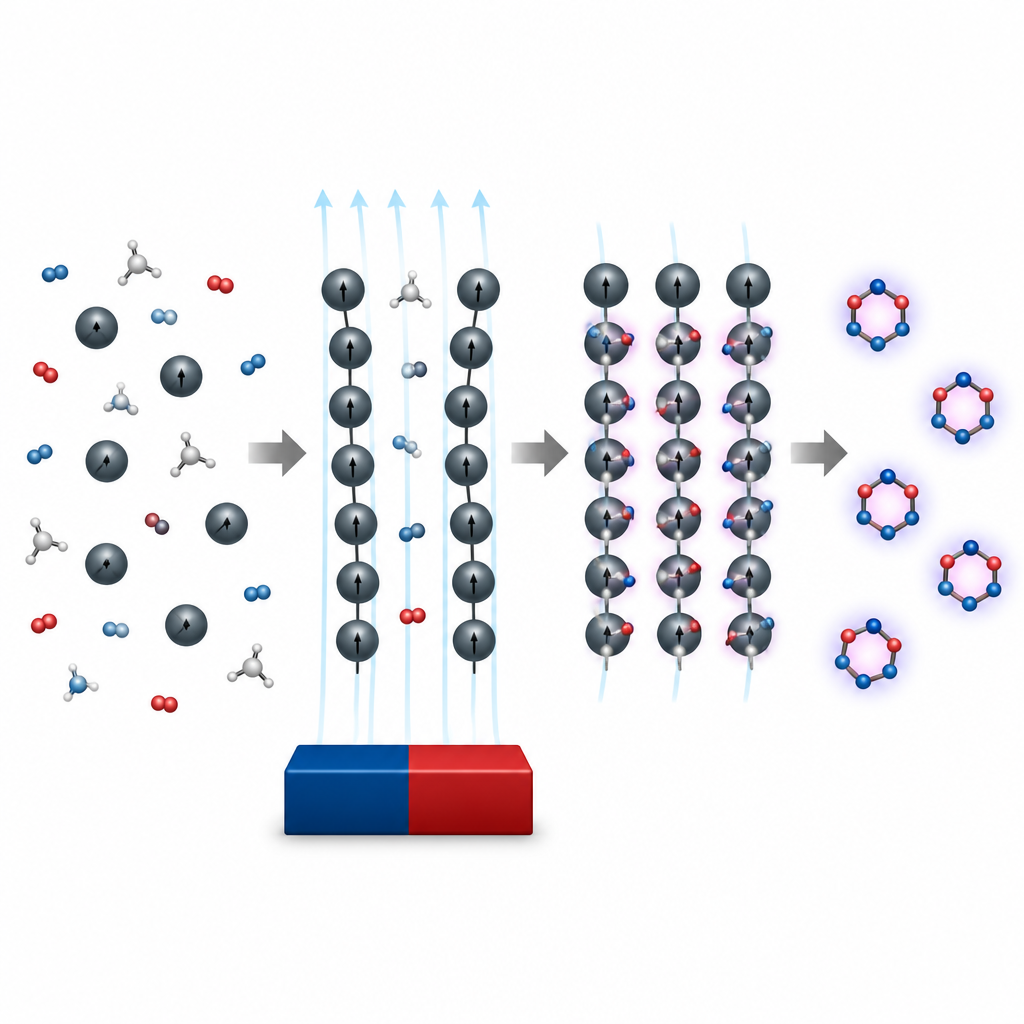
In the new method, the team placed tiny iron oxide particles in a solution of simple starting chemicals and then exposed the mixture to a strong static magnetic field produced by a neodymium magnet. Without the field, nothing happened even after many hours. When the magnet was switched on, however, the nanoparticles lined up in an orderly way and acted as miniature reaction stations, drawing the starting molecules to their surfaces and helping them snap together into more complex ring structures within only 15 to 25 minutes at room temperature.
Checking the particles and the products
To understand why the system worked so well, the scientists examined both the magnet and the nanoparticles in detail. Magnetic measurements confirmed that the neodymium magnet generated a powerful, stable field strong enough to control the particles. Electron microscopy images showed that the iron oxide particles were truly nanoscale, between about 9 and 50 billionths of a meter across, with mostly round shapes and a large surface area. X-ray tests verified that the particles had the right crystal structure. The team then used standard lab tools for organic chemistry, such as infrared and nuclear magnetic resonance spectra, to confirm that the desired ring-shaped products had indeed formed.
Cleaner reactions with less waste
The process was designed with green chemistry principles in mind. The reactions ran in ethanol, a relatively safe and bio-based solvent, and required no heating beyond room temperature, which lowers energy demand. After each run, the same magnet that drove the chemistry was used to pull the iron oxide catalyst out of the mixture, simply by inserting it into the reaction vessel. The recovered catalyst could be washed and reused at least four times with almost no loss of activity. Calculations of green metrics, such as how efficiently atoms from the starting materials end up in the final product, showed good performance and compared favorably with older methods that need higher temperatures, stronger acids, or more complicated catalysts.
What this means for greener chemistry
In everyday terms, the study shows that a strong permanent magnet can act like a traffic director for tiny particles, lining them up so they guide simple ingredients into valuable ring-shaped molecules quickly and with less waste. Because the method works at room temperature, avoids harsh additives, and uses a reusable magnetic catalyst, it offers a promising route toward cleaner production of compounds that are central to many medicines and advanced materials.
Citation: Morsy, H.A., Moustafa, A.H., El-Sayed, H.A. et al. Neodymium magnetic field meets nanocatalysis: a sustainable route to novel azines and condensed heterocycles. Sci Rep 16, 15859 (2026). https://doi.org/10.1038/s41598-026-51258-8
Keywords: green chemistry, magnetic nanoparticles, heterocycle synthesis, neodymium magnet, nanocatalysis