Clear Sky Science · en
Investigation of the synergistic effects of UV radiation and elevated temperatures on regenerated cellulose fiber-reinforced bio-polyamide 5.10 composites
Why protecting green plastics matters
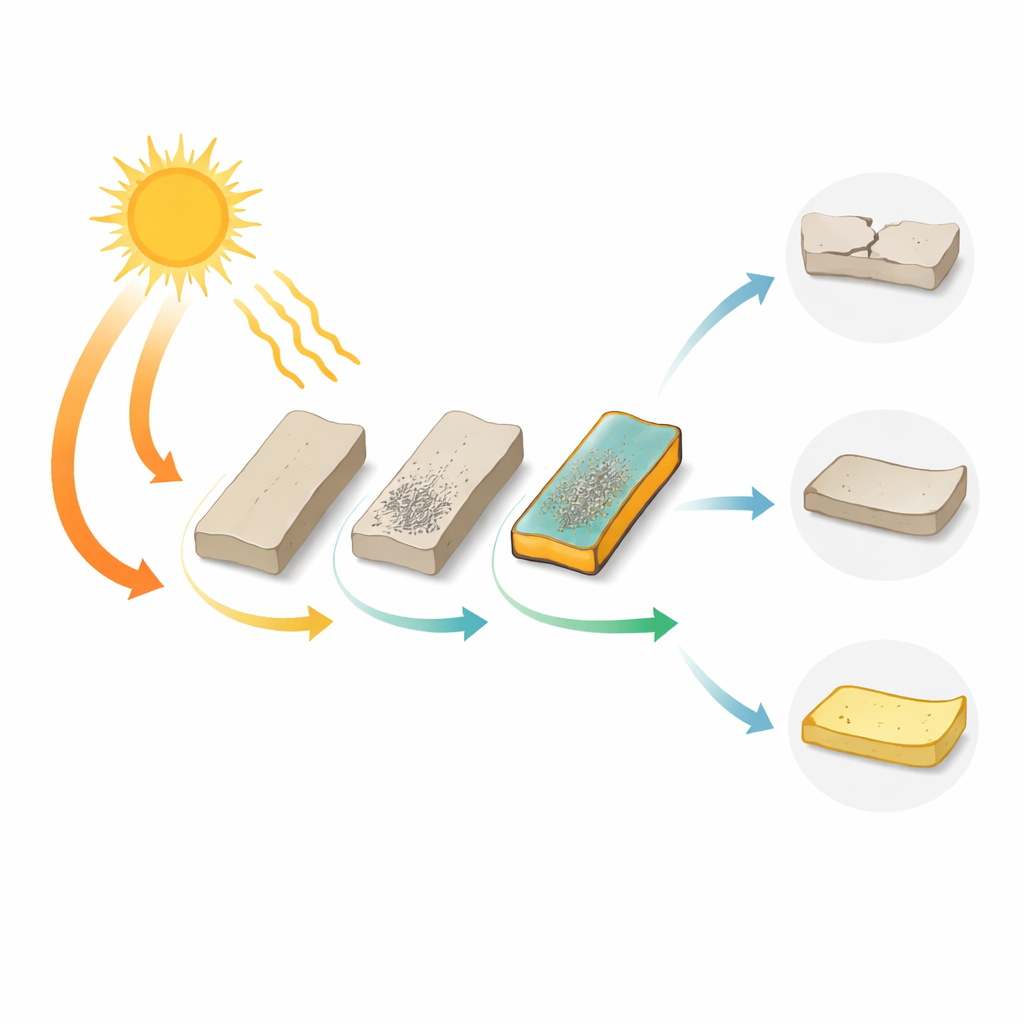
As industries search for greener materials than conventional oil-based plastics, one big question remains: will these new materials survive years of sunlight and heat in real products like cars or outdoor equipment? This study looks at a promising bio-based plastic reinforced with man‑made cellulose fibers and asks how it ages when exposed to both ultraviolet (UV) light and high temperatures—and how additives can keep it from becoming brittle, cracked, and discolored.
A new kind of strong, plant-based plastic
The researchers focused on a plastic called bio‑polyamide 5.10, made entirely from renewable building blocks. Compared with common bioplastics like PLA, it already offers higher strength, heat resistance, and better resistance to water attack. To further boost performance, the team reinforced this plastic with short regenerated cellulose fibers—factory‑made fibers similar to viscose that behave more consistently than raw plant fibers. The result is a lightweight composite that could replace glass‑fiber‑reinforced plastics in applications such as automotive parts, where long‑term durability is essential.
Putting the materials through accelerated aging
To simulate years of outdoor use, the team produced six versions of the material: the neat plastic, the fiber‑reinforced composite, and both of these with either of two commercial UV‑protection packages. Test pieces were stored for one week at four different temperatures (from room temperature up to 90 °C) at controlled humidity, with and without intense artificial sunlight. Afterwards, the samples were equilibrated and then examined in detail. The researchers measured how much moisture the materials absorbed, how their internal structure changed, how their surfaces looked and felt, and how their strength, toughness, and melt behavior evolved.
How heat, light, water and fibers interact
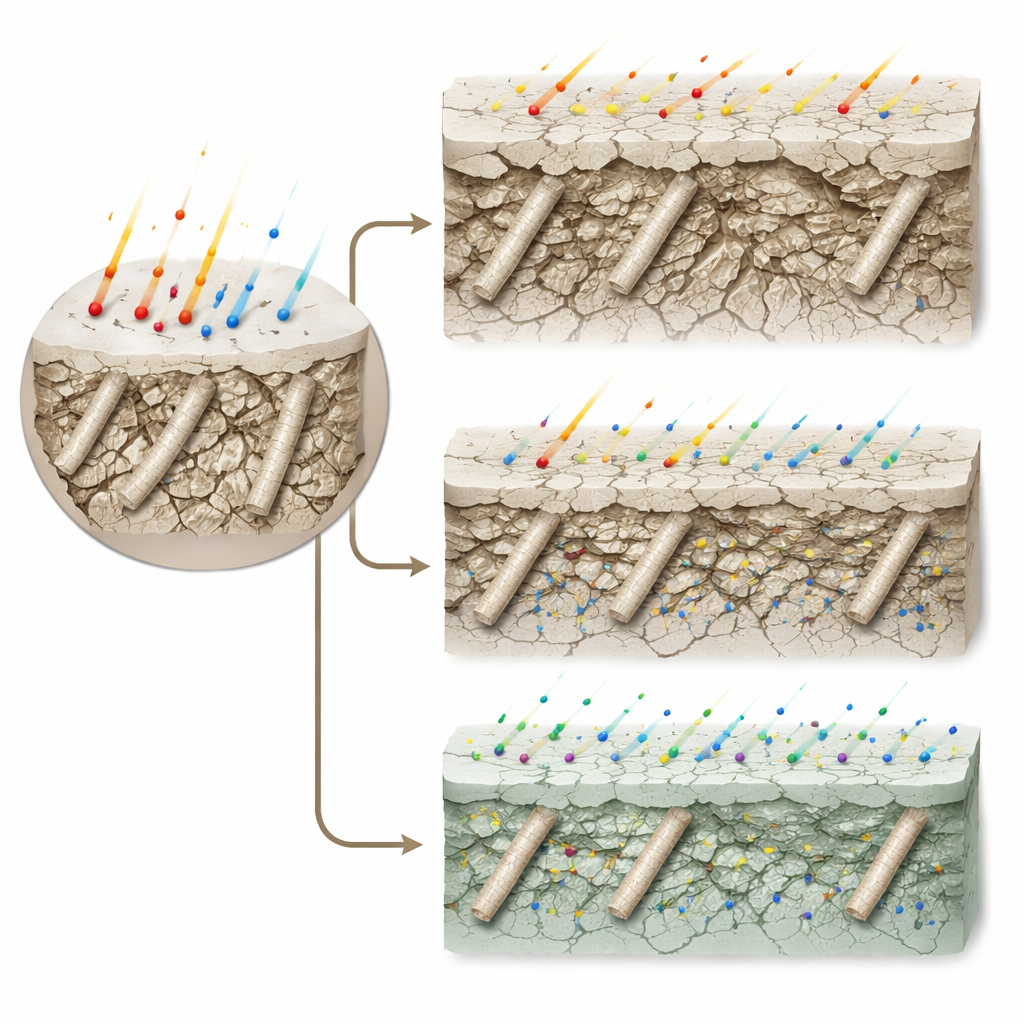
Without protection, the bio‑polyamide showed clear signs of damage under strong UV and heat: its molecules broke into shorter chains, the surface became less polar and more brittle, and the plastic turned yellow. Heat encouraged the polymer chains to rearrange into more crystalline regions, while UV light triggered chemical reactions that formed new oxygen‑containing groups. Moisture played a dual role. In the plain plastic, absorbed water softened the material at moderate conditions but also sped up long‑term chemical attack, contributing to embrittlement at higher temperatures. Adding cellulose fibers increased total moisture uptake even more because the fibers themselves are highly water‑loving and act like tiny sponges. This extra moisture made the composite somewhat more flexible and impact‑resistant at intermediate conditions, but under harsh UV and heat it ultimately led to fiber damage and a shift from gentle fiber pull‑out to brittle fiber breakage.
Why one stabilizer clearly outperformed the other
The two protection strategies behaved very differently. The UV absorber mainly worked like a sunscreen, soaking up harmful light and releasing it as heat, but it did little to stop the chemical chain reactions once they started. In some cases it even contributed to yellowing. By contrast, the formulation containing a hindered amine light stabilizer, together with other antioxidants, acted like a chemical “firefighter” inside the plastic. It repeatedly trapped aggressive radicals created by UV and oxygen, slowing both heat‑driven and light‑driven damage. Samples with this package kept their strength, flexibility, surface appearance, and color much better than the unprotected or UV‑absorber‑only versions, even at the highest temperature and under strong UV.
What this means for future sustainable products
For designers hoping to replace oil‑based engineering plastics with greener options, this work delivers a clear message: bio‑polyamide 5.10 reinforced with regenerated cellulose fibers can indeed be durable enough for demanding uses, but only if it is properly stabilized against the combined assault of heat, sunlight, and moisture. The study shows that the right additive system—especially one based on hindered amines—can keep these composites from cracking, weakening, or yellowing, even under harsh conditions. That makes them realistic candidates for long‑lived, lightweight components in cars, electronics housings, and other applications where sustainable materials must also stand the test of time.
Citation: Falkenreck, C.K., Zarges, JC. & Heim, HP. Investigation of the synergistic effects of UV radiation and elevated temperatures on regenerated cellulose fiber-reinforced bio-polyamide 5.10 composites. Sci Rep 16, 13770 (2026). https://doi.org/10.1038/s41598-026-51172-z
Keywords: bio-based polyamide, cellulose fiber composites, UV aging, thermal oxidation, polymer stabilization