Clear Sky Science · en
Metaheuristic-enhanced deep learning for monthly pan evaporation prediction under limited climatic data
Why drying water matters for everyday life
Water vanishes from lakes, reservoirs, and farm ponds every day through evaporation, quietly shaping how much water is left for drinking, growing food, and protecting ecosystems. Measuring and predicting this loss sounds simple—just watch water disappear from a pan—but in reality it is difficult, especially in places with few weather instruments. This study explores how modern deep learning, guided by nature‑inspired search strategies, can forecast monthly pan evaporation using only a handful of basic climate measurements, helping communities plan for droughts, floods, and changing seasons even when data are scarce.
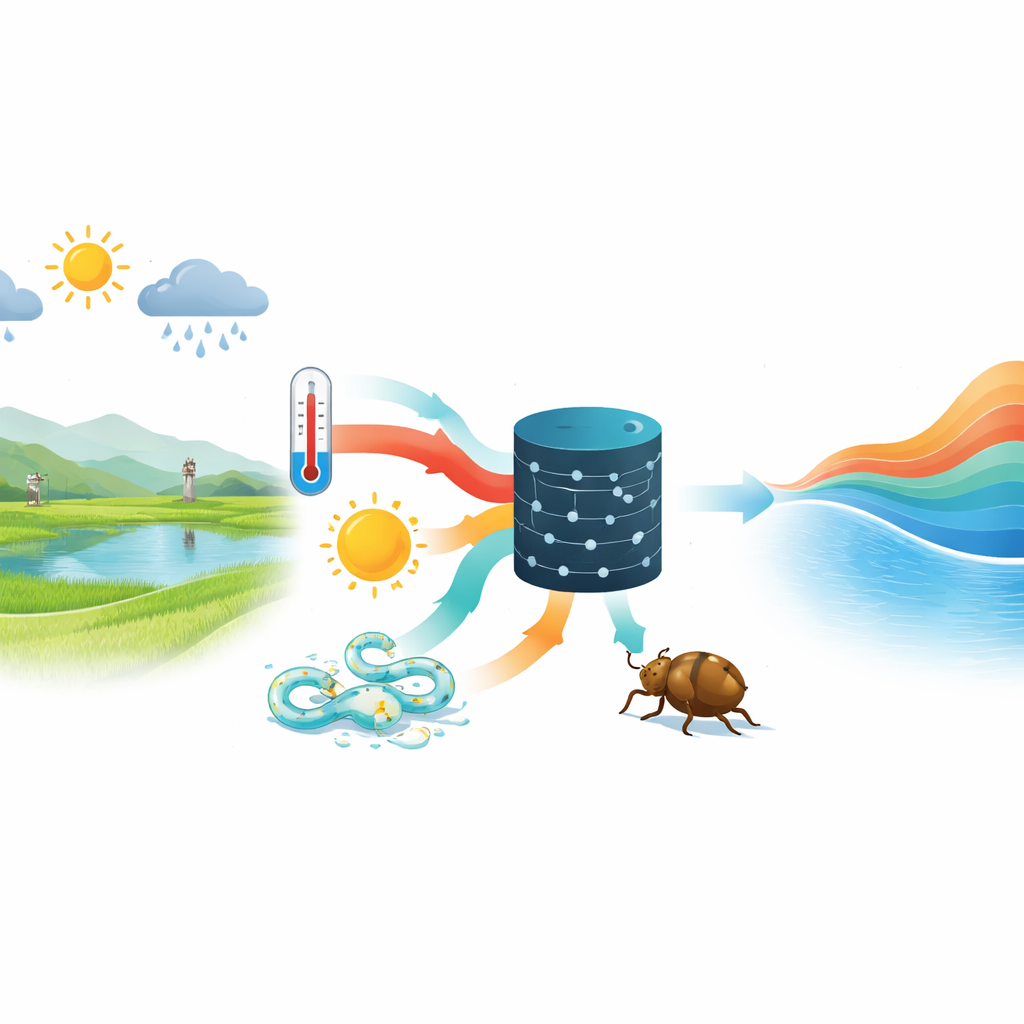
Watching water disappear from a metal pan
Engineers and hydrologists often use “pan evaporation” as a practical way to estimate how quickly water leaves open surfaces. A shallow metal pan filled with water stands in for lakes, canals, and reservoirs. Yet these measurements are prone to instrument faults, maintenance issues, and gaps in records. Indirect formulas that relate evaporation to climate variables, such as temperature and sunlight, also struggle when key data are missing. Because evaporation responds in a complex, non‑linear way to weather and landscape conditions, traditional approaches can misjudge how much water will be lost, particularly in regions where only a few basic climate variables are available.
Teaching a memory‑based model to read the weather
The authors build on a type of deep learning network called long short‑term memory (LSTM), which is designed to learn patterns in time‑ordered data. LSTMs act like a series of linked “memory cells” that decide what to keep, what to forget, and what to pass forward, making them well suited to follow changing climate conditions month by month. In this study, the models use only a small set of inputs: minimum and maximum air temperature and a measure of incoming solar energy. The goal is to predict how much water evaporates from a pan each month over many years, while remaining reliable even when the input information is limited or incomplete.
Letting protozoa and beetles guide the search
Training an LSTM involves choosing many internal settings—such as learning rate, number of hidden units, and dropout rate—that strongly influence its accuracy. Rather than tuning these by trial and error, the researchers enlist two new bio‑inspired “metaheuristic” optimizers: the Artificial Protozoa Optimizer (APO) and the Dung Beetle Optimizer (DBO). These algorithms mimic how microscopic protozoa forage, rest, and reproduce, and how dung beetles roll, reorient, steal, and nest with their food balls. In mathematical form, their behaviors translate into flexible search strategies that roam widely at first, then focus on promising regions of parameter space. By coupling APO and DBO to the LSTM, the study creates two hybrid models—LSTM‑APO and LSTM‑DBO—that automatically search for hyperparameter combinations giving the most reliable evaporation forecasts.
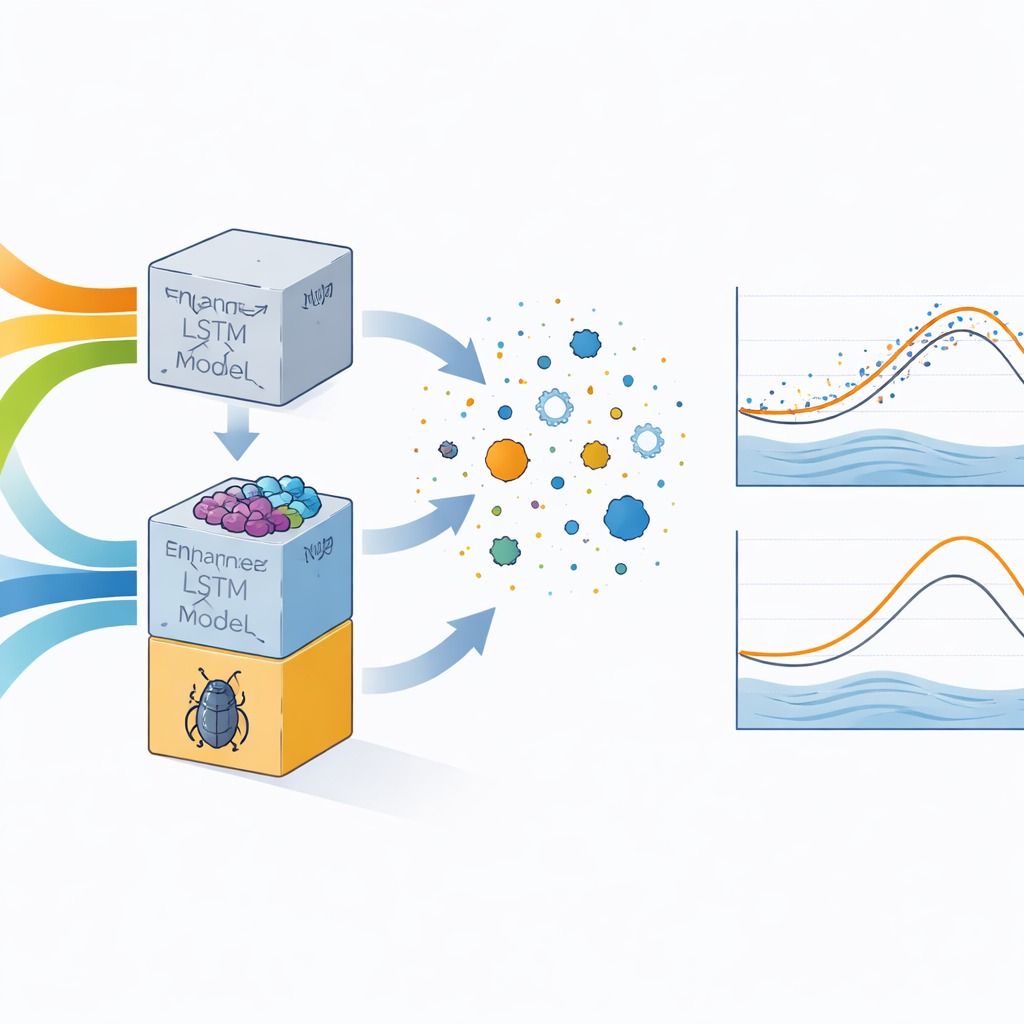
Testing the models in a monsoon‑shaped landscape
The team evaluates these methods using 40 years of data from two meteorological stations in southeast China, a monsoon region of lakes, rice paddies, and frequent floods and droughts. They deliberately mimic real‑world constraints by testing several data‑splitting strategies, where between 70 and 80 percent of the record is used for training and the rest for testing. They also explore different input combinations—temperature alone or temperature plus radiation—to see how little information the models can work with while still performing well. Performance is judged using common statistical measures of error and goodness of fit, and by visual checks such as scatterplots, Taylor diagrams, and violin plots that compare observed and predicted evaporation patterns.
Sharper forecasts from nature‑inspired tuning
Across both stations and all data‑splitting schemes, the APO‑ and DBO‑enhanced networks consistently beat the standard LSTM and earlier hybrids that used more established optimizers. In the best case for the first station, the LSTM‑APO model cut key error measures by nearly half and greatly tightened the match between observed and predicted evaporation. At the second station, it again reduced errors by about 40 percent and increased measures of predictive skill. LSTM‑DBO also achieved substantial improvements—typically cutting errors by 20 to 30 percent—while producing more stable predictions from one test configuration to another. An important practical finding is that more inputs are not always better: in many cases, simple combinations of minimum and maximum temperature outperformed models that also used idealized radiation, underscoring that carefully chosen, widely available variables can be enough when paired with a well‑tuned deep network.
What this means for managing water in a changing world
For non‑specialists, the takeaway is straightforward: by combining a time‑aware neural network with clever, biologically inspired search routines, it is possible to forecast how quickly water will evaporate from open surfaces using only a small amount of climate information. The LSTM‑APO and LSTM‑DBO models do not change the physics of evaporation, but they learn its typical behavior in a given region more accurately than earlier tools, even when data are limited. This can support better decisions about reservoir operation, irrigation planning, and drought preparedness in data‑poor regions. The authors suggest that future work should test these hybrids in real‑time settings and across a wider range of climates, and should add more weather details such as wind and humidity. Still, the current results already show that “protozoa” and “dung beetles” in code can help safeguard very real water supplies on the ground.
Citation: Kisi, O., Adnan, R.M., Zounemat-Kermani, M. et al. Metaheuristic-enhanced deep learning for monthly pan evaporation prediction under limited climatic data. Sci Rep 16, 14039 (2026). https://doi.org/10.1038/s41598-026-51071-3
Keywords: pan evaporation, deep learning, metaheuristic optimization, water resources, climate data