Clear Sky Science · en
Temporal kinetics of brain state effects on visual perception
Why drifting attention matters for seeing the world
Everyone's mind drifts: one moment you're focused on a screen, the next you're thinking about dinner. We usually assume that when attention wanders, the brain simply stops taking in as much information from the outside world. This study asked a more precise question: when we zone out, do we actually see less, or do we mostly just react more slowly? Using sensitive brain recordings, the researchers tracked how quick shifts between "on task" and "off task" states affect what we consciously perceive.
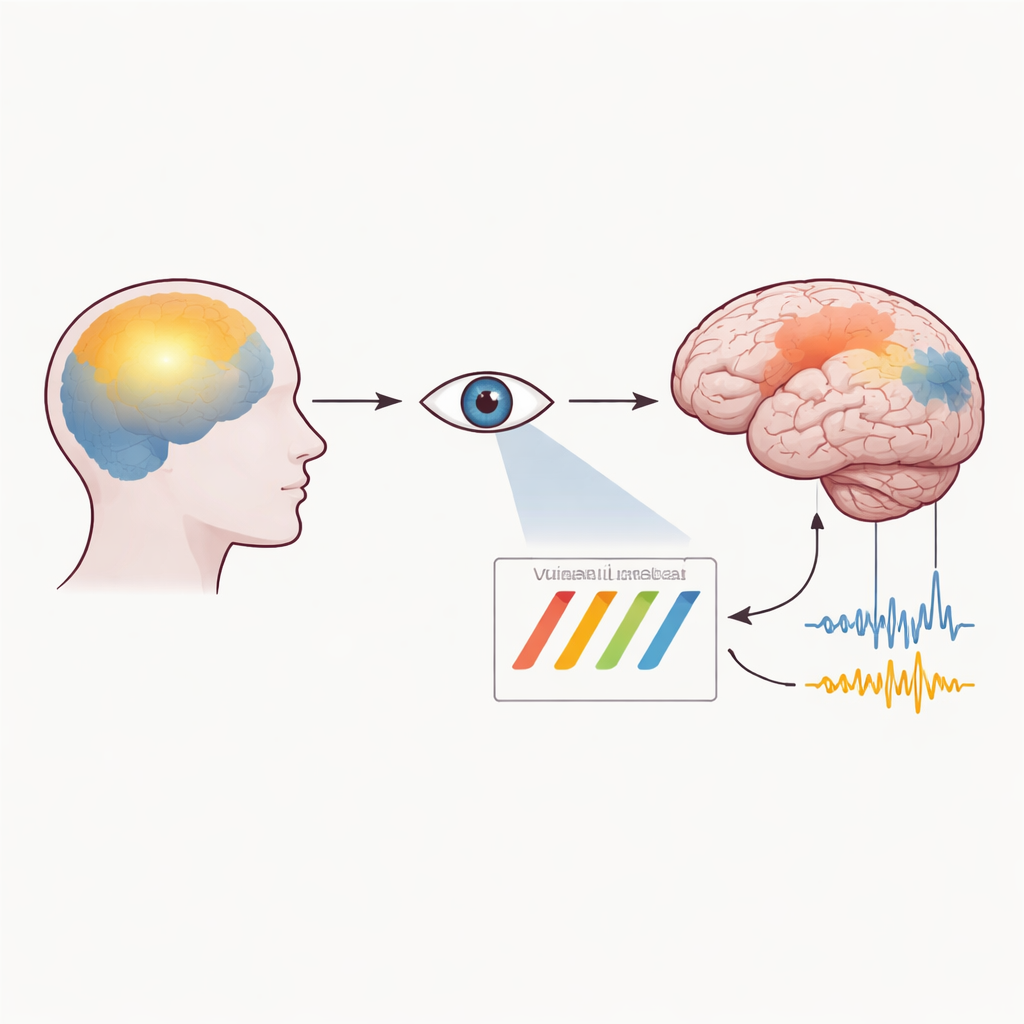
Two everyday brain modes: on task and off task
The team focused on two broad brain modes during wakefulness. In the "ON" state, people are alert and engaged with the task in front of them. In the "OFF" state, attention turns inward to memories, plans, or daydreams—a familiar experience often described as mind wandering. Volunteers performed demanding visual tasks while their brain activity was recorded with magnetoencephalography (MEG) and electroencephalography (EEG), techniques that detect tiny magnetic and electrical signals from the brain. After some trials, the participants reported how focused they had been, allowing the researchers to label moments as more ON or more OFF and train a computer classifier to recognize these states from brain activity alone.
Tracking fast flips in attention
One striking result is how quickly the brain flips between these states. By decoding ON and OFF patterns from rhythmic "theta" activity in the MEG signals, the researchers found that people could drift from focused to unfocused in as little as about two seconds. After a "thought probe"—a brief question asking where their mind had been—participants temporarily snapped back to an ON state. But within a few trials, the probability of being OFF crept up again, revealing a slow, almost wave-like drift toward inattention even when people tried to stay on task. This shows that our internal state is not stable from trial to trial, but continuously sliding along a spectrum of focus.
Seeing just as well, but reacting more slowly
The next question was whether these rapid brain state changes actually altered what people could see. In the first experiment, participants judged the tilt of a colored grating among distractors. Surprisingly, their ability to tell left from right tilt—especially for clearly visible, "suprathreshold" targets—was almost the same in ON and OFF states. What changed instead was timing: when OFF, participants responded more slowly and with more variability, even though their accuracy stayed high for easy-to-see targets. A second experiment with a simpler arrow-detection task showed the same pattern: reaction times were longest and most inconsistent when people were OFF, while overall accuracy remained very high across states. Mind wandering, in other words, delays decisions more than it erases the sensory evidence.
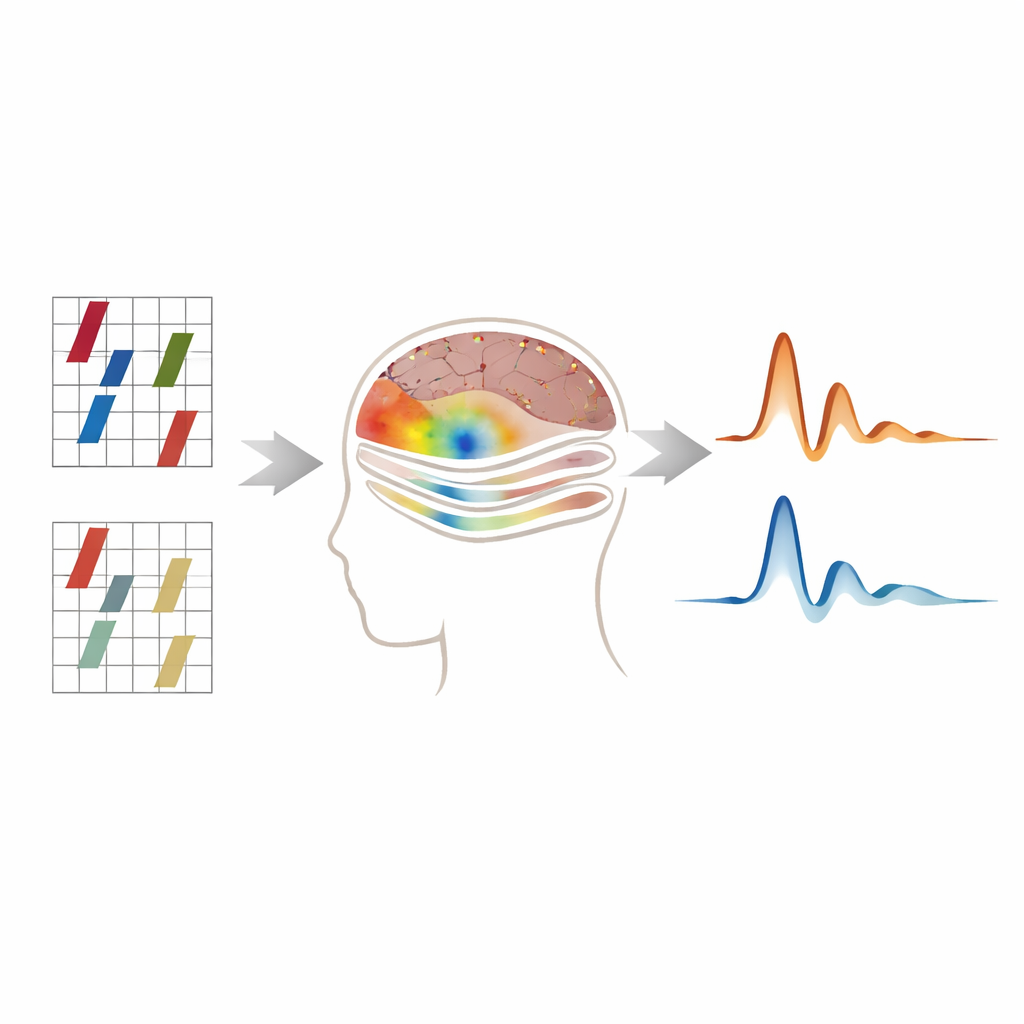
How the brain's fast signals carry visual detail
To probe what happens inside the visual system, the authors examined "broadband high-frequency activity" (BHA), a fast signal in the 80–150 Hz range that reflects local bursts of neural activity. In visual brain regions, BHA reliably tracked how strongly a target was tilted: larger tilts produced stronger BHA, forming a smooth, graded curve. During OFF states, BHA responses were weaker overall, yet still clearly distinguished between small and large tilts. This means that even when our attention drifts, the brain continues to encode fine-grained details about what we see. In a second experiment, the team compared BHA with an earlier visual response called the C1 component, which peaks around 70 milliseconds and reflects the first wave of input to primary visual cortex. They found that BHA peaked later than C1 and lasted longer, and only BHA—not C1—varied with attentional state. This timing suggests that BHA reflects not just raw input but also later feedback and state-dependent processing.
What this means for everyday perception
Put simply, this work shows that when your mind wanders, your eyes and early visual brain areas still capture the scene in front of you with impressive fidelity. What changes is how quickly and consistently you turn that information into a response. The fast, high-frequency signals that mark rich visual processing shrink during inattention but continue to carry usable sensory details, while the earliest visual response remains largely unchanged. The result is a more nuanced picture of mind wandering: rather than switching perception on or off, changing brain states reshape the timing and strength of communication within the visual system, allowing us to keep seeing the world even when our thoughts are somewhere else.
Citation: Schmid, P., Klein, T., Minakowski, P. et al. Temporal kinetics of brain state effects on visual perception. Sci Rep 16, 14689 (2026). https://doi.org/10.1038/s41598-026-50974-5
Keywords: mind wandering, visual perception, attention, brain rhythms, MEG EEG