Clear Sky Science · en
Comparing machine learning and deep learning approaches to predicting the seismic response of slab-column connections
Why safer floors in earthquakes matter
Many city buildings rely on flat concrete floors that rest directly on columns, without deep supporting beams. During an earthquake, the joints where slabs and columns meet can fail suddenly, causing floors to drop and buildings to partially collapse. This study explores how modern data driven tools can help engineers better predict how these critical joints behave in strong shaking, so that buildings can be designed or checked with greater confidence.
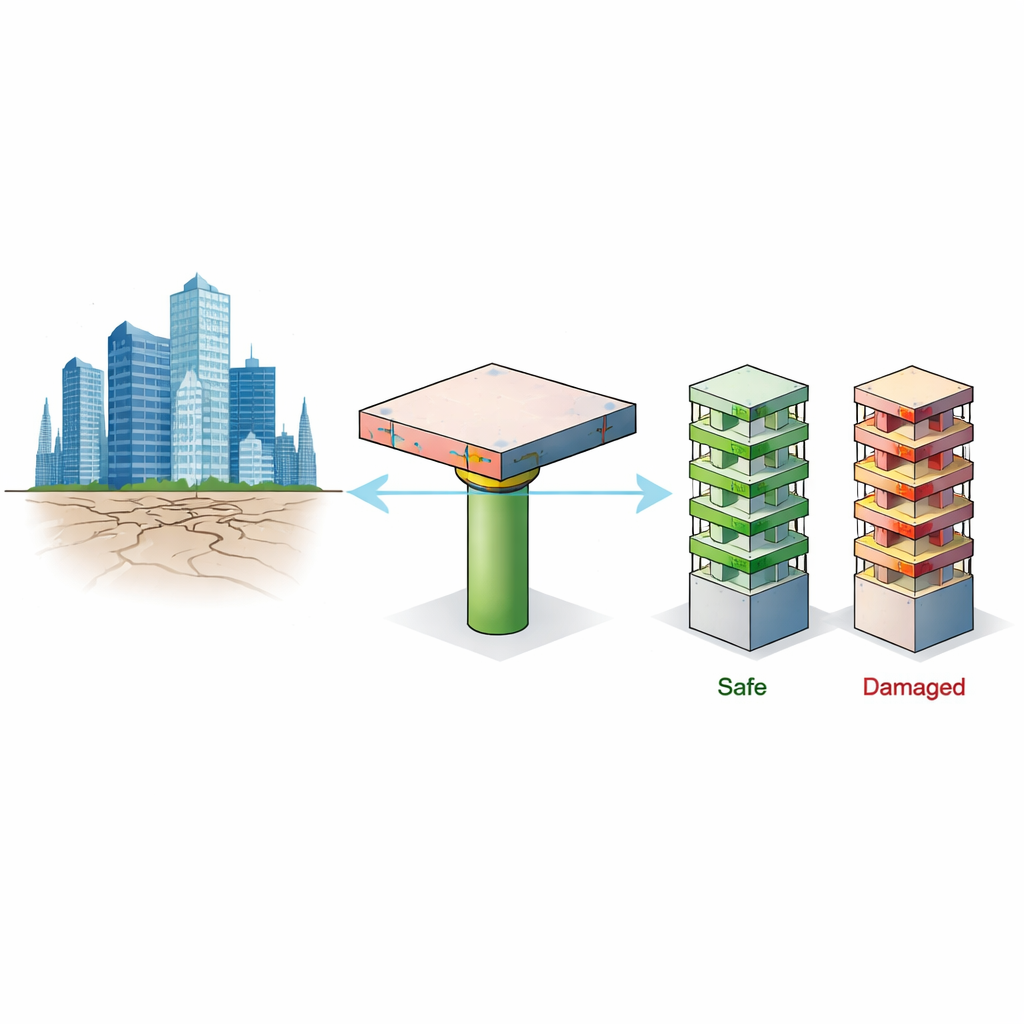
How building joints can suddenly fail
In flat slab buildings, the column must transfer both vertical weight and sideways earthquake forces into the floor slab. If the stresses concentrate too much around the column, the slab can punch through around the column like a stamp through paper. This brittle failure leaves little warning and can trigger progressive collapse. At the same time, the whole building sways, described by a measure called the drift ratio, which tells engineers how far the structure leans compared with its height. Both the local punching moment at the joint and the overall drift are controlled by many factors, including slab thickness, column size, amount of steel reinforcement, concrete strength, and the pattern of earthquake loading.
Using past tests and computers as learning tools
The authors assembled a database of 217 carefully documented laboratory tests on slab column connections under simulated earthquake loading. Each test included geometric dimensions, material strengths, reinforcement details, applied gravity load, loading type, and the measured punching moment and drift ratio at failure. They then split this information into separate training and testing sets, so that computer models would be judged on their ability to predict results they had not seen before. Before modeling, the team cleaned the data, handled missing values, scaled numeric ranges, and examined how each variable related to failure using visual tools such as boxplots and scatter plots.
Comparing many ways of letting computers learn
To find out which techniques work best, the study compared a wide range of machine learning methods against several deep learning approaches. The machine learning group included simple linear formulas, regularized versions that try to avoid overfitting, and more flexible tree based ensembles such as random forest, gradient boosting, and XGBoost. The deep learning group used neural network architectures more often seen in image or sequence analysis, including convolutional networks, recurrent networks, long short term memory networks, and a hybrid model that combined convolutional and recurrent layers. Unlike image problems, here these deep networks were fed structured tables of engineering numbers reshaped into one dimensional sequences.
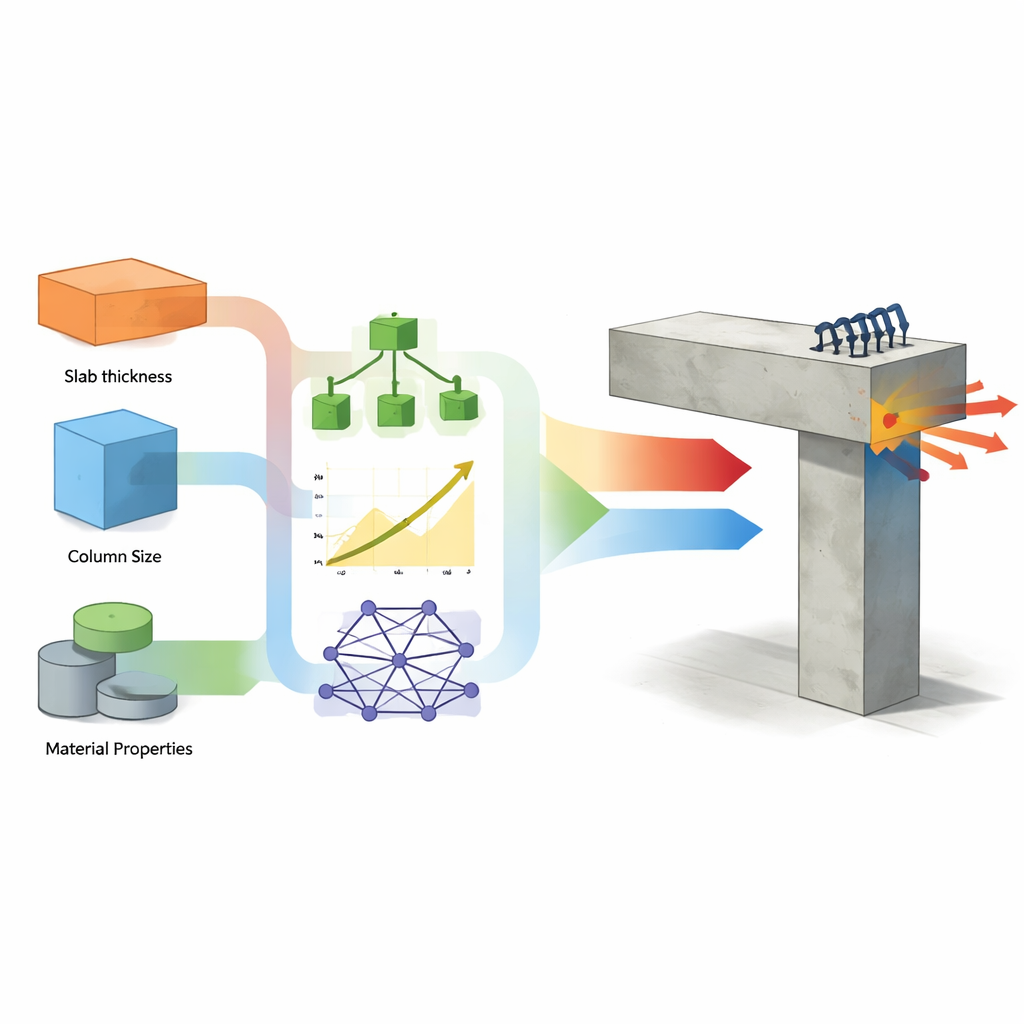
What the models revealed about strength and drift
For predicting punching moment at the slab column joint, the best performers were machine learning models built from many decision trees. Gradient boosting achieved the highest accuracy on unseen tests, closely followed by XGBoost and random forest. These models captured the complex, nonlinear mix of geometry, materials, and loading that governs local joint strength. For predicting drift ratio, which reflects how the whole system sways, random forest came out ahead of other approaches, although all models found this task harder and produced more scatter. Deep learning models, especially the hybrid type, did not surpass the tree based methods on this relatively small, tabular dataset and required far more computational effort.
What this means for safer building design
To a non specialist, the key message is that carefully chosen machine learning tools can already give engineers more accurate estimates of how and when slab column joints might fail in earthquakes, especially for the local punching strength and, to a lesser extent, overall drift. In this study, traditional tree based machine learning outperformed more fashionable deep learning networks for the available data, offering better accuracy with less complexity. The authors recommend using such models as decision support alongside existing design rules, rather than replacing engineering judgment. With larger datasets and refined features, these data driven methods could become a practical part of routine seismic assessment of flat slab buildings.
Citation: El-Mandouh, M.A., Youssef, H., Elborlsy, M.S. et al. Comparing machine learning and deep learning approaches to predicting the seismic response of slab-column connections. Sci Rep 16, 14718 (2026). https://doi.org/10.1038/s41598-026-50962-9
Keywords: seismic design, flat slab buildings, machine learning, punching shear, drift ratio