Clear Sky Science · en
Federated learning with swarm intelligence for efficient and secure medical image analysis
Why safer shared learning matters for medicine
Modern hospitals collect huge numbers of scans, from chest X-rays to breast images, but strict privacy rules make it hard to combine this knowledge. This paper shows how hospitals can train powerful artificial intelligence on medical images together without ever sharing patient data. It also describes a way to make that shared learning faster, more accurate, and more resistant to hacking by borrowing ideas from how flocks of birds and swarms of insects move.

How hospitals can learn together without sharing data
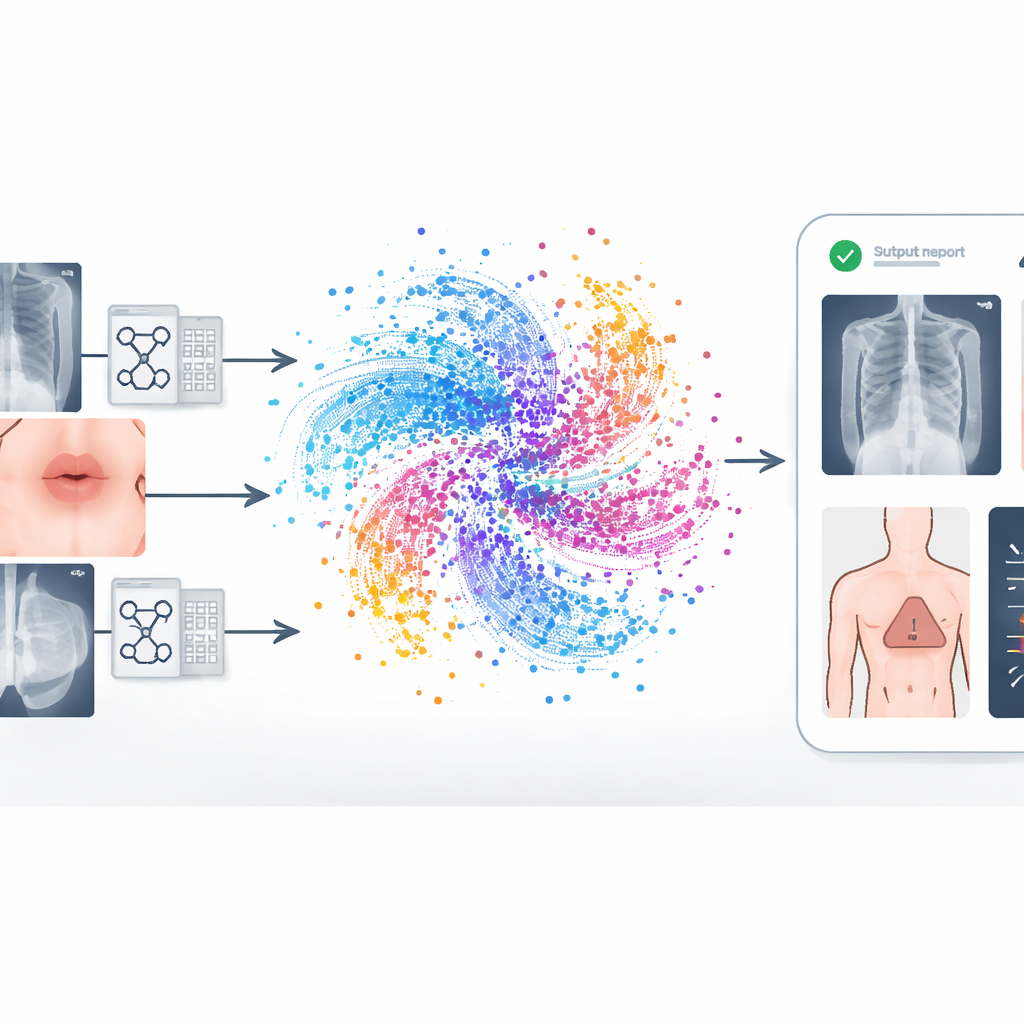
The study builds on a concept called federated learning, where each clinic or hospital trains its own copy of an AI model on local images, then sends only the model’s numerical updates to a central server. The server averages these updates into a stronger global model and sends it back, while raw images never leave the hospital. In this work, four simulated healthcare centers cooperated on three kinds of images: chest X-rays related to COVID-19, skin photos that may show monkeypox, and mammograms for breast cancer screening. This setup aims to mirror real life, where different hospitals see different patient groups and cannot simply pool their records.
Letting digital swarms tune the learning process
A key challenge in federated learning is picking the right model settings and deciding which parts of the image data are most useful. Instead of hand-tuning these choices, the authors use "swarm intelligence" inspired by animal groups. They combine two search strategies: Particle Swarm Optimization, which mimics birds following both their own best experience and the flock’s, and the Firefly Algorithm, where brighter solutions attract others. Inside each hospital, these swarms help choose which image features to keep and how to set learning knobs like step size and model depth. At the central server, similar ideas adjust how much weight to give to each hospital’s contribution, depending on data quality and performance.
Testing on COVID-19, monkeypox, and breast cancer scans
To see if this blended approach works in practice, the team trained deep convolutional neural networks on three public datasets. After using data augmentation to expand the number of training images, they measured success with standard scores such as accuracy, precision, and recall. Their best setups reached about 96.7% accuracy for COVID-19 chest X-rays, 96.1% for monkeypox skin images, and 97.0% for breast cancer mammograms. Compared with simpler federated setups, the swarm-guided system improved accuracy by several percentage points while also cutting the number of communication rounds between hospitals and the server by roughly a quarter.
Keeping privacy, security, and realism in balance
Because patient data are so sensitive, the framework layers privacy and security safeguards on top of the basic federated design. It uses encryption for all transmissions and a formal method called differential privacy, which adds carefully controlled noise to the shared updates so that individual patients cannot be traced. The authors analyze how this affects performance and show that, even under strong privacy settings, accuracy stays above 94% across tasks. They also study how well the system holds up under noisy images, simulated cyberattacks, and delays in network links, and find that performance degrades only modestly. Tests on outside datasets collected in different places suggest that the learned models can generalize beyond the original training sources.
What this means for future medical care
In plain terms, the paper shows that it is possible for many healthcare providers to pool the "knowledge" in their medical images without pooling the images themselves. By adding swarm-inspired tuning on top of federated learning, hospitals can get more accurate AI help for spotting COVID-19, monkeypox, and breast cancer, while using less network traffic and keeping within privacy laws. The authors argue that this kind of approach could make advanced diagnostic tools available even in smaller or remote clinics, helping doctors catch disease earlier without putting patient confidentiality at risk.
Citation: SayedElahl, M.A., Farouk, R.M., Ali, A.E. et al. Federated learning with swarm intelligence for efficient and secure medical image analysis. Sci Rep 16, 14734 (2026). https://doi.org/10.1038/s41598-026-50882-8
Keywords: federated learning, medical imaging, swarm intelligence, privacy preserving AI, healthcare AI