Clear Sky Science · en
Automated low-cost framework for crack measurements in RC structures using deep learning approach
Why tiny cracks in big structures matter
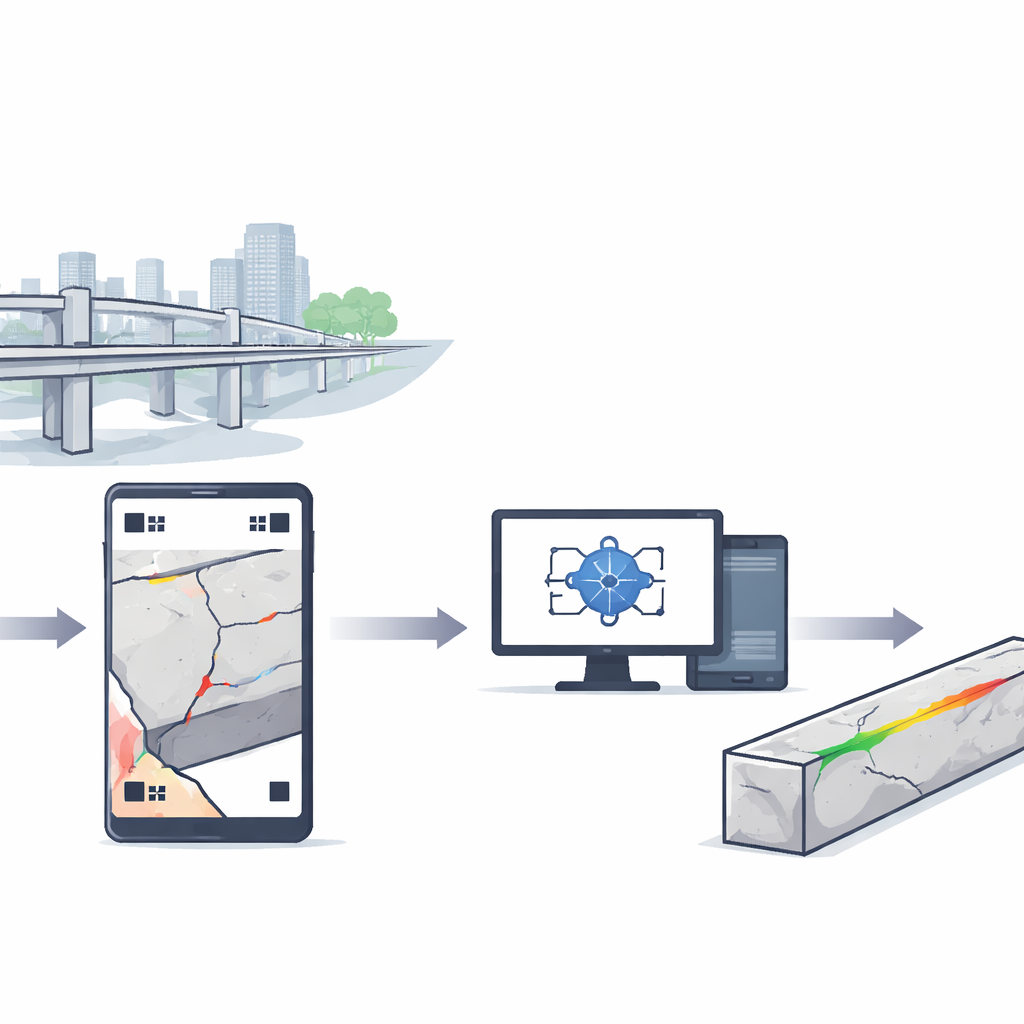
From highway bridges to apartment towers, many of the concrete structures we rely on every day slowly develop hairline cracks. These tiny openings can let in water and salt that eat away at the steel hidden inside, shortening a structure’s safe life. Inspecting and measuring these cracks has traditionally meant slow, hands-on work by specialists with magnifiers and gauges. This paper introduces a way to turn an ordinary smartphone into a low-cost inspection tool that can automatically spot cracks on concrete surfaces and estimate how wide they are, helping engineers decide when repairs are truly needed.
From slow manual checks to smart images
Engineers have long known that crack size and location are key clues to how much damage a concrete structure has suffered and how much life it has left. But manual crack measurements are time-consuming, depend on the inspector’s skill, and can be inconsistent from one visit to the next. Researchers have experimented with cameras, lasers, and even drones to automate the process, but many of these systems are expensive, tricky to set up, or hard to deploy in tight or indoor spaces. The authors of this study set out to design a practical alternative that works with widely available smartphones and simple printed patterns, keeping costs low while still delivering measurements accurate enough for real-world decisions.
Teaching a computer to see cracks
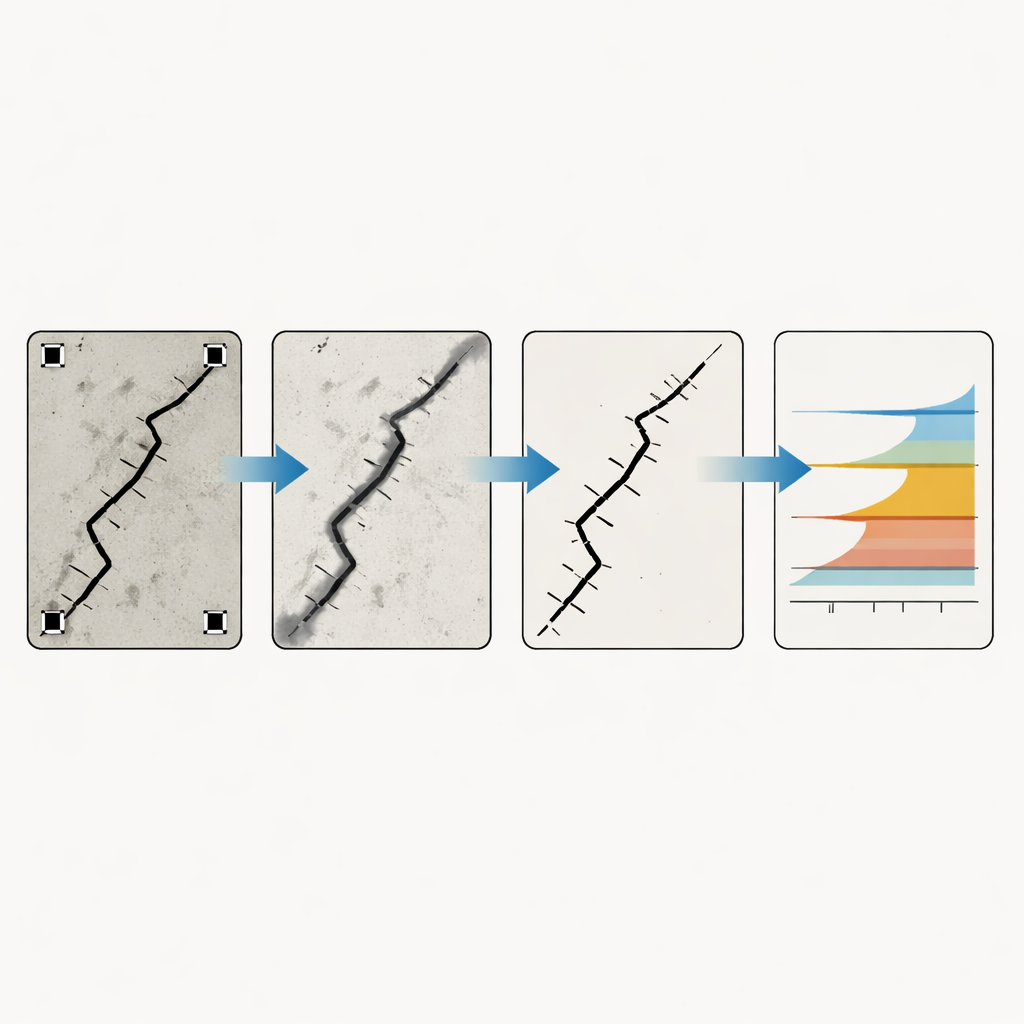
At the heart of the new framework is a modern image-recognition system based on a deep learning model called YOLO-V11. The team trained this model with thousands of photographs of cracked concrete surfaces so that it could distinguish true cracks from shadows, stains, and markings. To make the system robust in messy real environments, they deliberately added artificial colored lines onto training images, forcing the model to learn the subtle visual differences between a painted line and an actual break in the concrete. They also enhanced image contrast and sharpness during training. These steps significantly improved the model’s ability to find cracks and trace their edges, even when lighting is uneven or the surface is rough.
Turning pictures into real measurements
Detecting a crack is only half the job; engineers need its real width in millimeters, not just in pixels on a screen. To bridge that gap, the researchers used four small checkerboard patterns taped around the area being photographed. Because the size of each square on the checkerboard is known, the software can correct for camera tilt and lens distortion, then compute how many millimeters correspond to each pixel in the image. The crack region is analyzed in overlapping tiles so that very fine details are captured, then the software finds a thin “skeleton” down the center of each crack and measures the distance to the crack’s edges along this line. Combining these steps produces a map of crack widths across the inspected area.
How well it works in the real world
To test their approach, the team gathered 230 crack measurements from both lab specimens and existing concrete buildings, using a high-resolution digital microscope as the reference. They then took smartphone photos at about one meter distance, ran them through their framework, and compared the predicted crack widths with the manual readings. On average, the automated system’s error was about one eighth of the true width, with typical differences of only a few hundredths of a millimeter. It performed especially well for cracks wider than half a millimeter, where the variation between predicted and actual widths was small. For extremely thin cracks, the uncertainty was higher, suggesting that closer photos or higher-resolution cameras would further improve accuracy.
What this means for everyday safety
The study shows that a carefully designed combination of smartphone photography, simple printed patterns, and advanced image analysis can provide reliable crack measurements without expensive gear or highly specialized operators. The system tends to slightly overestimate crack widths, which is a conservative and safer bias when evaluating structural health. With future improvements—such as using built-in depth sensors on newer phones instead of physical checkerboards—the method could make routine, low-cost health checks of concrete buildings, bridges, and other structures much more accessible, helping owners spot problems earlier and prioritize repairs where they matter most.
Citation: Hassouna, M., Marzouk, M. & Fathalla, E. Automated low-cost framework for crack measurements in RC structures using deep learning approach. Sci Rep 16, 14678 (2026). https://doi.org/10.1038/s41598-026-50880-w
Keywords: concrete cracks, structural health monitoring, deep learning inspection, smartphone-based measurement, infrastructure safety