Clear Sky Science · en
Stochastic optimization framework for microgrid energy management integrating electric vehicles, renewable sources, and storage
Why smarter local power matters
Across the world, more homes and cars are running on electricity from the sun and wind, while drivers plug in electric vehicles instead of filling up with gasoline. This cleaner future brings a challenge: solar panels and wind turbines do not always produce power when we need it most, and electric cars can create new rush hours on the power grid. This study explores how a local power network, called a microgrid, can juggle solar panels, wind turbines, battery storage, and electric car charging in a smarter way so that electricity stays reliable, costs less, and puts less strain on cables and transformers.
A neighborhood sized power network
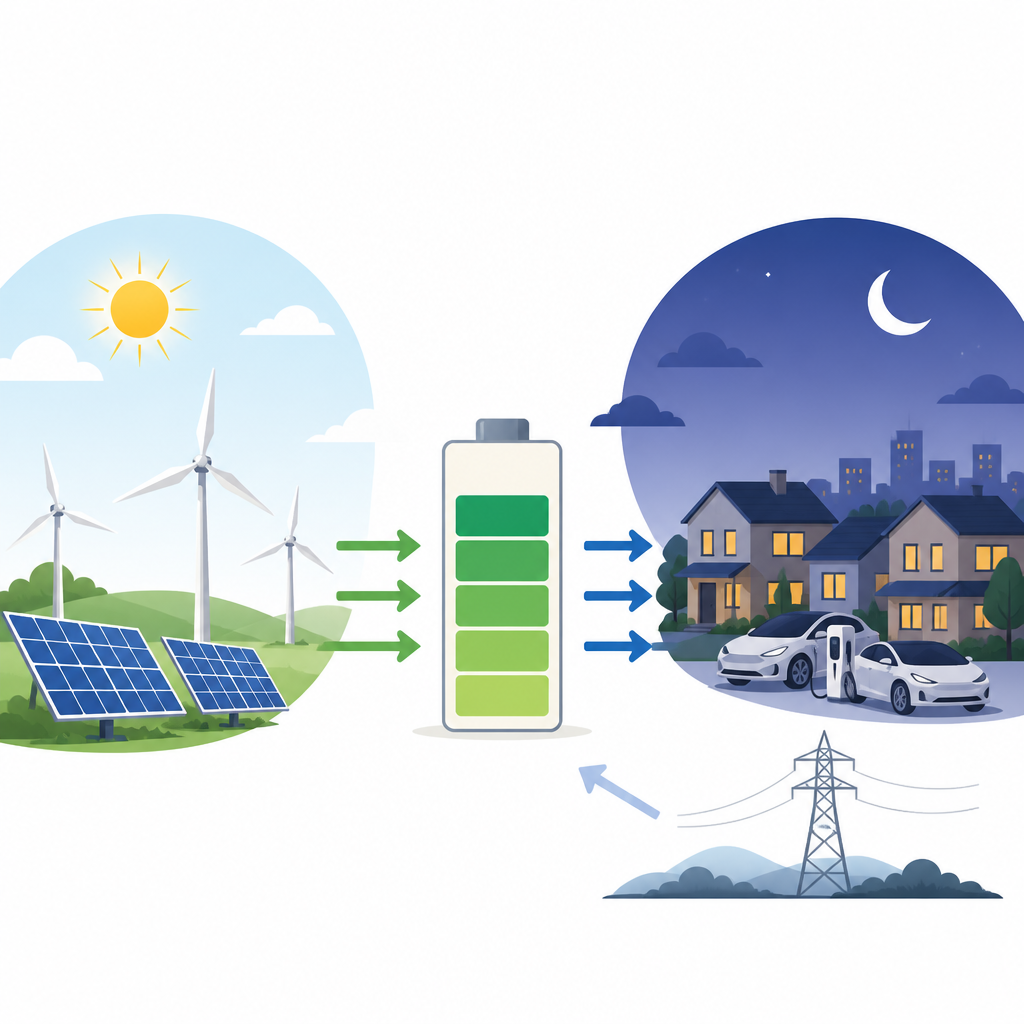
The researchers focus on a microgrid that represents a typical town sized distribution network. In this setup, several solar panel groups and wind turbines are spread across different connection points, while four charging stations serve electric vehicles throughout the day. A large stationary battery sits at a key node, able to charge when extra renewable energy is available or when grid prices are low, and discharge when demand is high. The microgrid is still linked to the main utility grid, but the goal is to use that connection more wisely so that local clean power and storage carry more of the load.

Planning for many possible futures
Weather, driving habits, and market prices all change from hour to hour, which makes it hard to plan power flows a day in advance. Rather than assume a single best guess, the study builds hundreds of possible daily patterns for sunshine, wind speed, electricity demand, and energy prices, based on years of recorded data. A roulette style selection process picks combinations of these patterns and assigns each one a likelihood, then a fast filtering step keeps only a small set that still captures the overall range of behavior. This trimmed set of futures feeds into a mathematical planner that decides, for every hour, how much power should come from the main grid, solar panels, wind turbines, the big battery, and the electric car chargers.
How the battery keeps the grid in balance
The planning tool treats the battery as more than a simple backup. It decides when to charge the battery, when to discharge it, and how deeply it should be cycled, while also counting the long term wear and replacement costs of the battery itself. By doing this, the system can soak up extra renewable power during low demand hours and return it to the grid during the evening peaks when people come home and plug in their cars. The study also respects basic safety rules: network voltages must stay within safe limits, line currents cannot exceed ratings, and the battery must begin and end the day with the same stored energy, ready for the next cycle.
What happens to costs and equipment stress
When the battery is switched off in the model, the microgrid leans heavily on the main grid during busy hours, causing high energy purchases, low bus voltages in distant parts of the network, larger power losses in the lines, and heavy loading of the main transformer. When the battery is included and carefully scheduled, the total daily operating cost falls by about one sixth, mainly because less expensive energy is drawn from the grid at the right times. The maximum loading of the transformer drops from roughly 3.7 to 3.0 megawatts, and voltages across all connection points remain within the recommended band. During the evening peak, stored energy cuts both losses and grid imports, illustrating how one well placed battery can ease stress on existing equipment.
How battery design choices affect the outcome
The authors also explore how battery settings influence the results. Limiting how deeply the battery is discharged each cycle lengthens its lifetime and reduces the need for replacements, even though it slightly reduces the usable energy per cycle. Higher charge and discharge efficiency means fewer losses inside the battery, which directly lowers operating costs. The study shows that by tuning the depth of discharge and aiming for higher efficiency, operators can cut daily costs even further while preserving the battery over more years of service.
Takeaway for clean and reliable power
For readers interested in cleaner energy and electric vehicles, the key message is that local smart planning can make a big difference. By using a detailed, uncertainty aware planning method, this microgrid keeps lights on, charges cars, and uses more solar and wind power, all while spending less money and putting less strain on transformers and cables. Rather than relying on a single forecast, the approach prepares the system for many possible days, leading to schedules that are both cheaper and more reliable. The work suggests that as neighborhoods add more rooftop panels and charging stations, pairing them with well managed battery storage and smart planning tools will be vital to keeping power both clean and dependable.
Citation: Ali, Z.M., Mostafa, M.H. Stochastic optimization framework for microgrid energy management integrating electric vehicles, renewable sources, and storage. Sci Rep 16, 15494 (2026). https://doi.org/10.1038/s41598-026-50822-6
Keywords: microgrid, battery storage, electric vehicle charging, renewable energy, energy management