Clear Sky Science · en
Rill erosion dynamics in smallholder farming systems of wet tropical Africa
Why small farm fields matter for food and soil
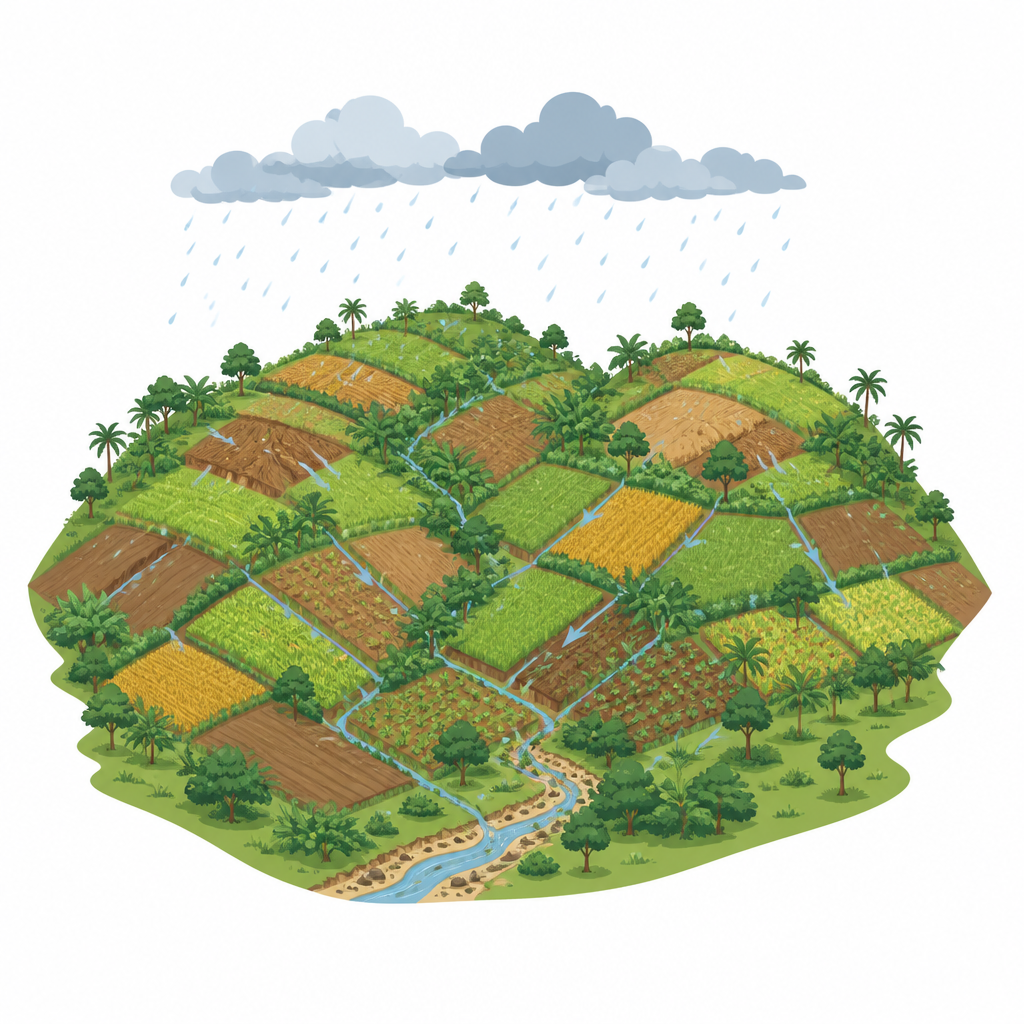
In the steep green highlands where the Nile and Congo rivers begin, millions of families grow food on tiny fields. These small plots feed local communities, but heavy tropical rain can wash away precious soil. This study looks closely at how soil is actually being lost from these small farms and asks a simple but vital question: do many small, uneven fields help protect soil, or do they make erosion worse?
Watching the land from above
To find out, researchers flew small camera drones over four farming areas in the border region of eastern Democratic Republic of the Congo and western Uganda. The landscape there is very hilly and hit by intense rainstorms several times each rainy season. Over two years, the team repeatedly photographed 833 individual fields, often twice a month. By stitching these photos into detailed maps, they could see where thin, narrow channels called rills had formed, showing where soil had been carved out and moved downslope.
How and where the soil is cut away
The scientists grouped each field into simple classes based on what they saw: fields with thick plant cover, fields with bare or nearly bare soil but no rills, and fields where rills cut through part or most of the land. They then compared these patterns with field slope, soil cover, and surface condition. The drones revealed that rill erosion was a regular feature of the rainy season, with new channels appearing after many storm periods. Yet only about one in five fields ever developed rills during the study, and most of those did so only once. Even neighboring fields that looked similar from above often behaved very differently under the same rain.
Patchy fields, broken flow
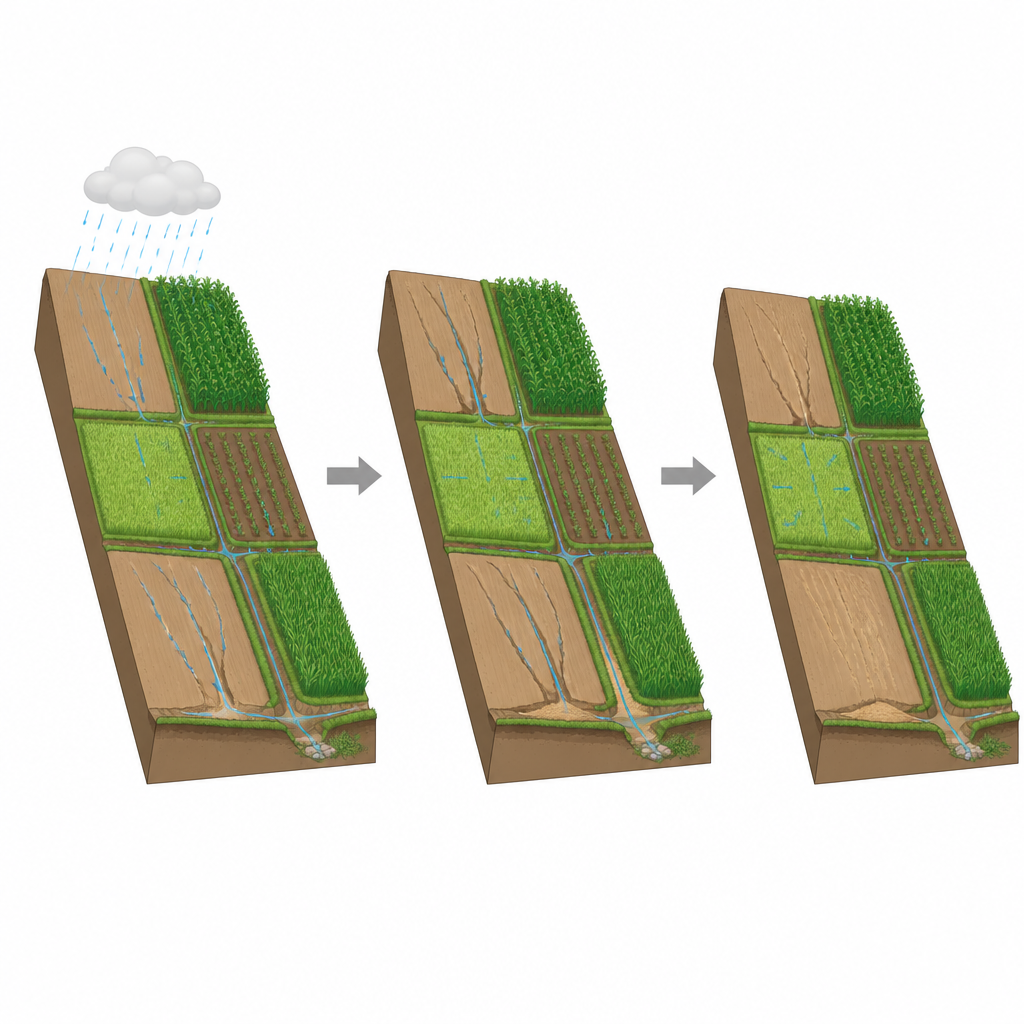
One striking finding was that rills rarely ran straight across several fields from the top to the bottom of the hill. Instead, they tended to start and stop within individual plots. Different crops, planting dates, fallows, and grass strips created a patchwork of rough, smooth, bare, and covered soil. This broken pattern interrupted water flow and forced much of the eroded soil to settle within or just below each field before it could reach streams. Steeper slopes did increase the chance of strong rill formation, especially on the very steep Ugandan site, but overall slope length across many fields turned out to matter less than how those fields were arranged and managed.
Why big models can misjudge the problem
Many existing studies of soil loss in tropical Africa use large computer models or small test plots. Those methods often assume long, smooth slopes and do not properly include the fine scale patchiness seen in real smallholder landscapes. As a result, they tend to count every steep hillside as fully connected from top to bottom, and they ignore how field borders, local ditches, and mixed crops break up water and sediment flow. By comparing their drone observations with these assumptions, the authors argue that common models are likely to overestimate how much soil is actually exported from hillsides dominated by small farms.
What this means for the future of farming
The study concludes that the maze of small fields, varied crops, and local drainage features in this region does more than just reflect limited resources; it also helps disrupt the downslope march of eroding soil. In other words, current smallholder systems partly protect themselves by breaking the hillside into many smaller units. Plans to modernise farming through larger, more uniform fields and heavier machinery could remove that hidden protection and sharply increase soil loss unless strong soil conservation measures are put in place. For communities balancing the urgent need for higher yields with long term soil health, this research highlights that how land is divided and managed can be as important as how steep it is.
Citation: Wilken, F., Fiener, P., Batista, P. et al. Rill erosion dynamics in smallholder farming systems of wet tropical Africa. Sci Rep 16, 15863 (2026). https://doi.org/10.1038/s41598-026-50821-7
Keywords: soil erosion, smallholder farming, tropical Africa, rill formation, UAV monitoring