Clear Sky Science · en
Environmental and sustainable valorization of spent adsorbent: safety and acute toxicity evaluation in rats via probit analysis
Why turning toxic waste into a safer resource matters
Heavy metals such as lead, mercury, and arsenic can quietly build up in our air, water, and food, harming the brain, heart, kidneys, and other organs even at low levels. Modern water treatment plants use special powdered materials to pull these metals out of dirty water. But once these powders are loaded with metals, they themselves become a kind of hazardous waste. This study asks a practical question with big implications: how safe are these metal filled powders if people or animals are exposed to them, and can they still be part of a greener waste management plan?
Cleaning dirty water with layered mineral sponges
The researchers focused on a family of materials called layered double hydroxides, which act like tiny stacks of mineral sheets. In this work, they built a version made from zinc, cobalt, and iron. These stacks offer a large internal surface where dissolved metal ions from wastewater can lodge themselves. In earlier work, the same team showed that their material can efficiently grab arsenic, lead, and mercury from water. Here, they first used tools such as infrared light, X ray diffraction, and electron microscopy to confirm that the mineral framework stays intact after it catches these metals, and that the metal ions are truly attached to or packed between the layers rather than just loosely stuck on the surface.
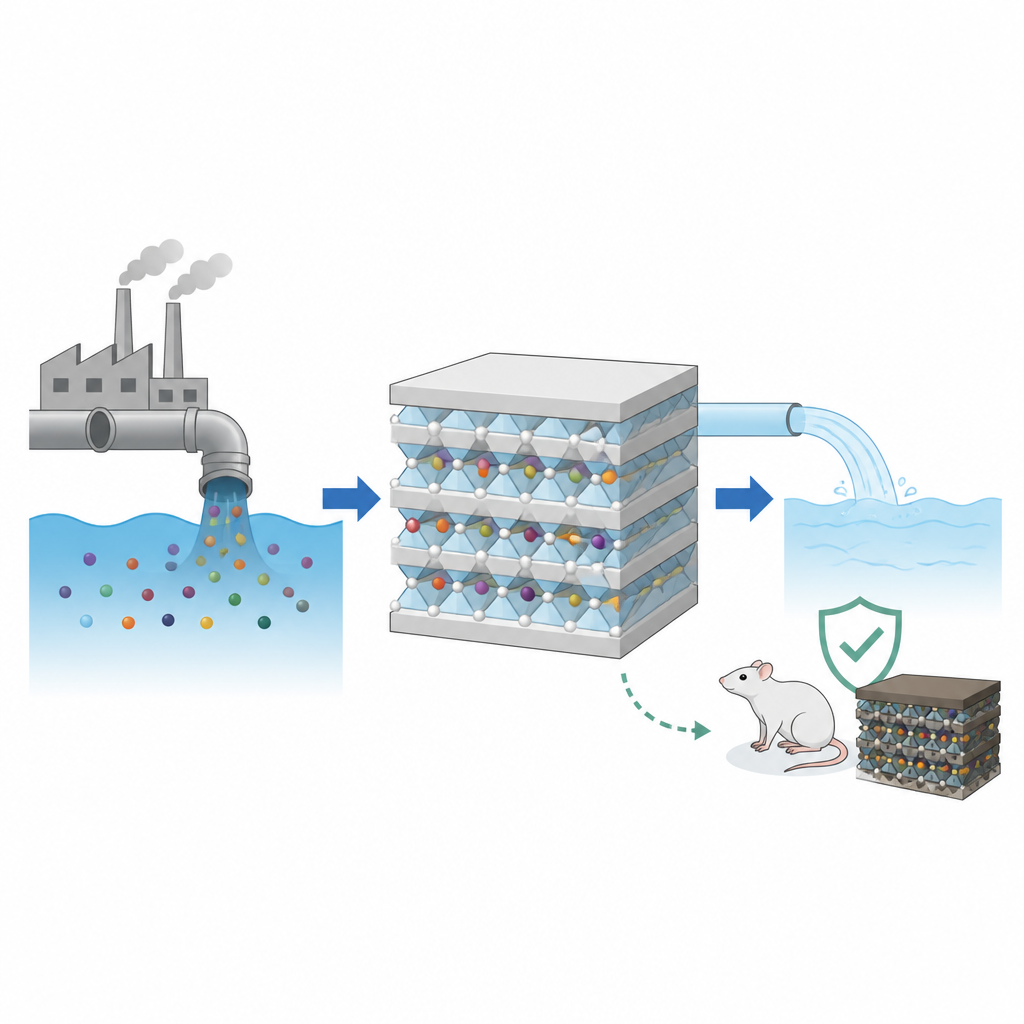
From water filters to living bodies
To find out what happens when these "spent" filters enter a living body, the team carried out controlled studies in rats. Groups of animals received single oral doses of the clean material and of the same material loaded separately with arsenic, lead, or mercury, at increasing dose levels. The animals were then watched closely over ten to fourteen days for changes in weight, behavior, breathing, and signs of illness or death. At the end of the study, the scientists examined blood chemistry, complete blood counts, and thin slices of organs such as liver, kidney, lung, heart, and stomach under the microscope to look for subtle injury.
Putting numbers on safety and risk
Instead of just counting how many animals survived at a given dose, the team used a standard statistical tool from toxicology called probit analysis to estimate the LD50, the dose that kills half of the animals, and other key thresholds. The clean layered material itself showed the widest margin of safety, with an LD50 of about 661 mg per kilogram of body weight. When it carried arsenic, the LD50 fell to 370 mg/kg, while mercury loading brought it down to 204 mg/kg. Lead loading was the most hazardous, with an LD50 near 104 mg/kg. Based on usual practice, the authors proposed that one twentieth of each LD50 could be considered a conservative "safe" working dose in future biomedical or handling scenarios, with the arsenic loaded material allowing a higher safe dose than the mercury or lead versions.
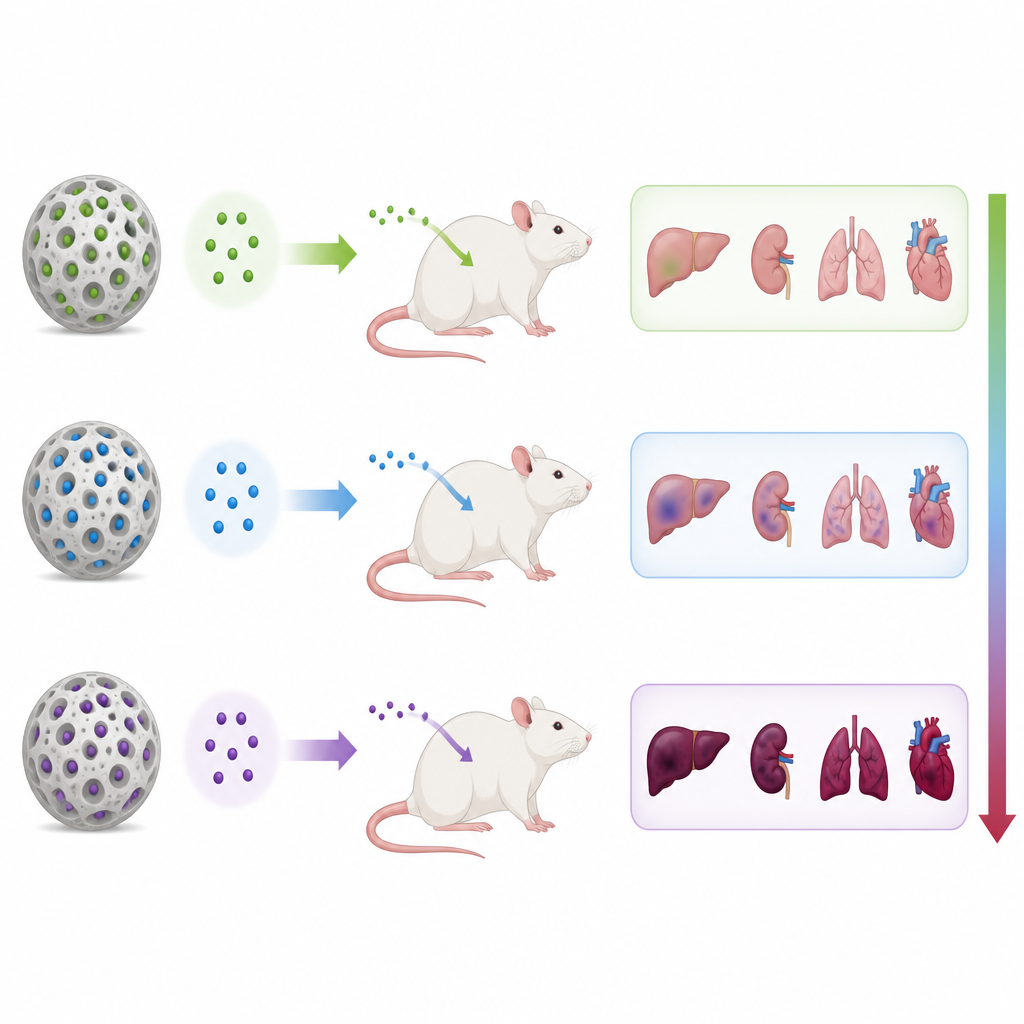
What the organs and blood revealed
Blood tests and tissue slides filled in the picture behind these numbers. For the clean material and the arsenic loaded form, liver and kidney function markers in blood stayed close to those of untreated animals, and organ structures appeared mostly normal, with only mild changes. In contrast, rats exposed to lead and mercury loaded powders showed stronger signs of strain. There were shifts in some white blood cell types that point to inflammation, higher liver enzyme activity that hints at stressed liver cells, and microscopic evidence of damage such as widened liver blood spaces, early scarring, and injured kidney tubules. These findings suggest that while the mineral framework holds on to metals to some extent, lead and mercury can still interact with sensitive tissues once inside the body.
What this means for safer waste handling
To a non specialist, the key message is that the same powder that helps clean water can itself be relatively safe or more risky depending on which metal it carries. The bare layered material and its arsenic loaded version appear to pose a lower acute danger, while versions loaded with lead and mercury need stricter control. By turning animal responses into clear dose numbers, this work offers practical safety benchmarks for factories and regulators deciding how to transport, reuse, or dispose of these spent filters. It moves the conversation from simply "Does this material remove pollution from water?" to "How can we design and manage it so that pollution does not return to harm people or the environment in another form?"
Citation: Aita, S.A., Mahmoud, R., El-Ela, F.I.A. et al. Environmental and sustainable valorization of spent adsorbent: safety and acute toxicity evaluation in rats via probit analysis. Sci Rep 16, 15333 (2026). https://doi.org/10.1038/s41598-026-50808-4
Keywords: heavy metals, wastewater treatment, nanomaterials, toxicology, layered double hydroxide