Clear Sky Science · en
Performance and environmental assessment of concrete made with treated industrial wastewater
Why turning waste water into building water matters
Concrete is everywhere in modern life, from homes and bridges to schools and hospitals. But making all that concrete uses huge amounts of clean drinking water at a time when many regions already struggle with water shortages. This study explores a simple idea with big potential: can carefully treated industrial wastewater safely replace fresh water in making concrete and mortar, without weakening buildings or harming the environment?
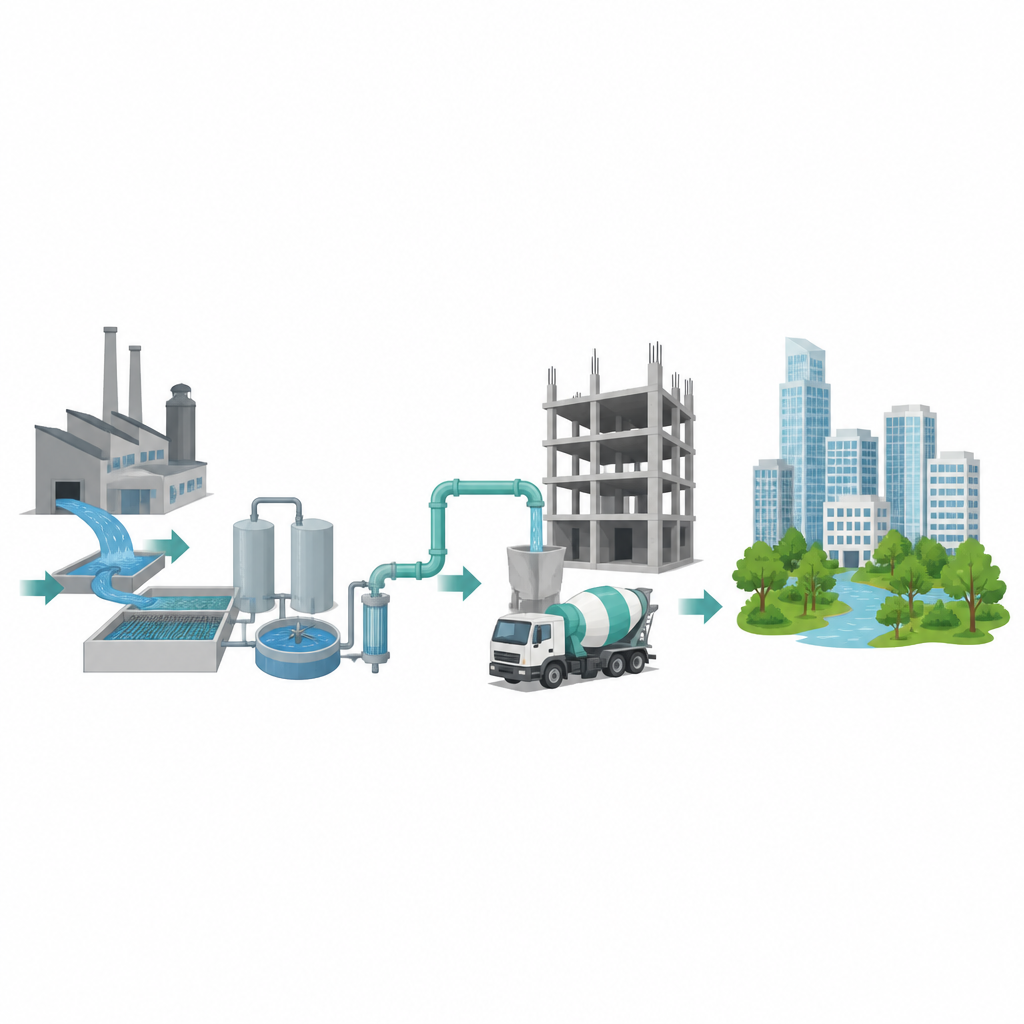
From factory drains to building sites
The researchers worked with two real types of treated industrial wastewater, one from a textile factory and one from a food processing plant. They also created laboratory water containing only known amounts of copper and zinc so they could study heavy metals on their own. First, they measured basic water quality, including salts, organic matter, and metal content, and compared the results to national and international limits for concrete mixing water. Most values were within allowed ranges, although the industrial waters carried more organic matter than drinking water.
How the concrete itself performed
The team then mixed three sets of concrete: one with normal drinking water and two with the treated factory waters. They tested how easy the fresh concrete was to handle, and how strong it became over days and months. Workability stayed almost the same. Compressive strength, which reflects how much squeezing force the material can carry, dropped by less than 10 percent when treated waters were used. Splitting tensile and flexural strengths, related to cracking and bending, fell by less than 5 percent. These small losses stayed within code limits and would not normally change how a structure is designed.
What happens inside the pores
Concrete durability depends strongly on how water and dissolved substances move through its tiny pores. In this study, concrete made with treated wastewater actually soaked up less water through capillary action, likely because organic compounds partly blocked some of the finest pores. At the same time, rapid chloride penetration tests showed slightly higher electrical charge passing through specimens made with textile wastewater, pointing to more ions moving in the pore solution. X-ray diffraction measurements confirmed modest changes in the internal crystal products of cement hydration, consistent with mild delays caused by impurities.
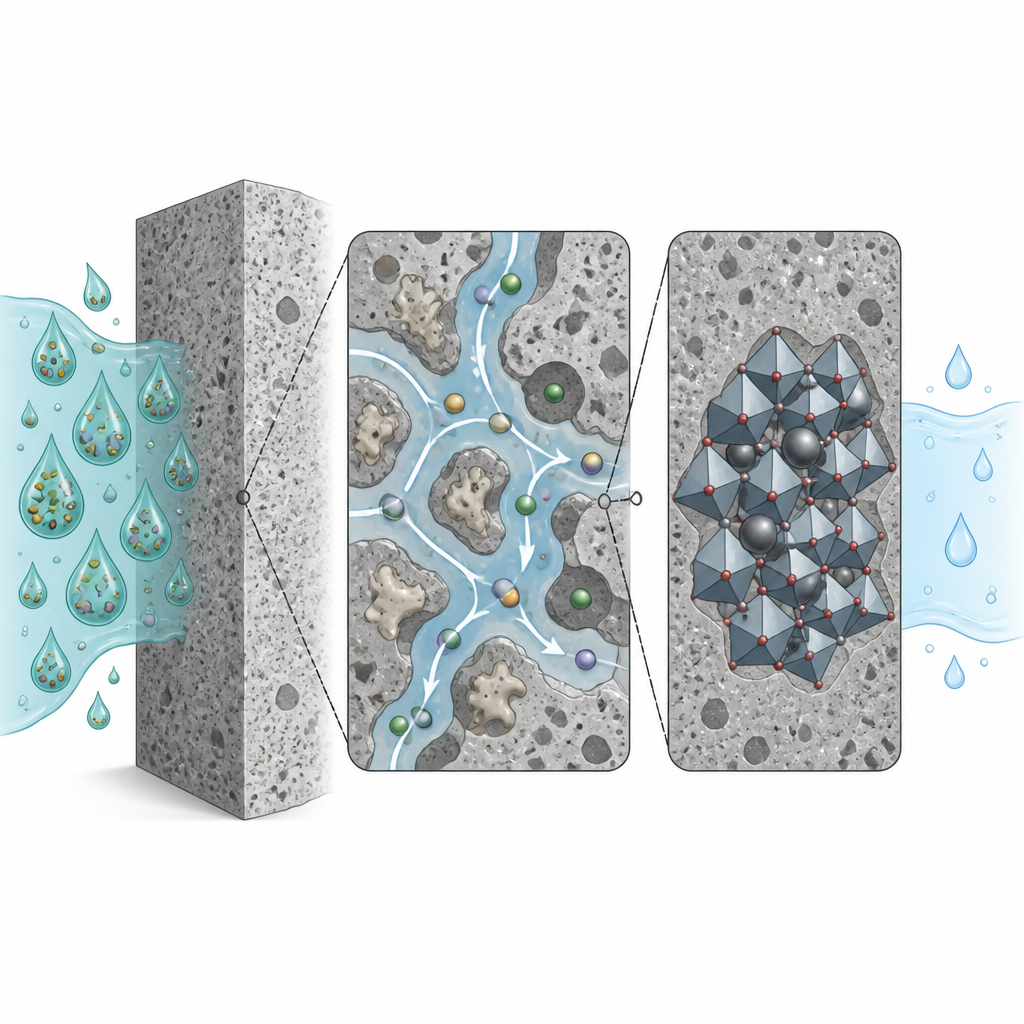
Checking safety for people and the environment
To see whether harmful metals might escape over time, the researchers made cement pastes and mortars using the synthetic copper and zinc solutions. They measured setting times and strength, and then ran accelerated leaching tests in which samples sat in water while any released metals were tracked over several days. When heavy metal levels stayed at or below 0.5 grams per liter, the mortar lost less than 10 percent of its strength and setting times still satisfied code limits. Above that threshold, strength dropped too far and setting delays became unacceptable. Even so, leaching tests showed that more than 94 percent of the zinc remained locked inside the cement matrix, with only a small fraction entering the surrounding water.
What this means for future building water
Put in everyday terms, this work shows that well treated industrial wastewater can replace drinking water in many concrete and mortar mixes with only small effects on strength and cracking behavior, while keeping heavy metals largely trapped inside the hardened material. As long as the water is tested regularly and metal levels are kept below clear limits, using it in structural concrete is both technically sound and environmentally safe. This approach can help construction projects save thousands of liters of valuable fresh water, easing pressure on scarce supplies while still delivering durable, reliable infrastructure.
Citation: Mohsen, S., Shamseldein, A., hany Wadie, E. et al. Performance and environmental assessment of concrete made with treated industrial wastewater. Sci Rep 16, 15062 (2026). https://doi.org/10.1038/s41598-026-50807-5
Keywords: treated industrial wastewater, concrete durability, heavy metal leaching, sustainable construction, water reuse