Clear Sky Science · en
Shear performance of slender reinforced concrete beams: an analysis of various international standards
Why long, thin beams matter in everyday buildings
From highway overpasses to open plan offices, many modern structures rely on long, thin concrete beams that carry heavy loads while using as little material as possible. These “slender” beams help create wide, column free spaces and lighter buildings, but their safety depends on how well they resist a sideways cutting action called shear. This article explores how different countries’ design rules treat the same problem, and what that means for safety, cost, and future construction. 
How different rule books see the same beam
The authors compare shear design rules for slender reinforced concrete beams across six major standards: Egyptian (ECP), American (ACI), European (Eurocode 2), Canadian (CSA), British (BS), and Japanese (JSCE). All of these codes split a beam’s shear strength into two parts: what the plain concrete can carry and what the steel stirrups add. Yet each code uses its own formulas, safety factors, and minimum steel limits. The study maps out these differences, highlighting how choices such as strength reduction factors, assumed crack patterns, and limits on maximum stress cause the same beam to be treated more cautiously in one country and more boldly in another.
What makes a beam slender or stocky
To a designer, a beam is “slender” when it is much longer than it is deep. Different codes define this slightly differently, but all agree that slender beams behave unlike short, stocky ones. In long beams, loads are spread out and shear is resisted mainly through bending action and the rough contact across cracks, while in short beams forces follow a more direct arch like path. The article contrasts slender and non slender beams, showing that slender members are more sensitive to buckling, deflection, and sudden shear cracking, and therefore require more careful detailing of reinforcement and stricter control of crack widths and deflections.
Testing the codes on example beams
To see how the rules diverge in practice, the researchers run detailed shear calculations for two example beams, one relatively deep and one slender. For each, they compute shear strength from concrete alone, from stirrups, and the total capacity according to every code. They also check required minimum stirrup area, maximum permitted shear, and safety margins. Some standards, such as ACI and JSCE, tend to predict higher capacities, which can reduce steel use but leave less reserve if conditions differ from assumptions. Others, notably Eurocode 2, give more conservative values, leading to heavier reinforcement but wider safety margins. 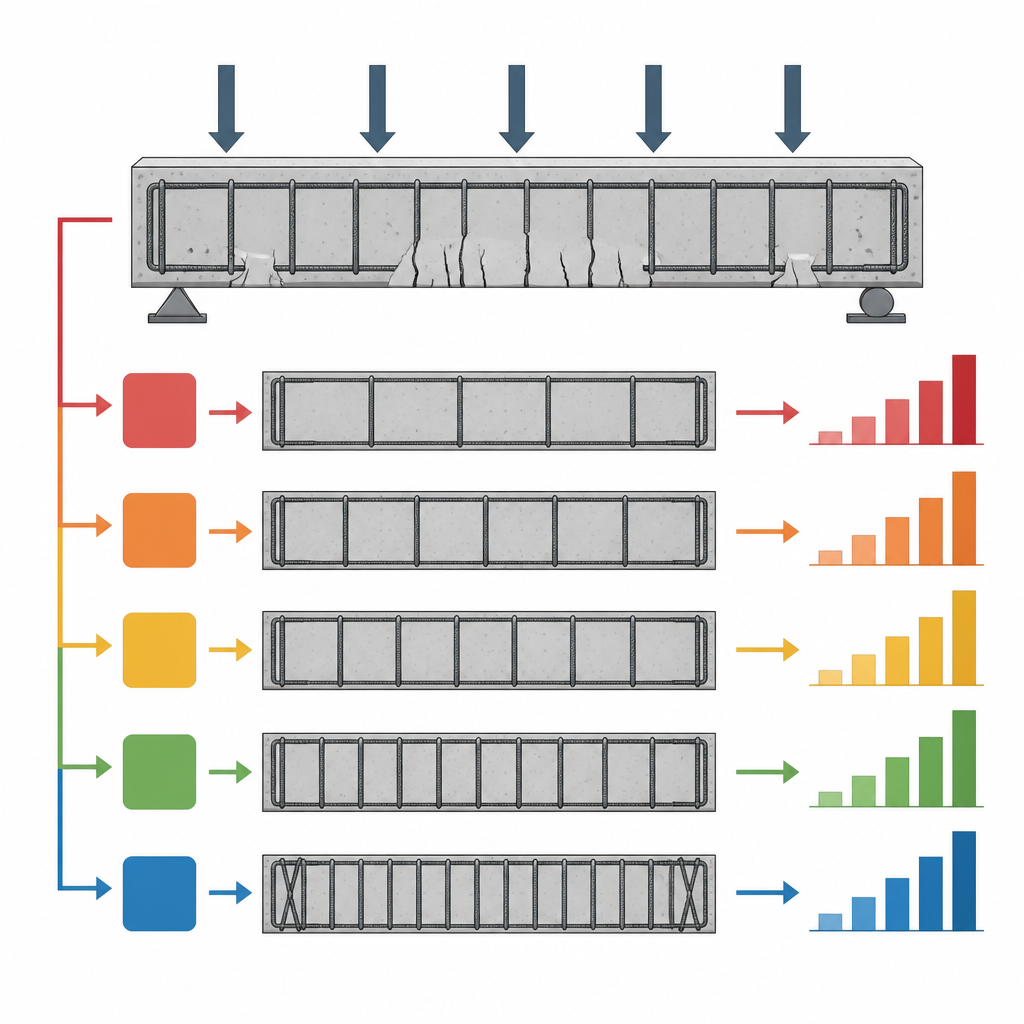
From calculations to a simple design shortcut
Beyond comparing existing rules, the study proposes a simple new equation that links the ultimate load of slender beams directly to their concrete strength, width, thickness, and the ratio of shear reinforcement. Using data from earlier laboratory tests on beams with different stirrup amounts, the authors fit a smooth curve that approximates how added stirrups raise the failure load. When checked against independent test results, the equation matches observed capacities reasonably well, suggesting it could serve as a quick tool to estimate how changes in stirrup ratio affect the strength of slender beams.
Why code differences matter for safety and cost
The comparisons reveal that predicted shear strength and safety margins can vary widely from one code to another, especially for slender beams, where the spread in results is largest. This means that two engineers designing the same beam under different standards could arrive at very different reinforcement layouts and construction costs. The authors argue that better alignment between codes, supported by new experiments and advanced computer models, would help ensure that slender concrete beams are designed both safely and economically worldwide. For non specialists, the key message is that the safety of long, thin concrete members does not rest on guesswork, but on carefully tested rules that are still being refined to keep pace with new materials and design needs.
Citation: Fayed, S., Basha, A. & Elnagar, A. Shear performance of slender reinforced concrete beams: an analysis of various international standards. Sci Rep 16, 15210 (2026). https://doi.org/10.1038/s41598-026-50769-8
Keywords: slender concrete beams, shear design codes, reinforced concrete, structural safety, shear reinforcement