Clear Sky Science · en
Integrating multivariate analysis and Air Pollution Tolerance Index (APTI) to evaluate four ornamental plants for sustainable indoor air phytoremediation
Plants as quiet helpers for cleaner indoor air
Many of us spend our days in closed rooms where invisible gases can slowly build up. In places like pharmaceutical laboratories, workers handle chemicals that release vapors linked to headaches, breathing problems, and long term health risks. This study asks a simple but important question: can common decorative houseplants quietly help protect people by scrubbing these pollutants from the air?

Hidden dangers in lab air
Inside pharmaceutical teaching labs, students and staff work with solvents that release volatile organic compounds, or VOCs. These include well known substances such as benzene and toluene that can damage health after long exposure. Along with these gases, indoor air often carries carbon monoxide, carbon dioxide, and fine dust particles small enough to reach deep into the lungs. Standard ventilation systems help, but they may not fully remove pollution close to where people breathe. Finding a low cost, low energy way to cut these levels is therefore attractive for schools, hospitals, and industry.
Putting four familiar plants to the test
The researchers chose four popular indoor plants that are easy to grow: Jade pothos (Epipremnum aureum), spider plant (Chlorophytum comosum), Syngonium podophyllum, and Cordyline fruticosa. They placed dozens of potted plants and green wall units in a real organic chemistry lab during normal student sessions. Sensitive instruments tracked levels of VOCs, carbon monoxide, carbon dioxide, and fine dust with and without plants present. At the same time, the team measured leaf traits such as chlorophyll (which reflects photosynthetic strength), water content, leaf surface pH, vitamin C levels, wax coating, and the number of tiny pores called stomata. These measurements were combined into an Air Pollution Tolerance Index that captures how well each plant copes with dirty air.
How plant features link to cleaning power
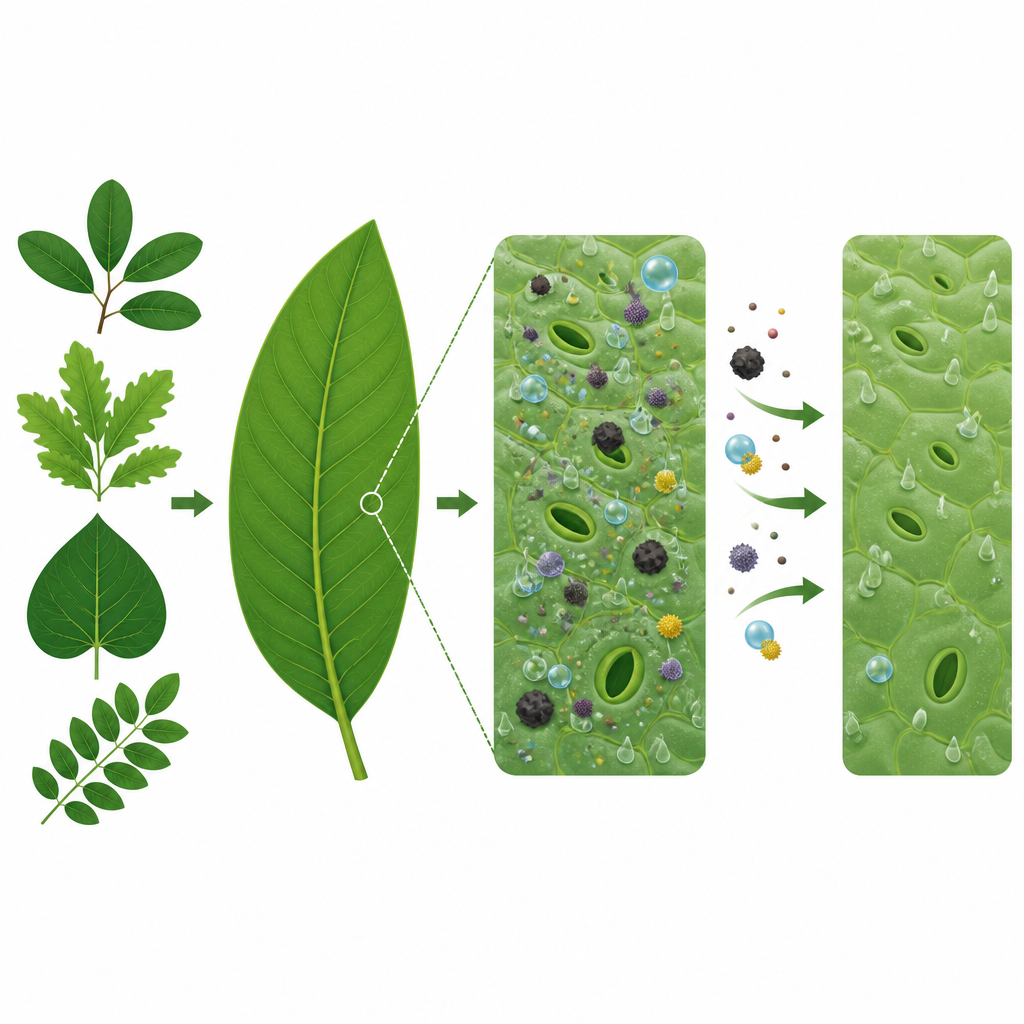
The study revealed that not all greenery works the same way. Cordyline fruticosa stood out as the top all around performer. It removed about 88 percent of both VOCs and carbon monoxide and cut carbon dioxide by more than a third. Cordyline also had the highest tolerance index, very high leaf water content, and dense stomata, which together point to a robust and active leaf surface. Syngonium podophyllum excelled at trapping tiny particles, achieving complete removal of both fine and coarse dust in the test conditions, while still cutting gases to a useful degree. Spider plant showed exceptional dust catching ability thanks to its long, arching leaves, and Jade pothos performed modestly across most pollutants.
Making sense of complex plant data
To understand why some plants cleaned the air better than others, the authors used statistical tools that look for patterns across many measurements at once. These analyses linked strong air cleaning to a mix of high tolerance index, rich chlorophyll, generous wax coatings, and abundant stomata. Plants that combined these traits tended to pull more gases into their leaves and hold more particles on their surfaces. The data also showed that tolerance index by itself is not enough: a plant can be tough and survive in polluted air yet still differ in how much pollution it actually removes. By considering both resilience and direct cleaning performance, the researchers built a more reliable way to rank species for indoor use.
What this means for everyday indoor spaces
From a layperson’s point of view, the message is straightforward. When chosen carefully and kept healthy, ordinary decorative plants can act as living air filters in settings where chemical vapors and dust are a concern. In this study, Cordyline fruticosa and Syngonium podophyllum were especially effective, suggesting they are strong candidates for green walls or clustered planters in pharmaceutical labs and similar workplaces. While plants cannot replace proper ventilation, they can complement mechanical systems, offering a quiet, energy saving boost to indoor air quality and creating more pleasant, healthier spaces for the people who work there.
Citation: Elhadad, S.M., ea, S., Saleh, I.H. et al. Integrating multivariate analysis and Air Pollution Tolerance Index (APTI) to evaluate four ornamental plants for sustainable indoor air phytoremediation. Sci Rep 16, 16013 (2026). https://doi.org/10.1038/s41598-026-50763-0
Keywords: indoor air quality, ornamental plants, pharmaceutical laboratory, volatile organic compounds, phytoremediation