Clear Sky Science · en
EV charging station selection and routing flask application with ACO and NSGA-II including photovoltaic energy constraints
Smarter road trips for electric cars
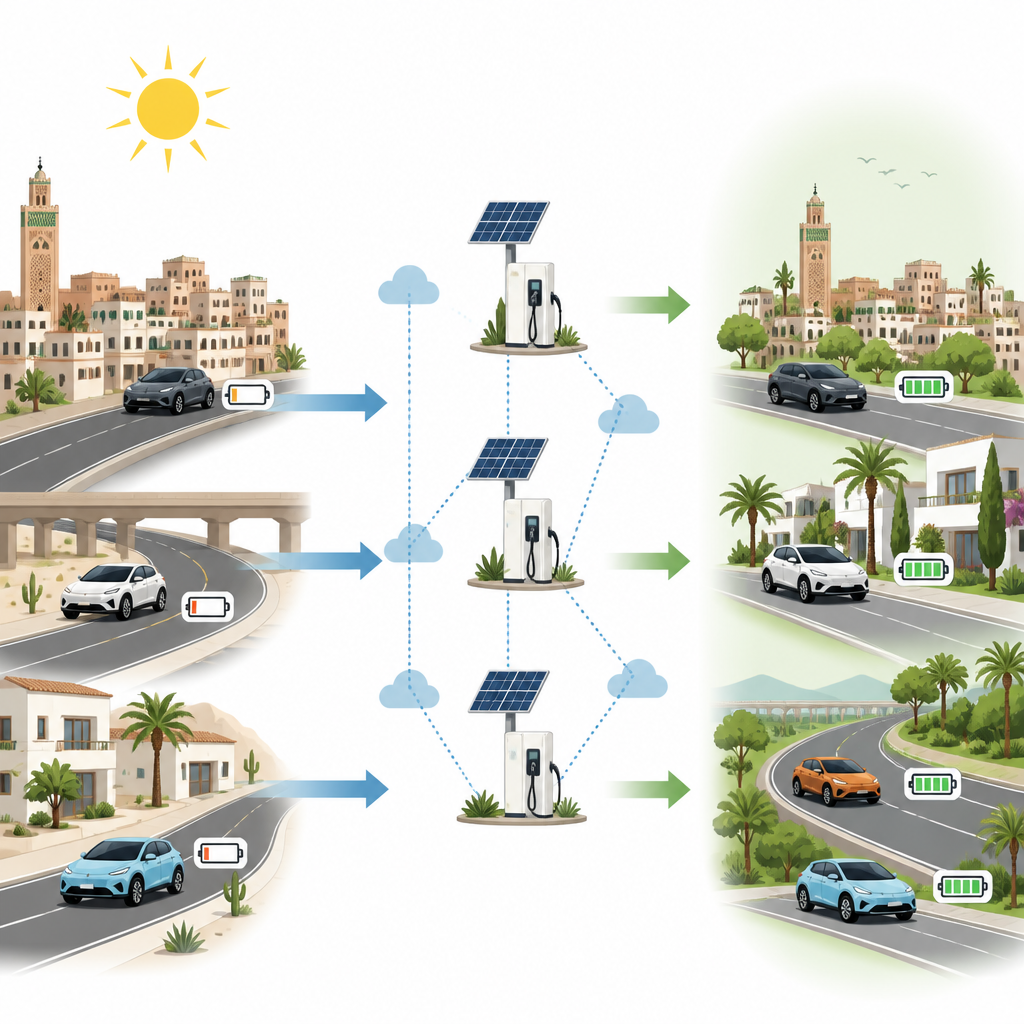
As more drivers switch to electric cars, a simple question becomes surprisingly tricky: where should you stop to charge? Picking the wrong station can mean extra detours, long lines, higher bills, and more pollution from fossil-fueled electricity. This study explores a smart routing system that helps electric cars in Morocco choose the best path and charging stop in real time, while taking advantage of free solar power whenever possible.
What makes choosing a charger so hard
On today’s roads, an electric driver must juggle many moving pieces at once. Battery charge, driving speed, station distance, queue length, electricity price, and even whether a station is running on solar panels or the power grid all matter. Most existing tools focus on just one slice of this puzzle, such as shortest distance or cheapest price, and often ignore how busy stations are or how much renewable energy they use. The authors show that this narrow view can leave drivers stuck waiting, paying more than needed, or missing chances to charge from clean solar power.
A digital assistant that looks ahead
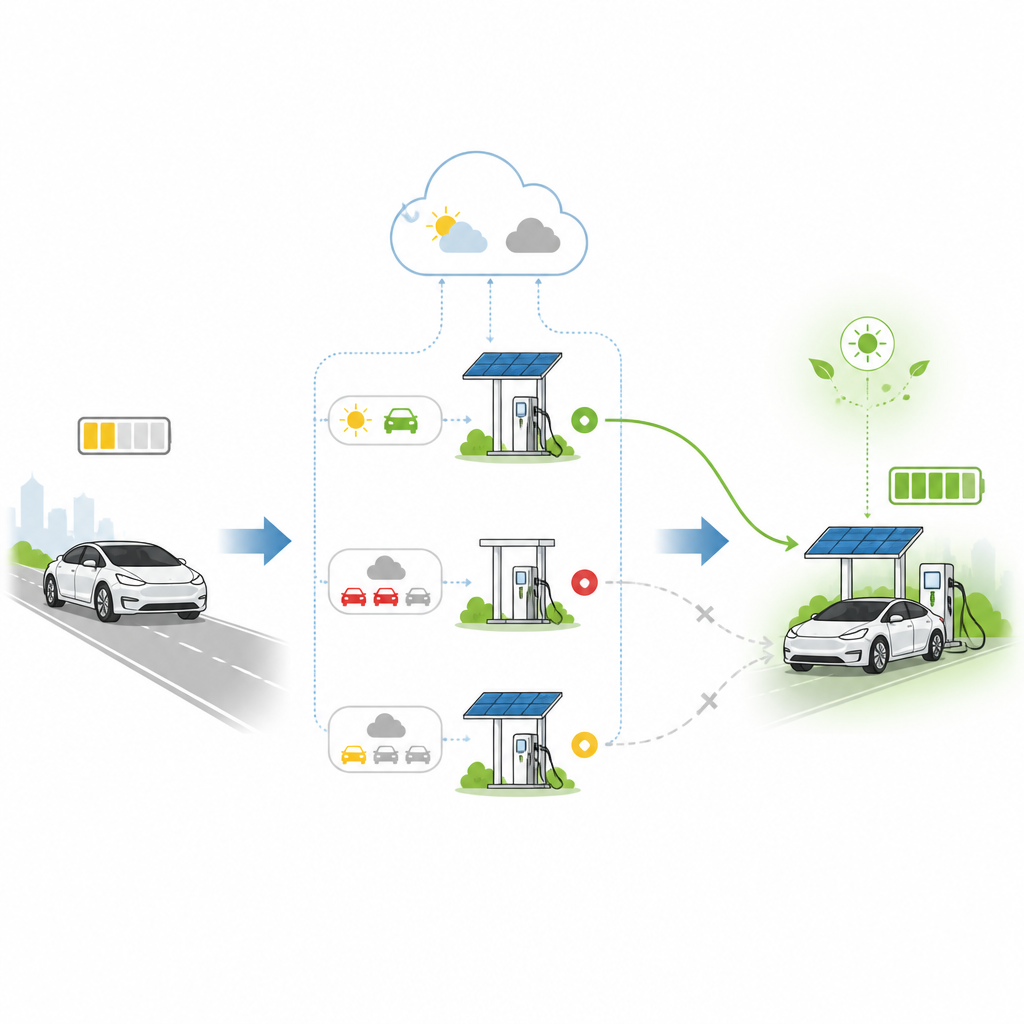
The researchers designed an online assistant that connects cars and charging stations through a lightweight internet link. Each station broadcasts its location, the number of free plugs, how much solar energy is available, and the current charging price. At the same time, each car tracks its position, battery level, destination, and likely speed on different types of roads. Using these live data streams, the system builds a map of possible routes and filters out any stations the car cannot safely reach while keeping an energy reserve.
How the smart search works under the hood
Inside the assistant, two nature inspired search methods work together. One searches the road network for promising paths that are short and efficient, taking into account city streets, suburban roads, and highways, as well as likely slowdowns from traffic lights and congestion. The other weighs several goals at once: getting there quickly, keeping waiting and charging times low, cutting costs, and using as much solar electricity as possible. Rather than chasing a single “perfect” answer, it builds a menu of good tradeoffs and then picks the option that offers the best overall balance for that specific trip.
Testing in Moroccan cities and highways
The team tested their assistant on realistic routes in and around Marrakech and Casablanca, two Moroccan cities with growing charging networks and strong sunshine. They built five typical travel stories, from city errands to highway drives between cities, and compared their hybrid method with three common approaches used alone. Across these cases, the new system cut driving distance by up to one tenth and reduced energy use by up to about one seventh compared with a simple shortest path planner. It also found routes that arrived sooner than methods focused only on energy or price, and it steered drivers toward stations with plentiful solar power whenever the sun was shining.
Cleaner power, lower bills, less waiting
Because the assistant deliberately favors solar fed chargers when it is practical, many trips drew most of their electricity from sunshine rather than the grid. In daytime city journeys with good solar supply, charging costs dropped by roughly one third or more, while the share of renewable energy often reached between seventy and nearly one hundred percent. That cleaner mix translated into about three to four kilograms less carbon dioxide per trip compared with relying on grid power alone. The system also showed it could adapt when forecasts of solar output or car energy use were slightly off, and it avoided charging plans that might leave a vehicle close to running out of charge.
What this means for future electric travel
For everyday drivers, the study points toward a future where a navigation app does more than simply point to the nearest plug. Instead, it could quietly weigh time, cost, station crowding, safety margins, and how green the electricity is before suggesting a stop. The authors argue that their approach is well suited to smart cities that want to support more electric vehicles without overloading power lines, and they outline how it could be scaled up to manage whole fleets of taxis or delivery vans. In plain terms, their main message is that careful, data driven planning can make electric travel cheaper, faster, and cleaner at the same time.
Citation: Belaid, M., Beid, S.E., Habib, S. et al. EV charging station selection and routing flask application with ACO and NSGA-II including photovoltaic energy constraints. Sci Rep 16, 14754 (2026). https://doi.org/10.1038/s41598-026-50734-5
Keywords: electric vehicles, charging stations, solar energy, route planning, smart cities