Clear Sky Science · en
UPLC-ESI/MS-MS-based phytochemical analysis of Schinopsis balansae leaf extract and anti-skin ageing properties supported with in silico molecular docking experiments
Why a tree from Argentina matters for your skin
Many people look for gentler ways to care for their skin and soften wrinkles, often turning to plant based creams and serums. This study explores the leaves of Schinopsis balansae, a tannin rich tree from South America, to see whether its natural compounds can help protect the proteins that keep skin firm and elastic. By pairing detailed chemical analysis with lab tests on key skin related enzymes, the researchers asked whether this little known tree could become a useful source of ingredients for future anti wrinkle products. 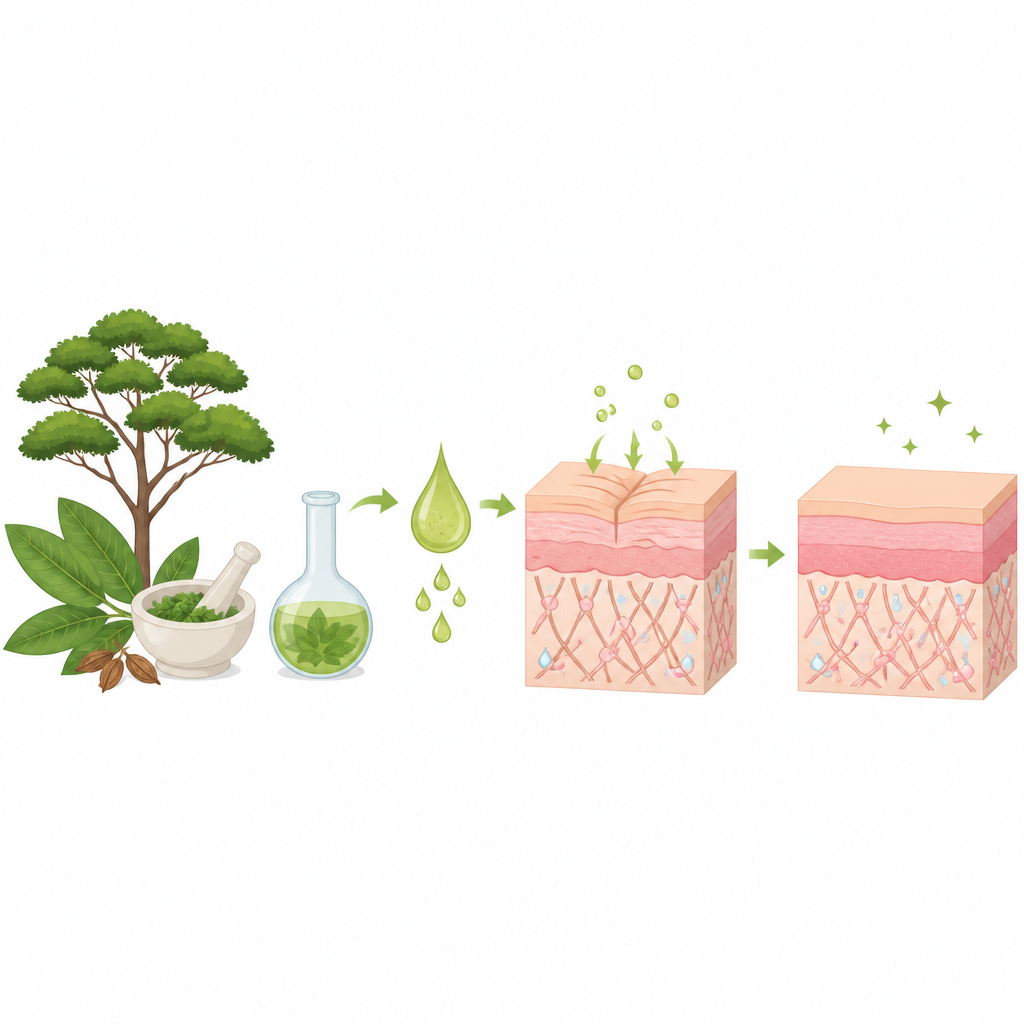
What happens as skin gets older
Skin aging is not just about time passing; it reflects changes deep in the living layers. With age, the support network outside skin cells, made of proteins like collagen and elastin, gradually breaks down. Enzymes such as collagenase and elastase speed this process by cutting these fibers, which contributes to dryness, sagging, and visible lines. Because of this, many scientists are searching for safe substances that can gently slow these enzymes, helping the skin keep its structure for longer.
A closer look inside the leaves
To see what is hidden inside the leaves of Schinopsis balansae, the team extracted them with a water rich alcohol mixture and ran the extract through a powerful form of liquid chromatography linked to mass spectrometry. This technique separates and weighs molecules, allowing researchers to sketch a chemical fingerprint of the plant. They tentatively identified twenty two compounds, including several flavonoids, phenolic acids, tannins, and triterpenoids, many of which are known for strong antioxidant activity. The extract was especially rich in phenolic compounds, which are often linked to protection against damage caused by reactive oxygen molecules that build up with age and sun exposure.
Testing how the extract affects wrinkle related enzymes
Next, the scientists checked whether the leaf extract could slow down the enzymes that attack collagen and elastin. In controlled lab tests, they mixed different doses of the extract with purified collagenase and elastase and monitored how well the enzymes worked. The extract reduced the activity of both in a clear dose dependent way, with relatively low concentrations cutting enzyme function by half. Its performance approached that of known reference substances used as positive controls, suggesting that the mix of natural molecules in the extract can meaningfully interfere with the breakdown of skin support fibers. 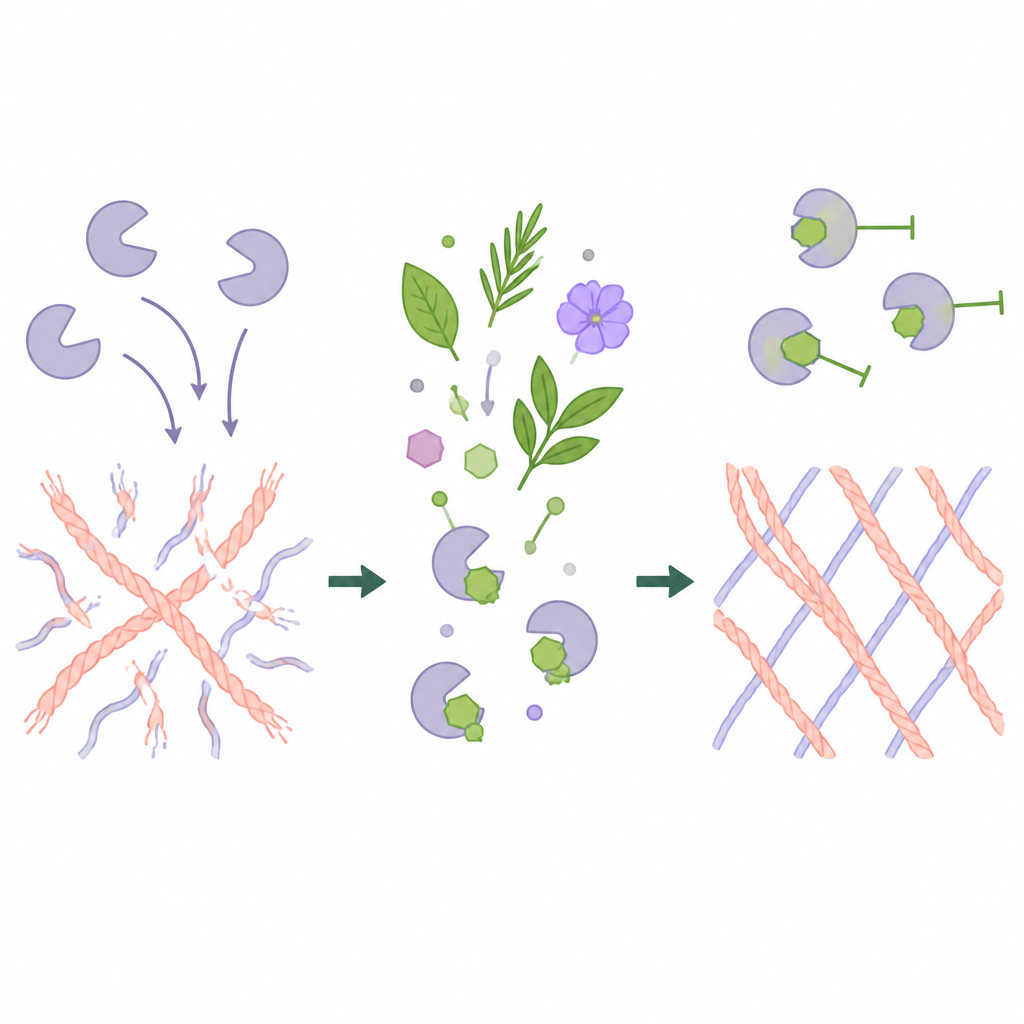
Peeking at how plant molecules may latch onto enzymes
Because the extract contains many different compounds, the team used computer based docking studies to picture how individual molecules might fit into the active pockets of collagenase and elastase. They built three dimensional models of the enzymes and tested how strongly major plant compounds could bind to them. Several flavonoid like molecules, such as quercetin O benzoyl hexoside and a homoisoflavone, showed strong predicted interactions with key amino acids in the enzymes active sites. While these simulations cannot capture everything that happens in real skin, they support the idea that specific components of the extract physically block the enzymes from cutting collagen and elastin.
What this could mean for future skin care
Put together, the findings show that Schinopsis balansae leaves are a rich source of antioxidant plant compounds that can slow two important wrinkle related enzymes in the lab and are predicted to bind tightly to their active sites. For a lay reader, this means that carefully prepared extracts from this tree may one day help support skin firmness by protecting its internal scaffolding. The work does not yet prove safety or effectiveness in people, but it offers a scientific basis for exploring this leaf extract as a natural ingredient in future anti wrinkle and skin care formulations.
Citation: El-Nashar, H.A.S., Al-Qaaneh, A.M., Al-Azzawi, M.A. et al. UPLC-ESI/MS-MS-based phytochemical analysis of Schinopsis balansae leaf extract and anti-skin ageing properties supported with in silico molecular docking experiments. Sci Rep 16, 15219 (2026). https://doi.org/10.1038/s41598-026-50709-6
Keywords: skin aging, plant extract, collagenase, elastase, phenolic compounds