Clear Sky Science · en
Peritoneal dialysis-induced senescence contributes to treatment failure in long-term PD
Why this matters for people on home dialysis
Peritoneal dialysis is a life-saving home treatment for people whose kidneys no longer work. It lets patients clean their blood without traveling to a clinic several times a week. Yet, for many, this freedom is temporary: after years, the treatment often stops working because the delicate lining inside the abdomen is damaged. This study asks a simple but crucial question: are “worn‑out” cells building up in that lining and quietly sabotaging peritoneal dialysis over time?
The body’s inner filter under constant strain
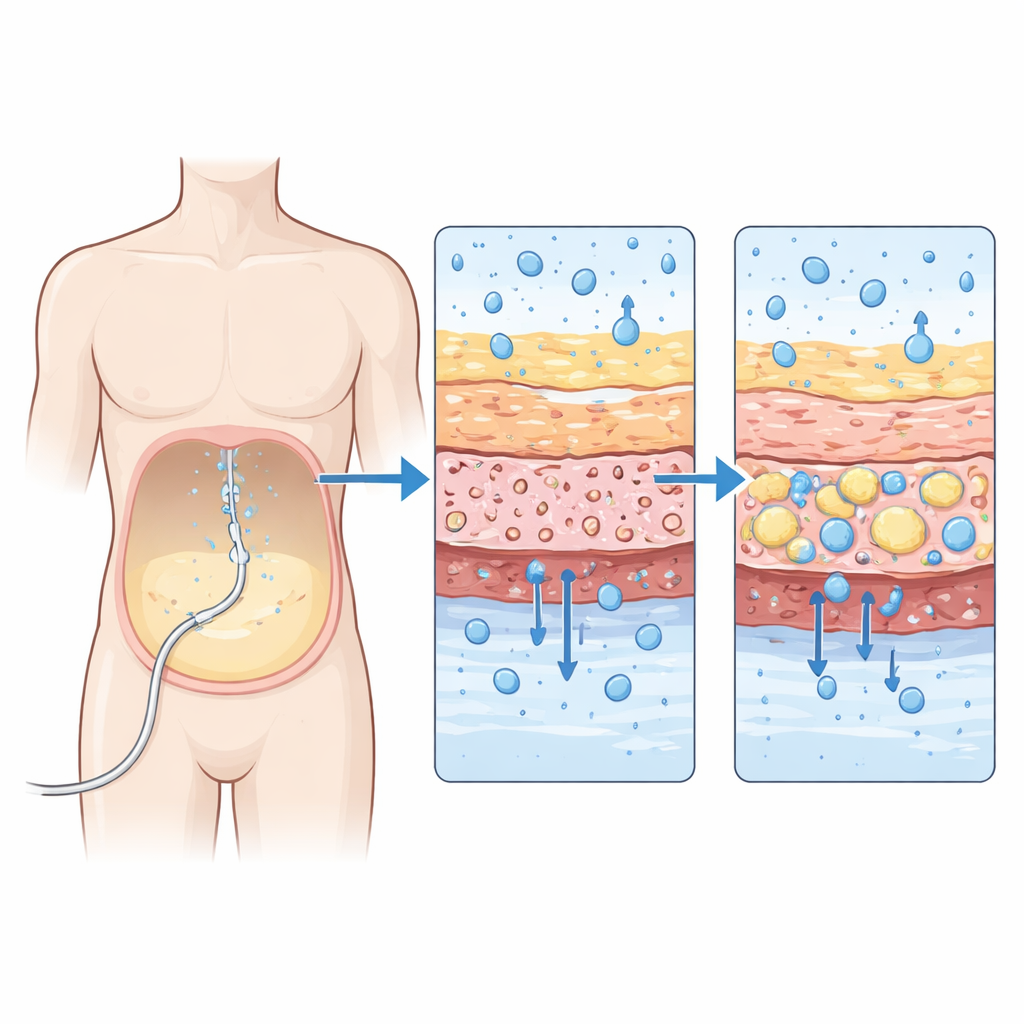
Peritoneal dialysis uses the thin membrane inside the belly as a natural filter. Sugar-rich fluid is run into the abdomen through a soft tube, where it pulls waste and extra water out of the blood before being drained again. The downside is that this fluid is harsh. Over years, it can scar and thicken the membrane, making it less able to move fluid. Patients and doctors see this as “treatment failure,” when dialysis can no longer remove enough fluid and the patient must switch to hemodialysis. The authors suspected that a build‑up of aged, non‑dividing cells—known as senescent cells—might be a key part of this slow decline.
Hunting for aged cells in the abdominal lining
The research team examined tiny tissue samples from three groups of people: those on peritoneal dialysis, people with severe kidney disease not yet on any dialysis, and individuals with healthy kidney function. They carefully matched the groups by age, sex, and other factors as much as possible, and excluded people with diabetes or recent infection to avoid confusion from other sources of damage. Using special staining methods, they measured how thick the membrane was, how many surface cells were missing, and where senescent cells appeared in the different tissue layers.
Where damage appears and how it progresses
The samples confirmed that people on peritoneal dialysis had lost many of the surface cells that normally coat the membrane, and that the supporting layer underneath had become much thicker. Senescent cells—identified by specific proteins they either gain or lose—were found mainly in this surface layer and, with longer time on dialysis, increasingly deeper in the tissue. Patients treated for more than a year had clearly higher levels of senescence markers than healthy controls. At the same time, signs of DNA damage, likely driven by chemically reactive molecules produced during dialysis, became more common. The study also found rising activity of a master switch for inflammation, suggesting that these aged cells may be sending out distress signals that promote chronic irritation without triggering a full‑blown inflammatory storm.

From stressed cells to failing treatment
Putting these findings together, the picture that emerges is of a membrane slowly overwhelmed by cellular wear and tear. Repeated exposure to dialysis fluid appears to generate oxidative stress, which injures DNA in the cells lining the peritoneum. Some of these cells then enter a senescent state: they stop dividing but stay metabolically active, change shape, and start to alter their surroundings. Over time, more and more such cells accumulate, the tissue thickens, normal surface cells are lost, and fluid can no longer move efficiently across the membrane. While the study cannot prove cause and effect, it strongly suggests that senescent cells play a central role in the gradual loss of peritoneal dialysis function.
New hope in drugs that target aged cells
The authors argue that these insights open the door to a new type of therapy for people on peritoneal dialysis. Rather than only adjusting the fluid or the dialysis schedule, doctors might someday use “senotherapeutic” drugs that either clear out senescent cells or soften their harmful behavior. Early trials of such drugs in other kidney conditions have already shown that trimming back senescent cells can reduce inflammation and improve organ function. If similar approaches can safely protect the peritoneal membrane, they could help patients stay on their preferred home treatment longer and with fewer complications.
Citation: Oberacker, T., Kraft, L., Pieper, J.M. et al. Peritoneal dialysis-induced senescence contributes to treatment failure in long-term PD. Sci Rep 16, 13519 (2026). https://doi.org/10.1038/s41598-026-50666-0
Keywords: peritoneal dialysis, cellular senescence, kidney failure, oxidative stress, senolytic therapy