Clear Sky Science · en
Integrated structural, optical and dielectric analysis of low-loss α-Al₂O₃ nanoparticles for UV photonic and dielectric applications
Why ultra clear ceramics matter
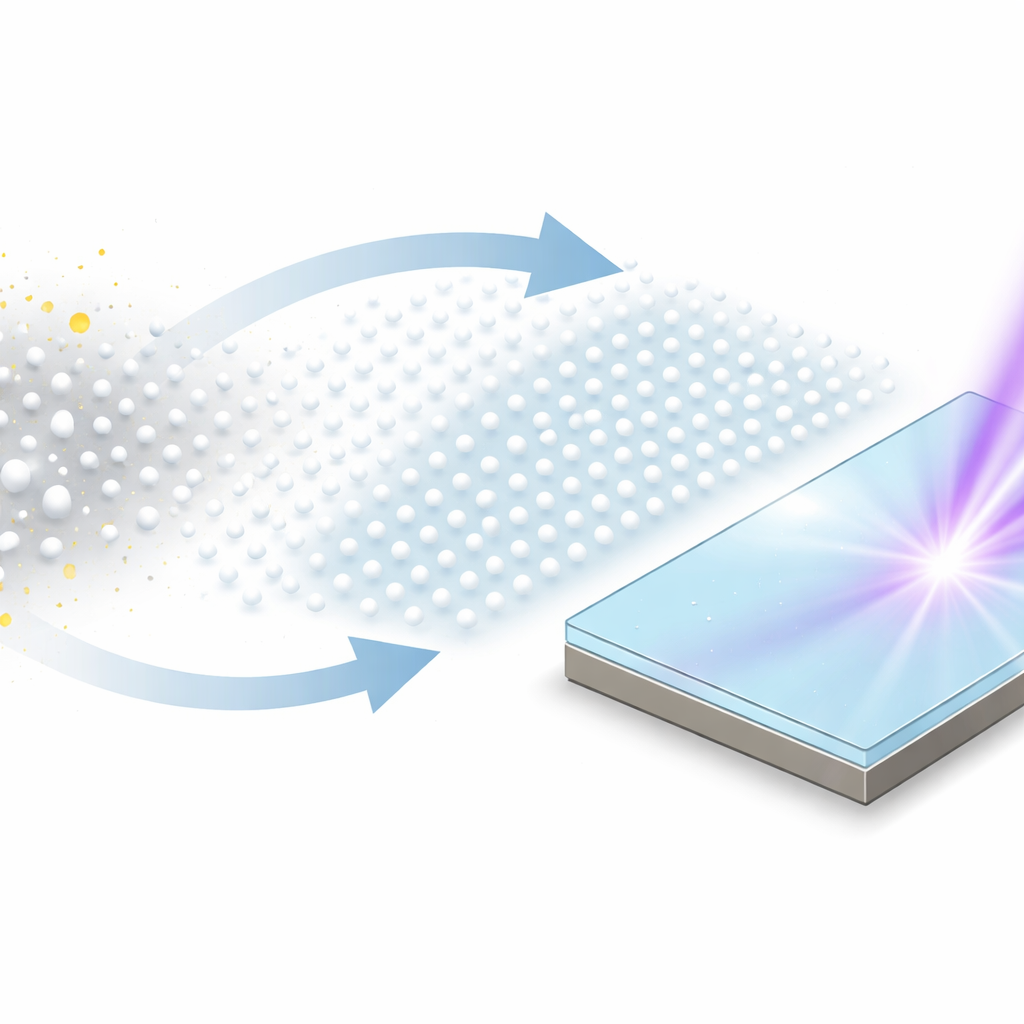
From phone screens to satellite sensors, many modern devices need materials that let light pass through while shrugging off heat and electrical stress. This study explores tiny particles of alpha alumina, a ceramic better known in its crystal form as sapphire, to see how their inner structure controls how well they handle ultraviolet light and electric fields with almost no energy loss.
Making tiny grains of a tough crystal
The researchers made high purity alpha alumina nanoparticles using a tailored sol gel recipe called the Pechini method. Metal salts were mixed with simple organic ingredients to form a uniform gel, then heated first to remove water and organics, and finally fired at 1100 °C to lock in the stable crystal form. This process produced white nanopowders in which transmission electron microscopy showed roughly 100 nanometer particles made of many smaller crystalline regions, while infrared measurements confirmed that the original organic ingredients were almost completely burned away.
Reading order inside the crystal
To understand how perfectly the atoms line up, the team used X ray diffraction and an advanced fitting approach known as Rietveld refinement. By carefully correcting for subtle distortions caused by the instrument, they could separate flaws in the sample from artifacts of the measurement. The improved model revealed a well defined corundum crystal structure with very small internal strain and crystallite domains around 24 nanometers across. Electron density maps based on this refined data showed sharp, clean peaks where electrons are most likely to sit, another sign of a nearly defect free lattice.
How these particles handle light
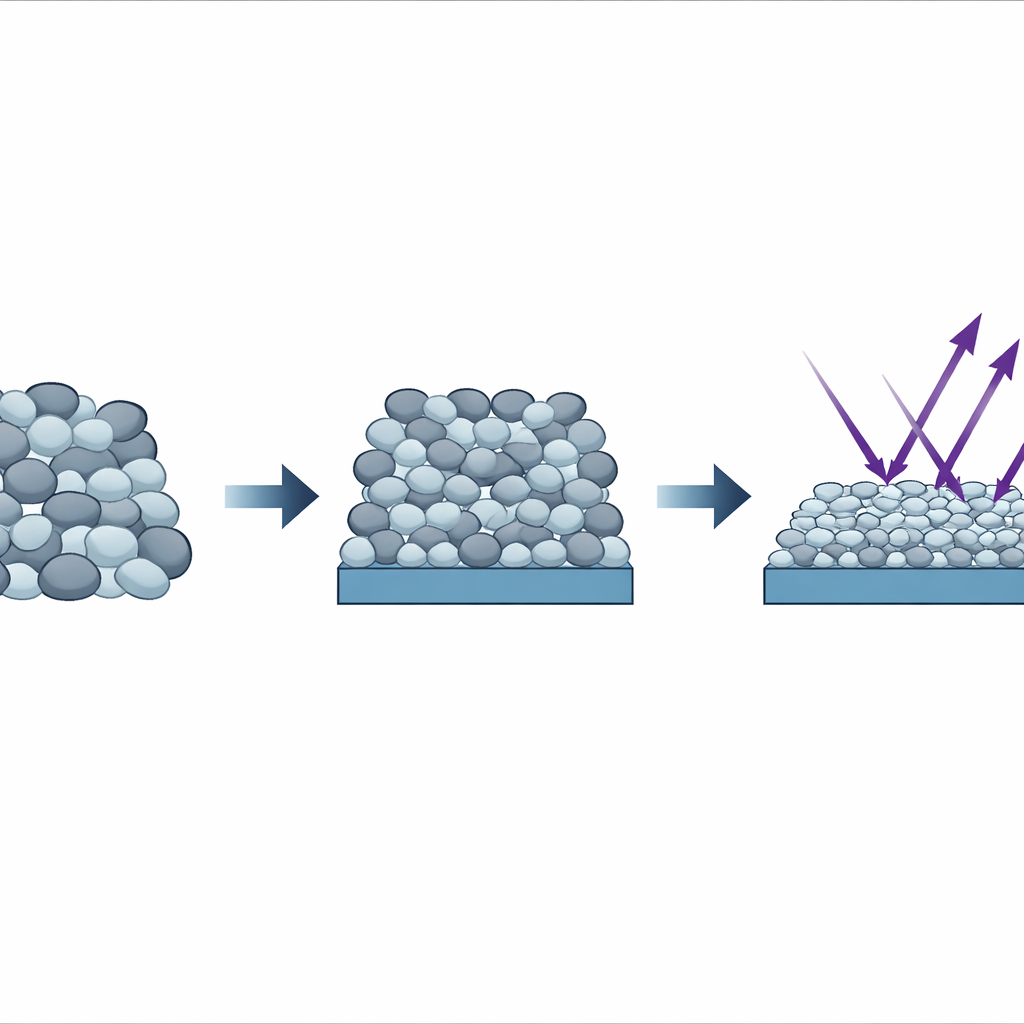
The optical tests focused on how the powders respond to light from the ultraviolet to the near infrared. Diffuse reflectance measurements, analyzed with a standard model for powders, showed that alpha alumina has a wide optical band gap of about 4.29 electronvolts, placing its strong absorption deep in the ultraviolet. In the visible range, both the absorption coefficient and the extinction coefficient were extremely small, while the refractive index followed a smooth, normal dispersion. Together these features mean that a layer made from these nanoparticles would be highly transparent to visible and near infrared light but could still interact strongly with high energy ultraviolet photons.
Electrical loss kept to a minimum
From the same optical data, the authors extracted how easily the material stores and loses electrical energy when light waves pass through it. They calculated the real and imaginary parts of the dielectric constant and combined them into a quantity called the loss tangent, which measures how much energy is converted to heat. Across a wide range of photon energies, the imaginary part stayed very small and the loss tangent fell between about ten to the minus four and ten to the minus six, indicating that almost all of the energy is stored and very little is wasted. A moderate lattice dielectric constant and a low plasma frequency pointed to a strongly insulating material with very few free charge carriers.
Where these powders could be used
Bringing these pieces together, the study shows that when alpha alumina nanoparticles are made with high structural perfection, they naturally combine clarity with electrical stability. Their wide band gap, very low optical and dielectric loss, and stress free crystal framework make them attractive for ultraviolet light emitting devices, solar blind detectors, durable optical coatings, and compact components in high frequency photonic circuits. In simple terms, these powders behave like tiny, robust building blocks for future devices that must guide intense light and strong fields without heating up or breaking down.
Citation: Mohamed, S.A., Rayan, A.M., Hakeem, A. et al. Integrated structural, optical and dielectric analysis of low-loss α-Al₂O₃ nanoparticles for UV photonic and dielectric applications. Sci Rep 16, 14706 (2026). https://doi.org/10.1038/s41598-026-50503-4
Keywords: alpha alumina, nanoparticles, ultraviolet optics, low loss dielectrics, photonic coatings