Clear Sky Science · en
Sustainable one-part geopolymeric hybrid composite derived from glauconite, talc, and olive seed waste–based activated carbon for Congo red adsorption
Turning waste into cleaner water
Colorful dyes make our clothes and textiles bright, but when those dyes end up in rivers and groundwater, they can threaten both ecosystems and human health. This study shows how simple natural minerals and an agricultural byproduct, olive seed waste, can be transformed into a low-cost powder that strips a stubborn red dye from water with near-total efficiency. For anyone interested in safer water and smarter use of waste, it offers a glimpse of how chemistry and engineering can work together to protect the environment.
Why a red dye is a serious problem
Many textile factories release leftover synthetic dyes into wastewater, and one of the most troubling examples is Congo red, a bright red dye that does not break down easily in nature and is linked to toxicity and possible cancer risks. Because these molecules resist natural decay, they can travel long distances, tinting streams and lakes and interfering with plant growth and aquatic life. Traditional treatment methods often struggle with such stubborn pollutants or generate new waste in the form of chemical sludge. This makes it vital to develop materials that can lock these dyes out of the water in a simple, reliable way, while also keeping costs and environmental side effects low.
Building a smart cleaning powder from simple ingredients
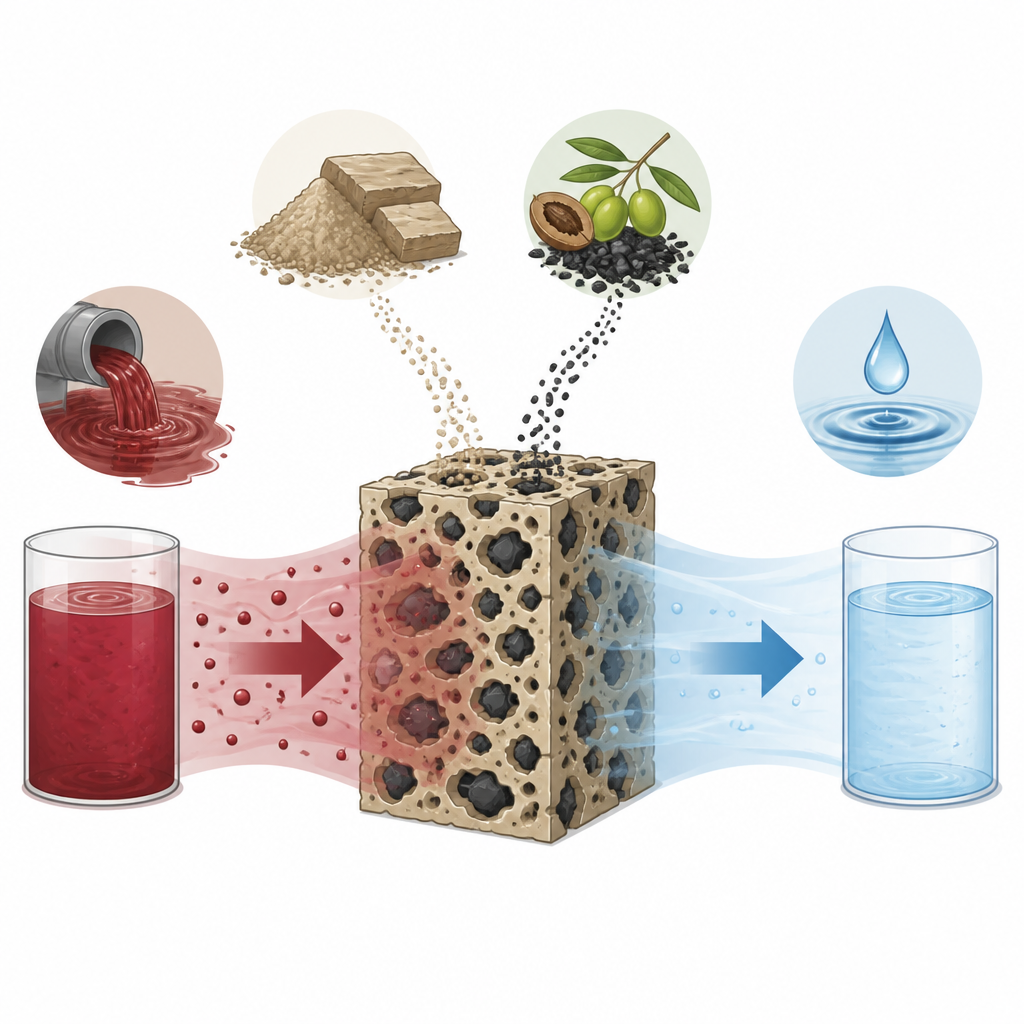
The researchers created a new powdered material called a one-part geopolymeric hybrid composite by combining two common clay-rich rocks, glauconite and talc, with activated carbon made from discarded olive seeds. First they heated the clays with a small amount of alkali so the minerals turned into a more reactive, glassy form. Then they mixed this glassy powder with the olive-seed carbon and water, cured it into a solid, and finally ground it into a fine adsorbent powder. Detailed tests using X-ray tools, infrared light, gas adsorption, and electron microscopes showed that the final material is mostly amorphous, full of pores, and packed with chemically active surfaces where dye molecules can attach.
How the new material traps dye from water
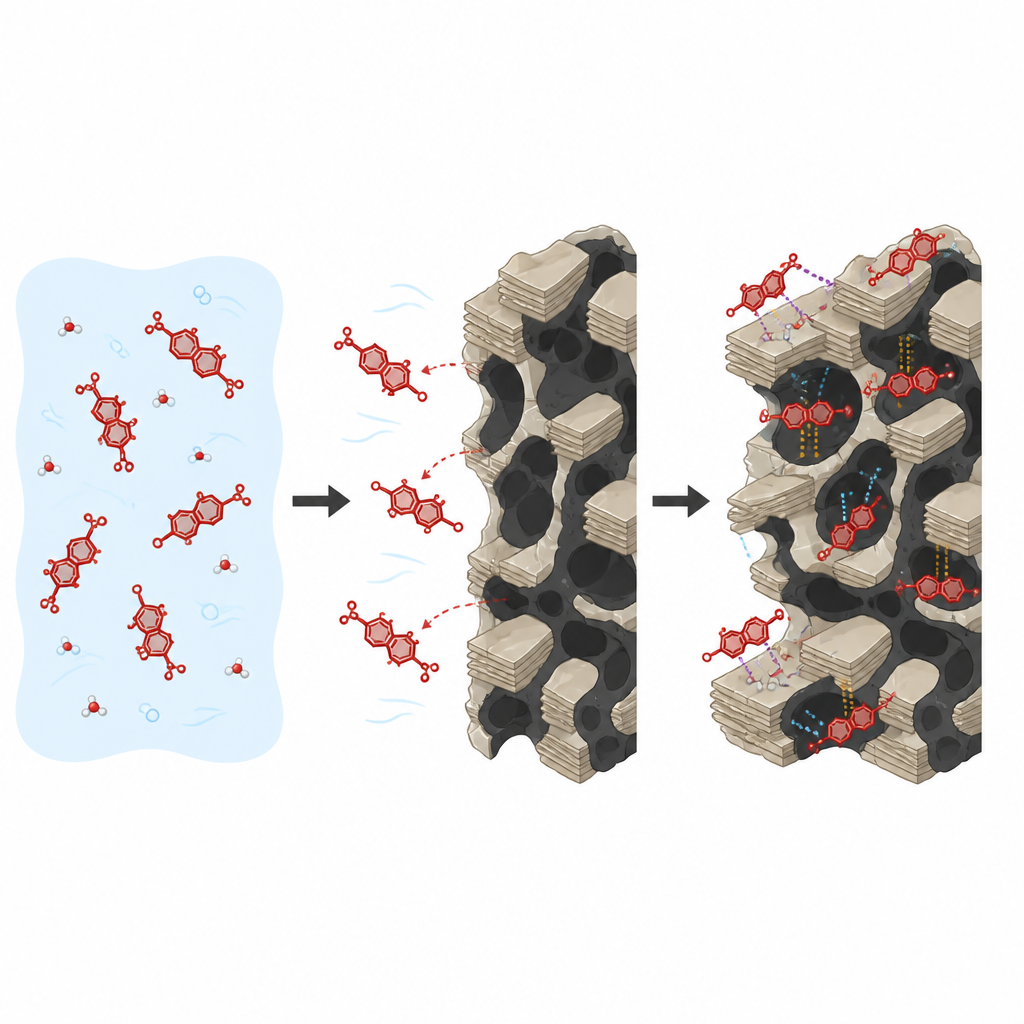
To see how well the powder works, the team stirred small amounts of it into dye-contaminated water while changing key conditions such as acidity, contact time, temperature, and starting dye level. They found that the material removed up to 99.2 percent of Congo red under acidic conditions, and still captured more than 80 percent even when the water was close to neutral or slightly basic. At the microscopic level, several forces cooperate: positively charged surface groups on the mineral part pull in the negatively charged parts of the dye; hydrogen bonds form between surface hydroxyl groups and the dye; and flat aromatic regions in the carbon layer stack with the ring-shaped parts of the dye. Careful mathematical modeling of how much dye sticks to the surface and how fast the process occurs revealed that dye molecules tend to arrange in a tightly packed, mostly vertical fashion at the active sites, and that the overall behavior matches a monolayer-like coverage with rapid initial uptake followed by slower filling of internal pores.
Testing performance, reuse, and practical costs
The new powder showed a very high capacity for holding Congo red, reaching about 367 milligrams of dye per gram of adsorbent at warmer temperatures, and this capacity increased as the water got hotter, indicating that the process absorbs heat and proceeds more readily with added warmth. The researchers used statistical design tools to pinpoint the best working recipe, identifying an acidic pH, moderate contact time, and low adsorbent dosage as the sweet spot for strong removal with efficient use of material. They also repeatedly loaded the powder with dye, washed it with acid to release the trapped molecules, and reused it several times. After five such cycles the material still removed nearly 88 percent of the dye, suggesting it is robust enough for repeated use. Importantly, a detailed cost analysis, based on real prices for raw minerals, chemicals, and energy, estimated that producing the powder costs only a few cents per gram, and that treating 100 liters of moderately polluted water would cost on the order of a couple of dollars.
From lab concept to cleaner industry
For non-specialists, the key message is that common rocks and farm waste can be turned into an affordable powder that pulls a harmful dye out of water very effectively, again and again. The study also connects this approach to wider sustainability goals, including cleaner water, responsible use of resources, and reduced pollution of rivers and seas. While future work must test the material on real factory waste streams and across a wider range of contaminants, this research demonstrates that it is possible to design water-cleaning materials that are both powerful and rooted in simple, widely available ingredients.
Citation: Gadallah, A.G., Elshimy, A.S., Hegazy, A.A. et al. Sustainable one-part geopolymeric hybrid composite derived from glauconite, talc, and olive seed waste–based activated carbon for Congo red adsorption. Sci Rep 16, 15991 (2026). https://doi.org/10.1038/s41598-026-50411-7
Keywords: water purification, Congo red, geopolymer adsorbent, olive seed waste, wastewater treatment