Clear Sky Science · en
Nitzschia excavata sp. nov. (Bacillariaceae), a new diatom species from a post-mining reservoir revealed by morphology, molecular phylogeny, and metabarcoding-based biogeography
A Hidden World in a Man-Made Lake
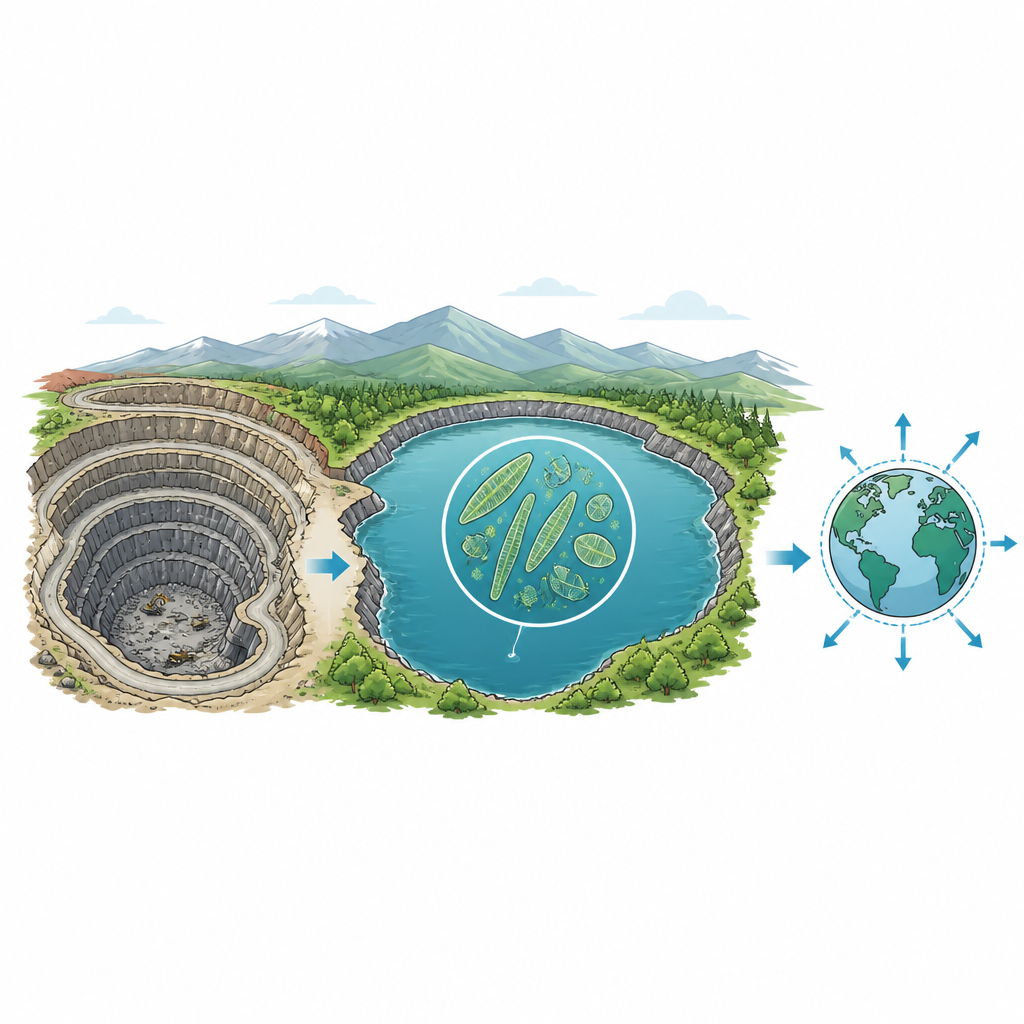
When an open-pit coal mine is abandoned and allowed to fill with water, it might look like a lifeless scar slowly turning into a pond. In fact, such places can become laboratories of evolution, hosting microscopic life that has escaped notice for centuries. This study explores one such reservoir in Poland and reveals a new species of diatom, a tiny glass-shelled alga, while showing how modern DNA tools can uncover its hidden journeys across continents.
The Unlikely Life of a Flooded Mine
The Bogdałów reservoir in western Poland formed when a lignite pit was deliberately flooded in the 1990s. Its waters are slightly alkaline, moderately mineral-rich, and fed by mine drainage and nearby streams. These stable but human-shaped conditions have turned the lake into a hotspot for diatoms, single-celled algae whose silica shells form intricate patterns under the microscope. Earlier work had already revealed unusual species here. In this study, researchers returned to the reservoir to examine a group of especially small, hard-to-tell-apart diatoms belonging to the genus Nitzschia, asking whether one of them might in fact be new to science.
Looking Closely at a Tiny New Neighbor
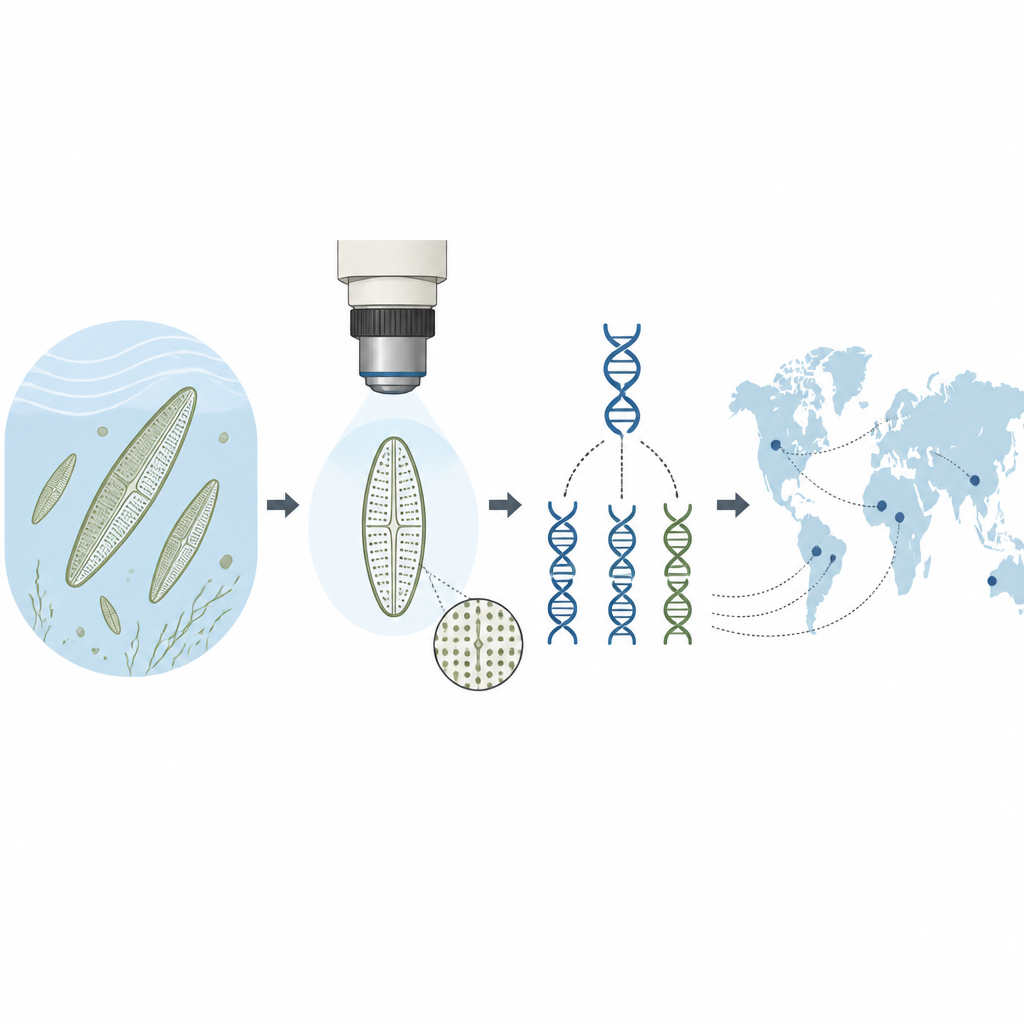
Using high-powered light microscopes, scanning electron microscopes, and confocal imaging, the team documented the form and inner structure of the candidate species, which they named Nitzschia excavata. Each cell carries two long, curved green plastids wrapped along the inside of its glass shell, often with bright storage granules at the tips. The shells themselves are narrow and lance-shaped, with very fine, closely packed rows of pores and evenly spaced internal ribs. Compared with its closest look-alikes, the new species has more linear outlines, slightly different ends, and a characteristic pattern of pores and ribs. These details, invisible to the naked eye, are critical for separating one species from another in this crowded branch of the diatom family tree.
Reading DNA to Place a New Species
Shell shape alone is no longer enough to understand how such microalgae are related. The researchers therefore sequenced pieces of nuclear and chloroplast DNA from eight laboratory-grown strains of Nitzschia excavata. They combined three genes into a single evolutionary tree alongside data from many known relatives. The new species fell within a group of small Nitzschia species but sat on its own long branch, clearly distinct from familiar forms such as Nitzschia palea and Nitzschia pusilla, which it superficially resembles. This blend of careful imaging and multi-gene analysis confirms that the Bogdałów diatom is not just a local variant, but a separate lineage that had gone unrecognized despite more than a century of diatom research.
Tracing a Tiny Traveler Across Continents
To find out whether Nitzschia excavata was unique to the Polish reservoir or more widespread, the team turned to environmental DNA, or metabarcoding. In this approach, short stretches of a marker gene are sequenced from hundreds or thousands of water samples, generating vast libraries of anonymous genetic fragments. The authors compared the genetic fingerprint of their new species against 24 large datasets from rivers and lakes worldwide, along with regional surveys and broad metagenomic archives. Although the species did not appear in earlier global screens, they found perfect or near-perfect matches in freshwater sites in Spain, Hungary, and northwestern China. These matches, supported by longer gene fragments in one Chinese dataset, show that the lineage extends far beyond its mining-lake birthplace.
What This Means for Human-Made Habitats
The picture that emerges is that Nitzschia excavata favors waters that are rich in dissolved ions, slightly alkaline, and well oxygenated, ranging from near-oligotrophic to moderately enriched conditions. Such environments occur naturally in some lakes and springs, but they are also common in post-mining reservoirs and other altered waters. The study suggests that these human-made habitats do not necessarily generate brand-new species; instead, they may serve as refuges where already widespread but rare microorganisms can thrive and finally be noticed. At the same time, the work warns against assuming that newly described microscopic species are local oddities. By pairing classic microscopy with DNA sequencing and global metabarcoding, researchers can uncover the true ranges of these tiny travelers and refine our understanding of freshwater biodiversity in a rapidly changing world.
Citation: Olszyński, R.M., Mann, D.G., Zakrzewski, P.K. et al. Nitzschia excavata sp. nov. (Bacillariaceae), a new diatom species from a post-mining reservoir revealed by morphology, molecular phylogeny, and metabarcoding-based biogeography. Sci Rep 16, 16561 (2026). https://doi.org/10.1038/s41598-026-50312-9
Keywords: diatoms, freshwater biodiversity, metabarcoding, post-mining reservoirs, microalgae diversity