Clear Sky Science · en
A polymer of calcium aluminate and water glass as cement substitute
Building With Less Carbon
Concrete is everywhere: in our homes, bridges, and city skylines. But making the cement that binds concrete together releases huge amounts of carbon dioxide, contributing around 8% of global CO2 emissions. This study presents a new kind of mineral-based “glue” for concrete that could dramatically cut that climate cost while still being easy for builders to use.
A New Kind of Stone Glue
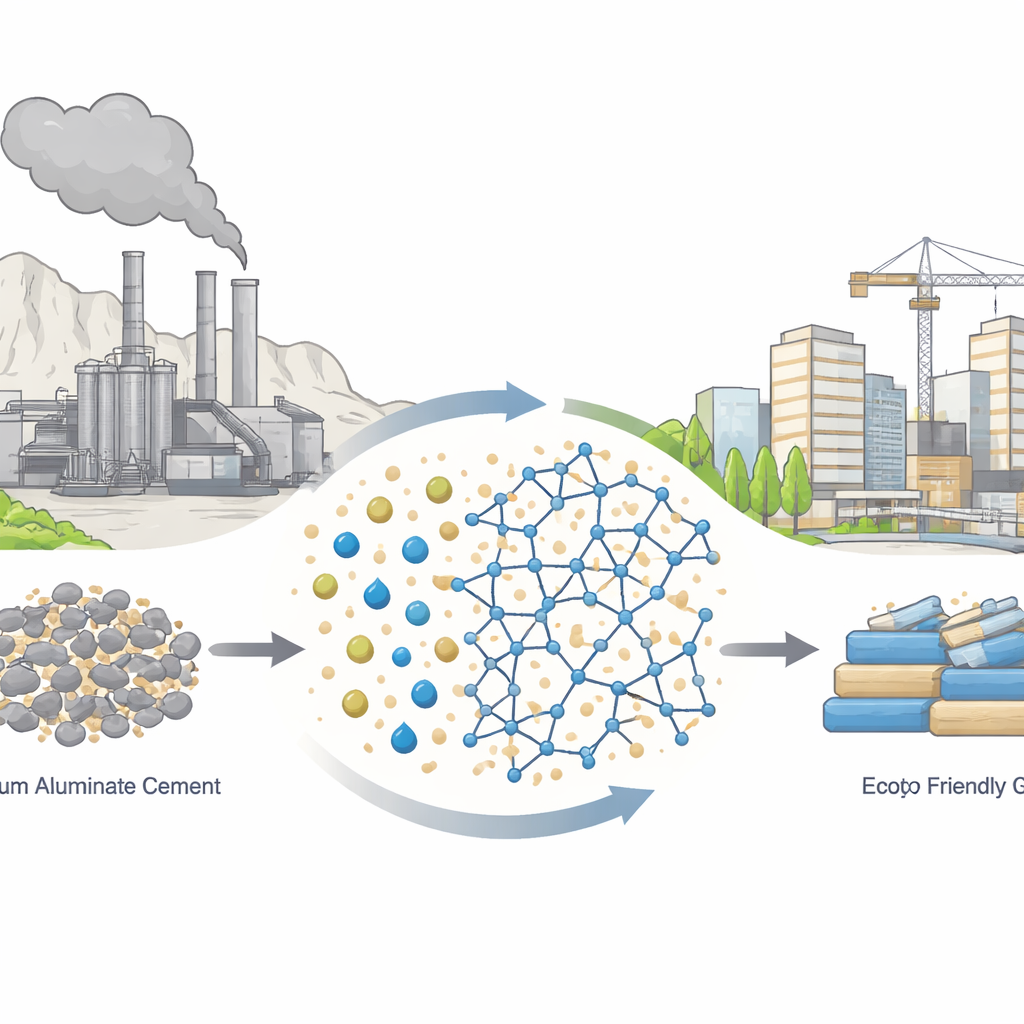
The authors explore a binder made from two main ingredients: calcium aluminate cement, a specialty cement rich in aluminum, and “water glass,” a liquid form of sodium silicate. When mixed under strongly basic (alkaline) conditions, these two react to form a carbon‑free, rock‑like polymer made only of silicon, aluminum, oxygen and metal ions such as sodium and calcium. Unlike today’s common Portland cement, this new binder needs no carbon‑rich limestone as its main source of calcium, so it avoids much of the CO2 released during traditional cement production. The mixture is a pourable suspension that can be handled with the same tools and techniques used for ordinary concrete.
How The Mineral Network Forms
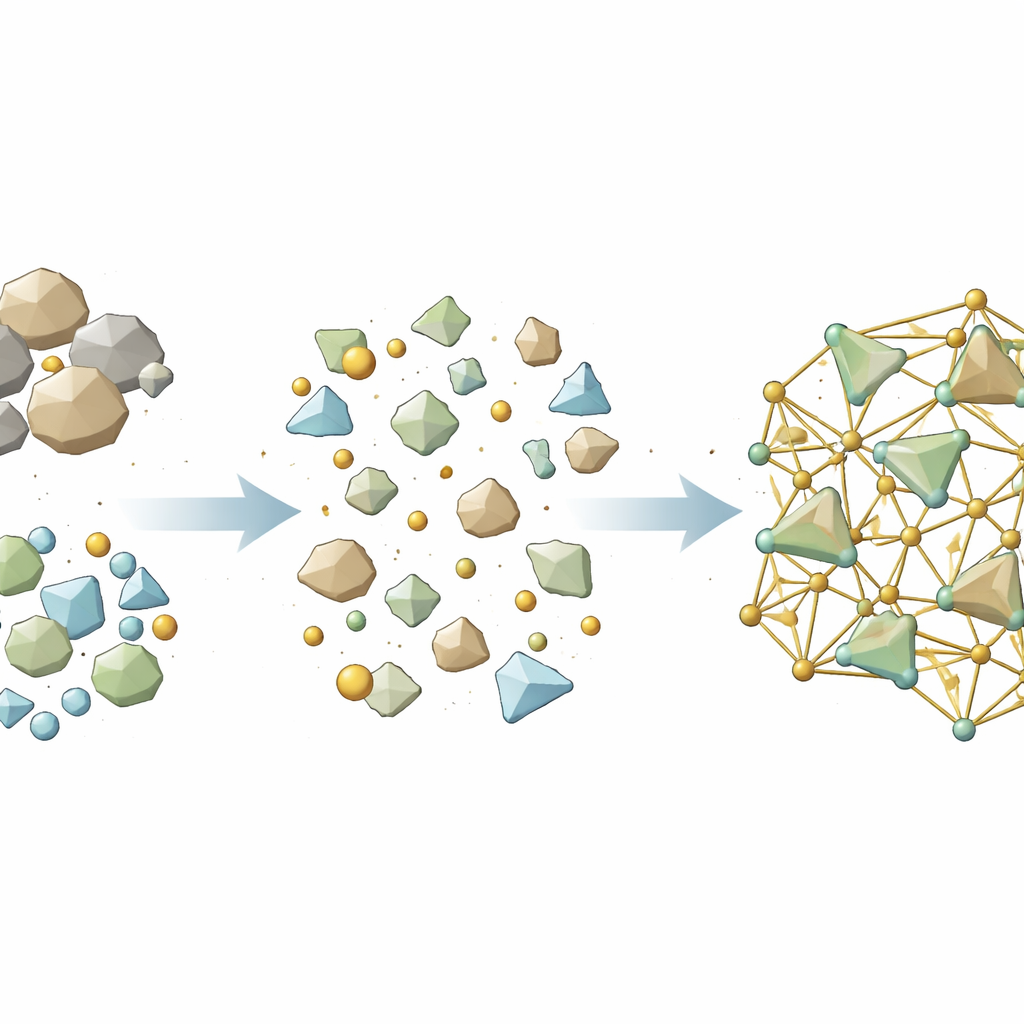
To understand and optimize this reaction, the researchers used infrared spectroscopy and nuclear magnetic resonance (NMR), methods that track how atoms are bonded in solids. They showed that only aluminum atoms sitting in a tetrahedral arrangement in calcium aluminates take part in the reaction; octahedral aluminum, such as in certain aluminum oxides, stays inert at room temperature. As the reaction proceeds, bonds shift from silicon–oxygen–silicon links to mixed silicon–oxygen–aluminum links, building long –O–Si–O–Al–O– chains and networks. The data indicate that the most stable and efficient structure forms when the number of reactive silicon units and reactive aluminum units is roughly equal—a one‑to‑one ratio that matches predictions from earlier work on natural minerals and ancient binders.
Finding The Sweet Spot For Mixing
Practical construction needs a material that both hardens quickly enough and ends up strong. The team adjusted the amount and type of calcium aluminate cement and the amount of added sodium hydroxide used to “activate” the water glass. By casting test cubes and measuring how much pressure they could withstand, they found an optimal range of calcium aluminate additions where strength increases sharply and then levels off—beyond that point, extra cement adds cost but not performance. They also mapped how setting time depends on the amount of sodium relative to silicon in the liquid. No hardening occurs below a certain sodium level; around a one‑to‑one sodium‑to‑silicon ratio, the material sets within a few hours, a practical window for construction work.
From Desert Sand To Durable Bricks
Because the fresh mixture is fluid and low in viscosity, it can bind a wide variety of fillers and aggregates. The authors demonstrate that dune sand, gravel, stones, expanded minerals like perlite and vermiculite, and even organic materials such as wood chips and biochar can be locked into solid composites. Bricks made from unwashed dune sand and gravel reached compressive strengths above 40 megapascals, comparable to structural concrete, over a wide temperature range between 4 °C and 65 °C. Remarkably, mixtures stored frozen at –21 °C remained workable after thawing and then hardened properly, adding flexibility for use in cold climates. When biochar is included, the resulting lightweight blocks can even store more carbon than is emitted in their production.
Cutting The Carbon Footprint Of Concrete
The study also estimates the climate benefit of switching from ordinary Portland cement to this new binder. Typical structural concrete releases around 140 kilograms of CO2 per cubic meter from the unavoidable breakdown of limestone in the kiln, even before counting fuel use. In contrast, the new system’s emissions mainly come from the release of CO2 when calcium aluminates and sodium carbonate–derived sodium hydroxide are made. For optimized mixtures with abundant aggregate, total emissions can be reduced by about two‑thirds compared with Portland cement concrete. Combined with the possibility of powering raw‑material production and mixing with solar electricity, the authors argue that global cement‑related emissions could be cut from roughly 8% of humanity’s total to below 2%.
A Familiar Process With Cleaner Results
For builders, one of the most important findings is that this polymer-based concrete behaves much like conventional concrete: it is mixed from a liquid component and solid powders, poured, and allowed to cure while kept moist over about ten days. Existing mixers, pumps and molds can be reused, and workers need no special retraining. At its heart, the chemistry echoes the durable mineral networks found in ancient Roman concrete, but with well‑defined, widely available raw materials. If adopted at scale, this calcium‑aluminate and water‑glass binder could enable the construction industry to maintain modern building practices while sharply lowering the climate impact of one of the world’s most important materials.
Citation: Spangenberg, B., Epping, J.D. A polymer of calcium aluminate and water glass as cement substitute. Sci Rep 16, 14042 (2026). https://doi.org/10.1038/s41598-026-50294-8
Keywords: low-carbon concrete, cement alternatives, geopolymer binder, calcium aluminate cement, water glass