Clear Sky Science · en
Experimental investigation of semi-flexible pavement performance using optimized nano-silica and sugarcane bagasse ash modified grouts
Turning Farm Waste into Tougher Roads
Modern roads face a double challenge: they must withstand heavy trucks, harsh weather, and fuel spills, while society pushes to cut the carbon footprint of construction. This study shows how an agricultural waste product from sugar production, combined with tiny particles called nano-silica, can be used to build stronger, longer-lasting pavements. By rethinking both the structure of the road and the recipe of the cement-like material that fills it, the researchers point toward highways and industrial surfaces that are both tougher and more sustainable.
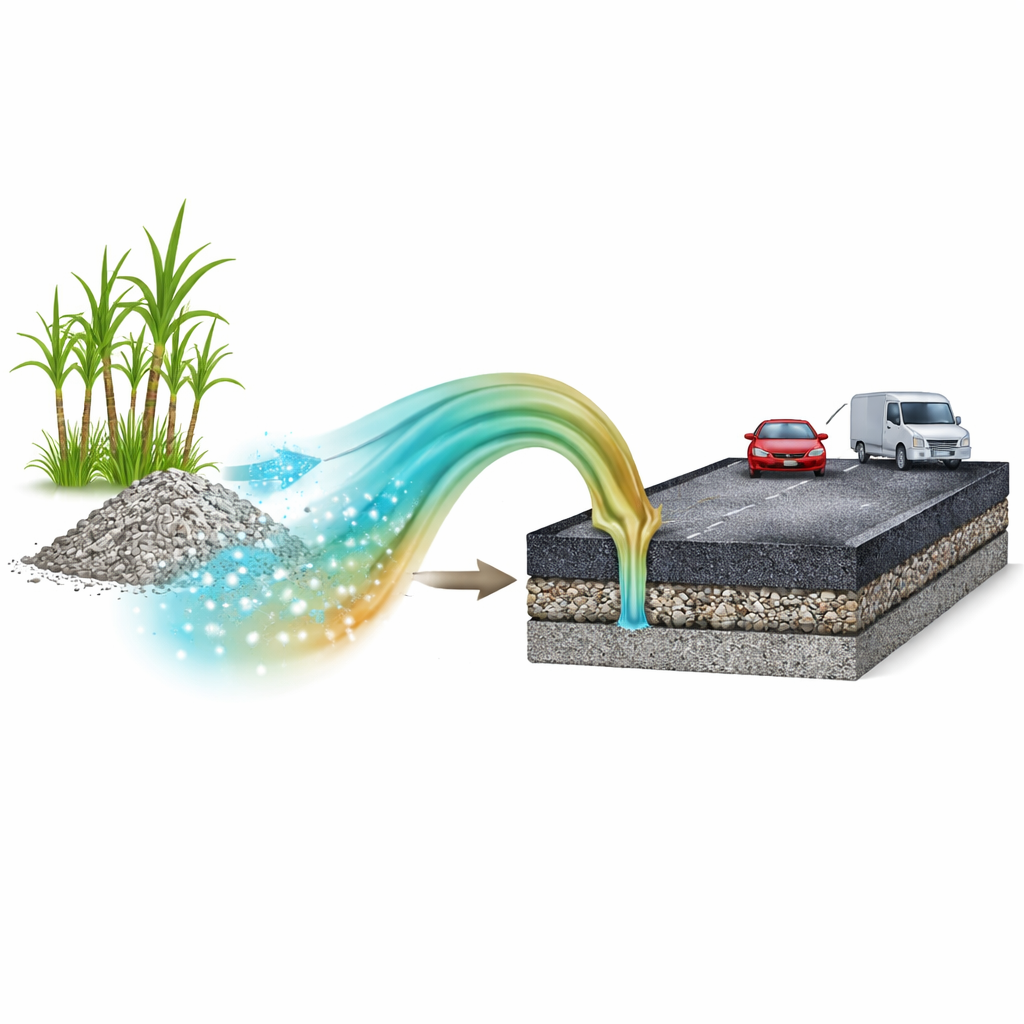
How a Hybrid Road Structure Works
Conventional asphalt pavements are flexible but can rut, crack, or soften under heat and fuel spills. Concrete is stiffer and more durable, but it is noisier, less comfortable to drive on, and prone to its own cracking problems. The team focused on an in-between solution called semi-flexible pavement. In this design, a very open, stone-rich asphalt layer with many connected voids acts like a skeleton. Those voids are then saturated with a highly fluid cement-based grout. The result is a road surface that combines the smooth ride and flexibility of asphalt with the strength and chemical resistance of a cementitious material.
Recycling Sugarcane Ash and Using Tiny Additives
To make this hybrid surface more climate- and resource-friendly, the researchers partially replaced ordinary Portland cement, a major source of industrial carbon dioxide, with sugarcane bagasse ash. This ash is a waste product from burning sugarcane residue in sugar and ethanol plants and is produced in tens of millions of tons every year worldwide. After careful drying, controlled burning, and fine grinding, the ash behaves like a reactive mineral that can help the grout harden and densify. The team also added a small amount of nano-silica, whose ultra-fine particles act as seeds that speed up hardening and help pack the microstructure more tightly.
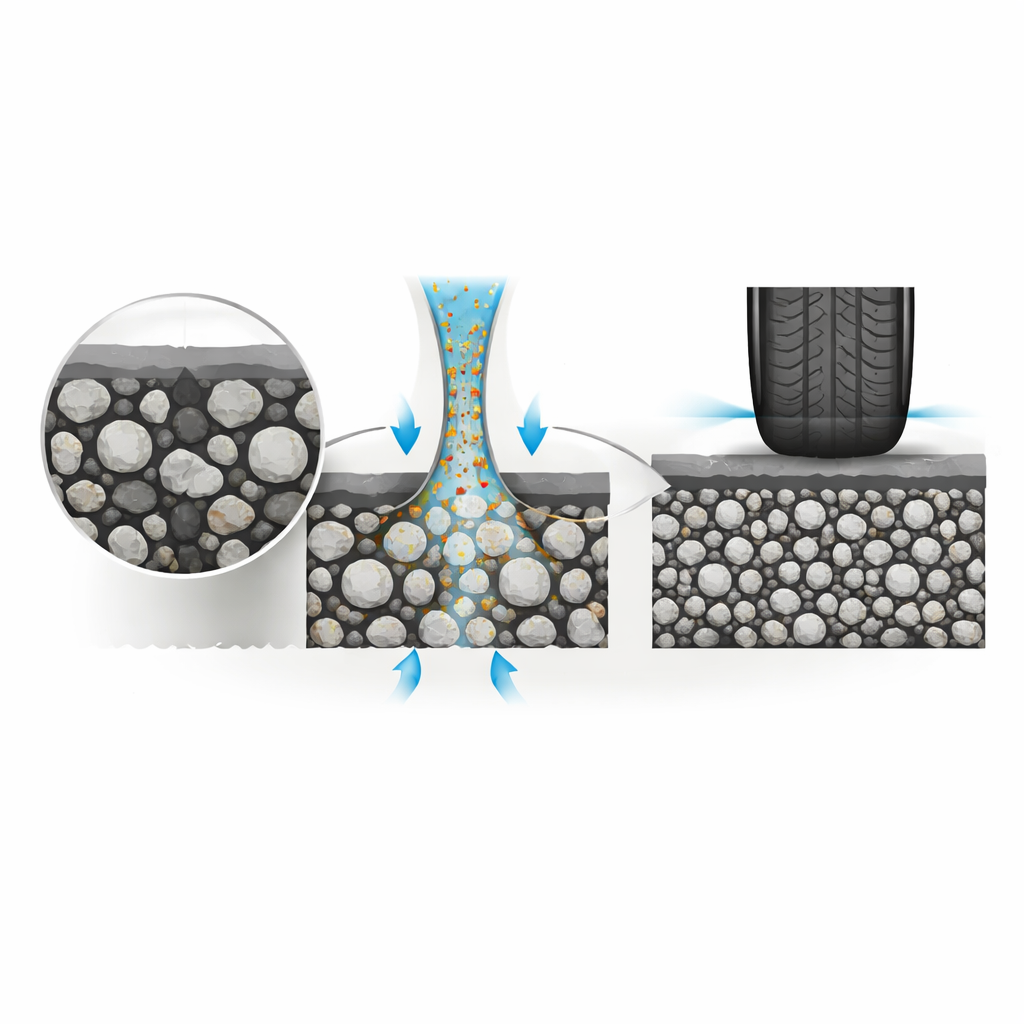
Testing Strength, Water, Traffic, and Fuel Damage
The scientists first optimized the grout formula so it would be fluid enough to flow into the asphalt’s pores but still harden into a high-strength network. They found that a mix using 10 percent sugarcane ash and 1 percent nano-silica, with a relatively low water content and a chemical plasticizer, produced about 22 percent higher compressive strength than a conventional grout. Microscopy and X-ray analysis showed that this mix formed a denser internal structure with fewer voids and more of the binding gel that gives cement-based materials their strength. Semi-flexible pavement slabs made with this optimized grout were then compared to standard hot-mix asphalt in the laboratory.
Performance Under Heavy Loads and Harsh Conditions
Under load-bearing tests, the semi-flexible surfaces far outperformed ordinary asphalt. They showed roughly 88 percent higher stability and a resilient stiffness above 5000 megapascals, indicating a much greater ability to carry heavy traffic without permanent deformation. In wheel-tracking tests that simulate rutting, the semi-flexible mixes developed only about 30 percent of the rut depth seen in conventional asphalt. When exposed to moisture, the semi-flexible specimens retained about 92 percent of their tensile strength, versus 88 percent for standard mixes, thanks to the grout’s ability to seal off pathways for water. Perhaps most strikingly, in tests where samples were soaked in diesel fuel and then brushed or re-tested for strength, the semi-flexible pavements lost less than 5 percent of their mass and kept about 93 percent of their strength, while ordinary asphalt degraded far more, with mass losses near 20 percent and only about 80 percent of strength retained.
Climate Benefits from Smarter Materials
Beyond performance, the researchers estimated the climate impact of swapping part of the cement for sugarcane ash and a small amount of nano-silica. For each cubic meter of grout, the modified recipe reduced carbon dioxide emissions by about 8.4 percent compared with a traditional all-cement mix, while also diverting agricultural waste from disposal. Taken together, the results suggest that semi-flexible pavements built with sugarcane bagasse ash and nano-silica grouts can provide stronger, more rut- and fuel-resistant road surfaces for demanding locations such as industrial yards, bus depots, and airport pavements, while modestly lowering the carbon cost of construction.
Citation: Sajid, M.A., Al-Nawasir, R., Khan, M.I. et al. Experimental investigation of semi-flexible pavement performance using optimized nano-silica and sugarcane bagasse ash modified grouts. Sci Rep 16, 13903 (2026). https://doi.org/10.1038/s41598-026-50120-1
Keywords: semi-flexible pavement, sugarcane bagasse ash, nano-silica, sustainable roads, asphalt performance