Clear Sky Science · en
Exploratory in vitro study of inductive heating–assisted refixation in cemented hip stems
Why this study matters for people with hip replacements
Total hip replacements give many people a second chance at pain free movement, but over time some of these artificial joints loosen and need risky revision surgery. Today, surgeons often have to chisel out hardened bone cement to remove the old metal stem in the thigh bone, a process that can damage bone and lengthen recovery. This study explores a very different idea: instead of tearing everything out, can doctors gently re soften the cement around a loosened stem by heating the metal from within, then press it back into place to regain stability?
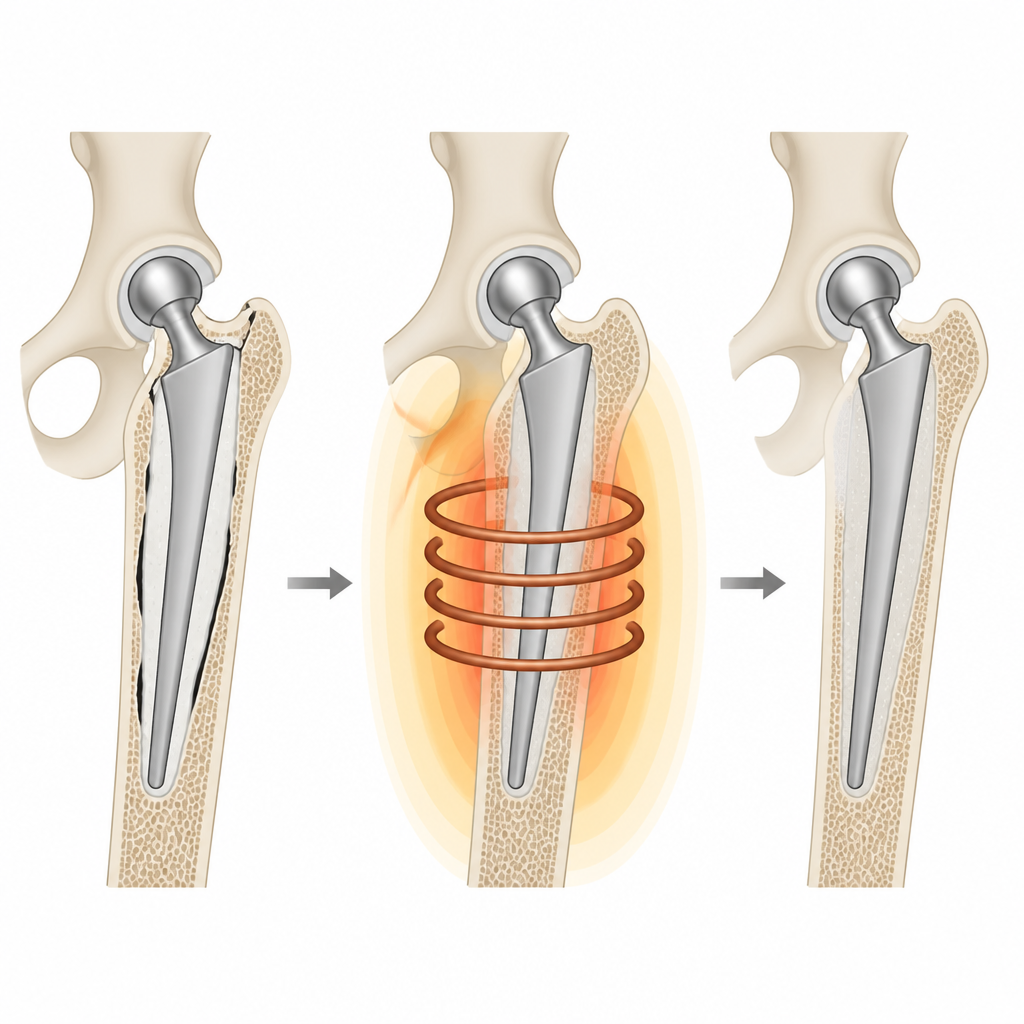
A gentler way to fix a loose hip stem
The researchers focused on cemented hip stems, where a metal rod is anchored inside the thigh bone using a plastic like bone cement. In some commonly used designs, the stem has a matte, slightly rough surface that grips the hardened cement. Over years of walking, tiny motions can grind away this cement, releasing wear particles and gradually loosening the stem. When that happens, current revision options are demanding for both patient and surgeon. The team asked whether they could restore the original grip by briefly softening the cement right where it meets the metal, without removing either the stem or the cement mantle from the bone.
Testing the idea in the lab
To explore this concept safely, the team built a simplified laboratory model rather than operating on people. They machined three cone shaped metal stems from a common hip implant alloy and roughened their surfaces to resemble real matte stems. Each stem was fixed inside a clear plastic tube using standard medical bone cement, mimicking the cement mantle inside a thigh bone. This setup let them carefully control forces and also listen for tiny cracking sounds in the cement using an acoustic sensor while twisting and pulling on the stem. They created three distinct situations for each stem: the initial well fixed state right after the cement hardened, a deliberately loosened state, and a refixed state after heating and pressing the stem back in.
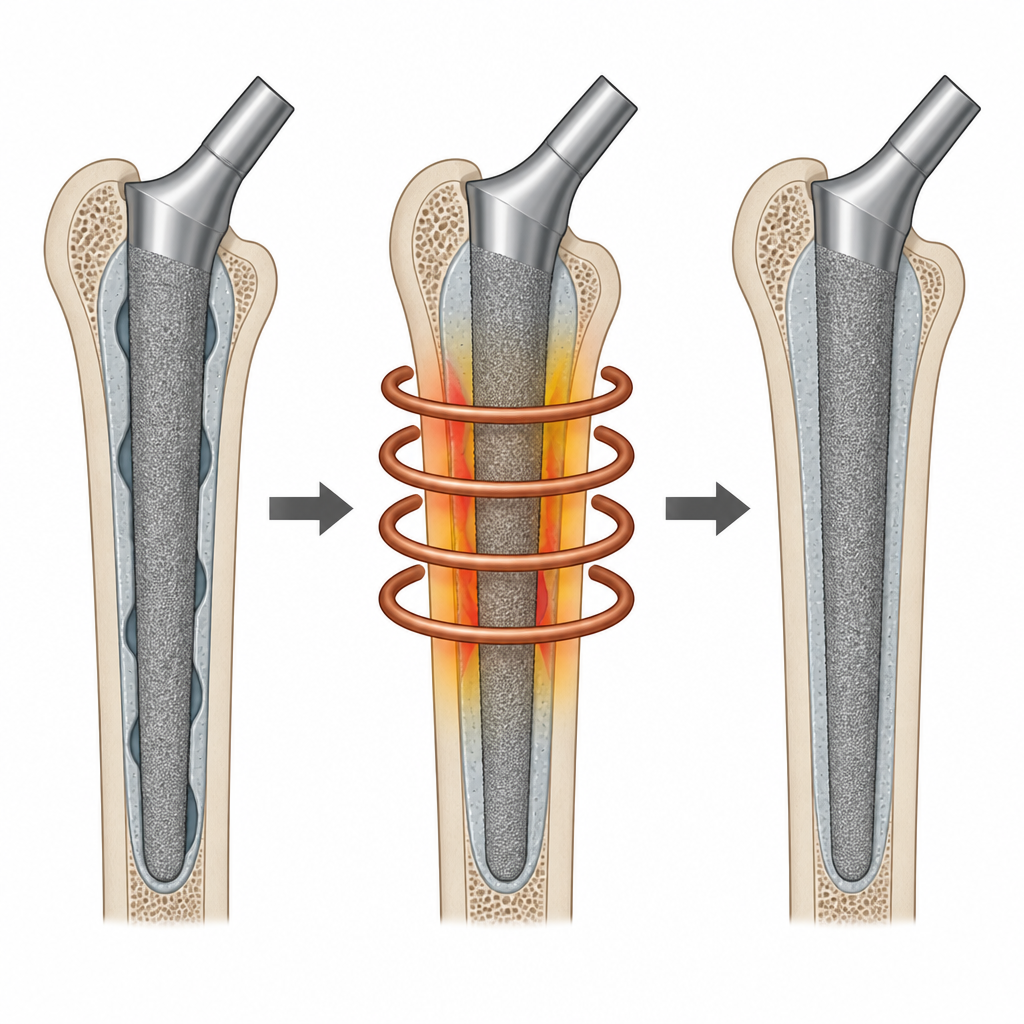
How heating and refixation were carried out
Loosening was simulated by repeatedly pulling the stem out a short distance and pressing it back into the cement mantle ten times, using forces similar to those a hip experiences during walking. As expected, this treatment reduced the force needed to pull the stem out by about 60 percent, showing that the grip had weakened. For the refixation step, the loosened stems were heated from the outside using an induction coil that warms only the metal. The stem surface was brought to about 95 degrees Celsius, a temperature known to soften this type of bone cement, and held there for five minutes. While the cement was softened, the stem was slowly pressed back in with a force comparable to body weight forces, then held in place as everything cooled back to room temperature.
What the measurements revealed
After each step, the team measured how strongly the stem was held by the cement by pulling on it until it slipped, and they monitored tiny twisting motions and the crackling acoustic signals that accompany micro damage at the interface. On average, the refixed stems did not regain the strong pull out forces of the original state and stayed at roughly the same level as the loosened condition. However, one of the three samples behaved differently: its pull out strength after refixation almost completely returned to the original value before loosening. In that sample, the acoustic signals also suggested that the micro level interlocking between stem and cement had been at least partly rebuilt. A dye test of the contact areas supported this picture, showing more continuous contact for the successful sample than for the others, where gaps remained in the middle part of the stem.
Limits, safety questions, and next steps
The authors stress that this is an early proof of concept in a very simplified setting. The “bone” in their model was a plastic tube with similar softening behavior to the cement, which likely overheated and reduced support during refixation. Real bones are stiffer, do not soften like plastic, and are cooled by blood flow, so the heat would spread differently and might be less damaging. The team suggests refining the heating approach, for example by using a two step strategy that gently warms a broad layer of cement and then briefly heats a thin layer right at the metal surface to enhance interlocking, while keeping temperatures in surrounding bone below harmful levels. They also found that acoustic emission sensing is a promising way to detect small slips at the implant cement contact, hinting at future tools for early diagnosis of loosening.
What this could mean for future hip care
In simple terms, this study shows that it may be possible, at least in some cases, to “re melt” and reset the cement around a loose hip stem by heating the metal and pushing it back into place, instead of cutting everything out. In one test stem, this thermal refixation almost restored the original holding power, suggesting a path toward less invasive revision procedures. Before such a method could be used in patients, the heating protocol needs to be optimized, tested in more realistic bone models, and carefully evaluated for safety to nearby tissues. If those hurdles can be cleared, future patients with loosening cemented hip stems might face shorter, safer revision surgeries and better long term joint stability.
Citation: Reulbach, M., Evers, P., Windhagen, H. et al. Exploratory in vitro study of inductive heating–assisted refixation in cemented hip stems. Sci Rep 16, 16278 (2026). https://doi.org/10.1038/s41598-026-50093-1
Keywords: hip replacement, cemented hip stem, implant loosening, induction heating, revision surgery