Clear Sky Science · en
Waste to energy through sustainable bioenergy and biohydrogen production from lignocellulosic waste using microbial fuel cell and microbial electrolysis cell
Turning farm waste into clean energy
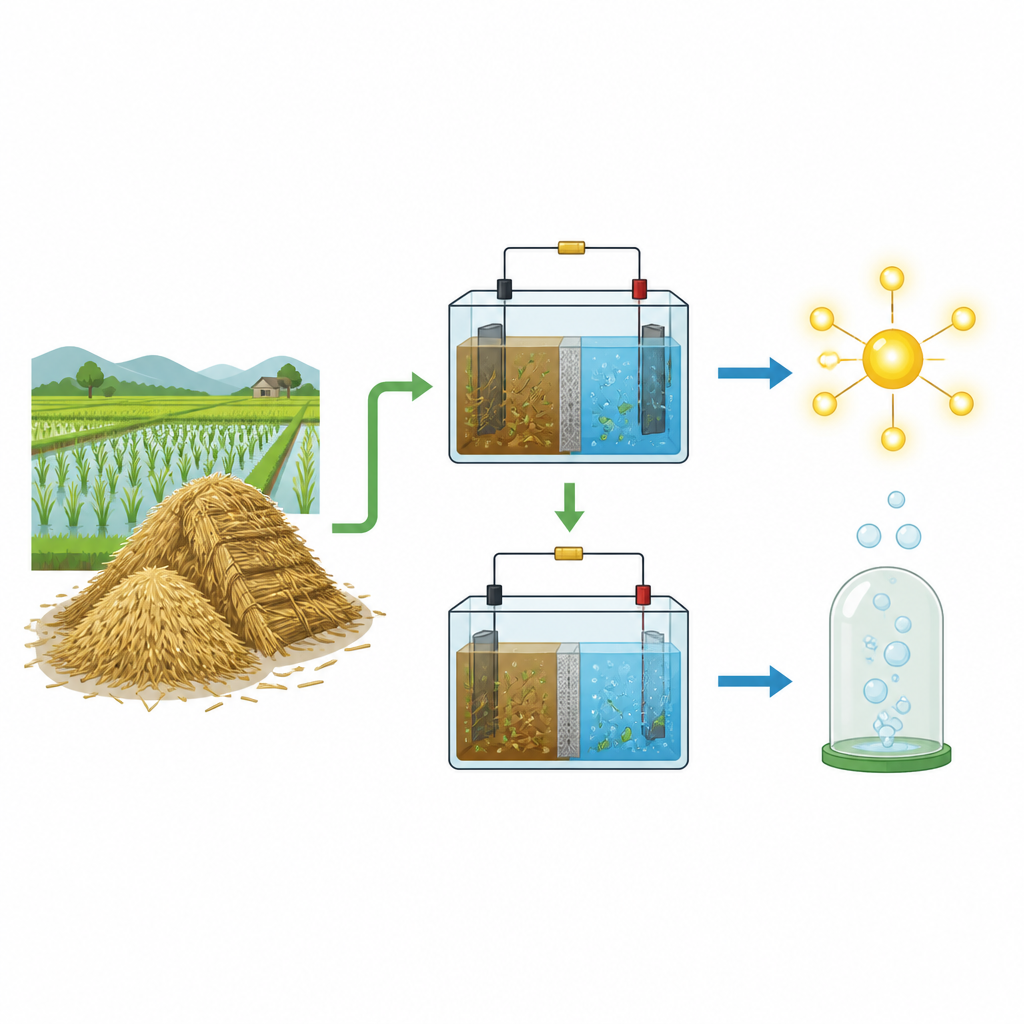
Across rice growing regions, leftover straw is often burned in the field, filling the air with smoke and greenhouse gases. This study explores a different path: using rice straw as a feedstock for small bioelectric devices that can both clean waste and produce useful energy in the form of electricity and hydrogen gas. The work shows how changing the way we prepare this humble residue can strongly affect how much energy we get back.
Why rice straw is a problem and an opportunity
Rice straw is produced in huge quantities every year and is mostly treated as a nuisance. Farmers commonly burn it to clear fields, which releases fine particles and gases that harm lungs, reduce soil quality, and add to climate warming. Yet this same straw is rich in plant fibers that store chemical energy. If that energy can be tapped in a controlled way, rice fields could become a source of clean power rather than pollution, helping rural areas manage waste and reduce reliance on fossil fuels.
Small devices that let microbes make electricity
The researchers used microbial fuel cells, simple two chamber devices where communities of bacteria break down organic material in one side and send electrons to an electrode. Those electrons travel through a wire to the other side of the device, creating an electric current while the microbes also help clean the waste. The team tested three forms of rice straw based material as the food for these microbes: ground straw, straw that had been chemically broken down into a liquid, and xylan, a simpler fiber extracted from that liquid. They compared each to a standard chemical food source to see which gave the strongest and cleanest power output.
Finding the best form of straw for making power
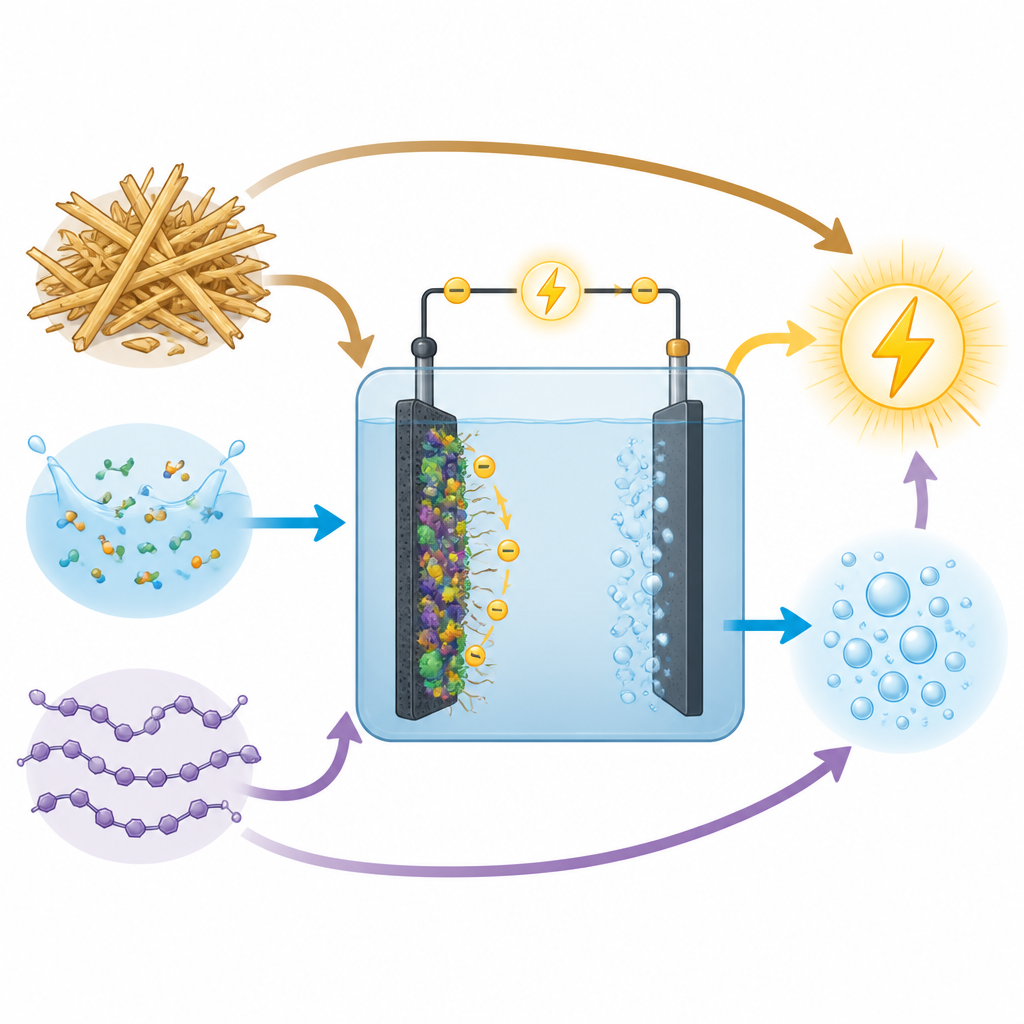
When these fuel cells ran on xylan, they produced the highest voltage and power, along with the most effective removal of organic pollution from the liquid. This suggests that the simpler structure of xylan is easier for the microbes to digest and convert into electrons. In contrast, the intact straw and the straw liquid still carried complex plant compounds that slow digestion or interfere with microbial activity, leading to lower electricity production. Detailed electrical measurements confirmed that cells fed with straw based materials could move electrons efficiently, with some setups showing very low resistance to electron flow and relatively high electrical currents.
Switching from electricity to hydrogen gas
The team also examined microbial electrolysis cells, a closely related type of device that uses a small extra voltage from outside to drive the release of hydrogen gas at one electrode. Here they fed the devices either straw liquid, xylan, or the standard chemical control. In this hydrogen focused mode, the straw liquid clearly performed best, leading to the highest power density, the fastest hydrogen production rate, and strong removal of organic matter. Xylan supported hydrogen generation but at roughly one third the rate of the straw liquid, likely because it requires extra biological steps and competes with other microbes that divert electrons away from hydrogen.
What this means for cleaner energy from crops
Overall, the study shows that the same agricultural waste can be tailored to different energy uses simply by changing how it is processed. A more purified fiber form of rice straw favors electricity production in microbial fuel cells, while a nutrient rich liquid from pretreated straw favors hydrogen gas in microbial electrolysis cells. For non specialists, the message is that farm leftovers like rice straw do not have to be burned or discarded. With relatively simple treatment and bioelectrochemical devices, they can be turned into cleaner energy carriers while also reducing water pollution, supporting more sustainable waste handling in farming communities.
Citation: Bayoumi, M., Hassouna, M.S., Hussien, A.A. et al. Waste to energy through sustainable bioenergy and biohydrogen production from lignocellulosic waste using microbial fuel cell and microbial electrolysis cell. Sci Rep 16, 15462 (2026). https://doi.org/10.1038/s41598-026-50075-3
Keywords: rice straw, microbial fuel cell, microbial electrolysis cell, biohydrogen, waste to energy