Clear Sky Science · en
Effect of faba bean-garlic intercropping on low-molecular-weight organic acids, yield components, and profitability under different spatial arrangements
Growing More Food from the Same Field
As the world’s population grows and farmland and water become harder to expand, farmers are under pressure to harvest more food and income from every hectare they already cultivate. This study asks a deceptively simple question with big consequences: if you plant faba beans and garlic together rather than in separate fields, and arrange their rows carefully, can you boost soil health, crop yield, and farm profits at the same time?
Why Mix Beans and Garlic?
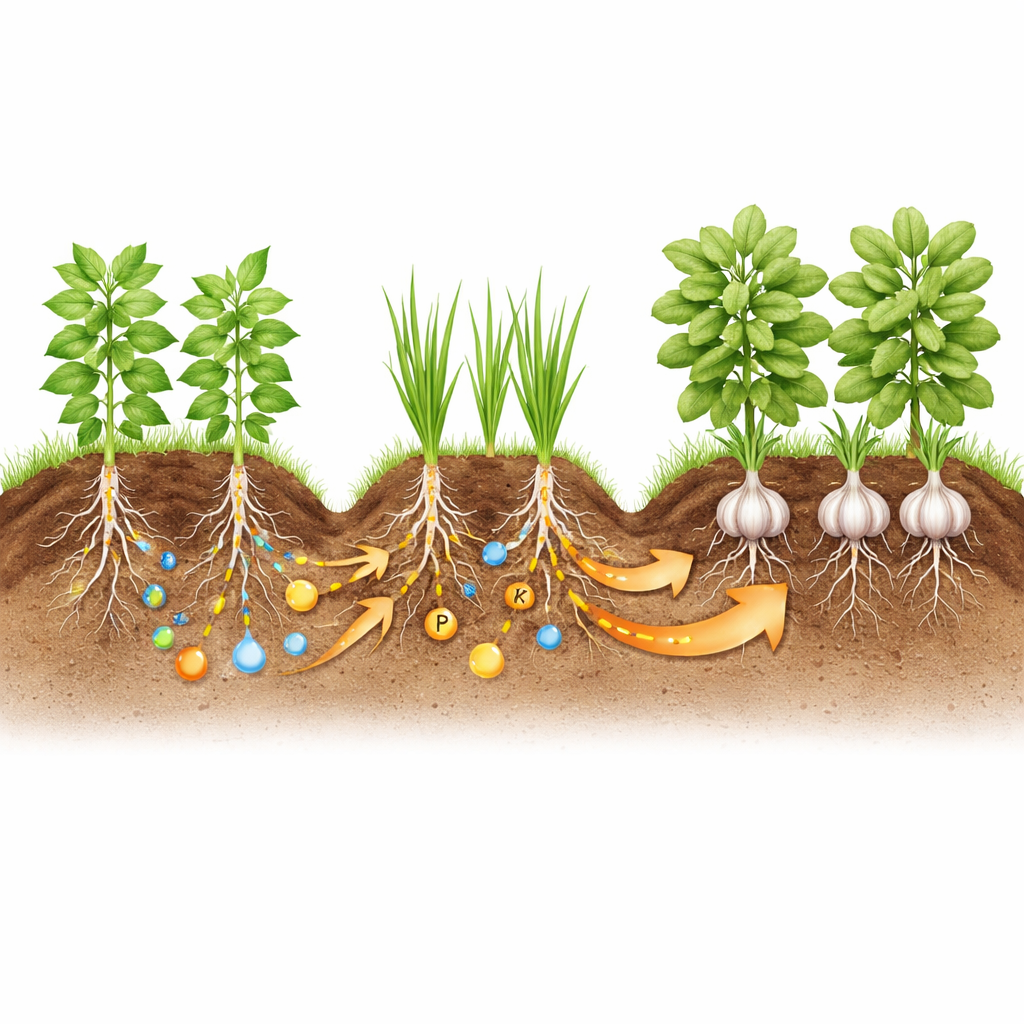
Intercropping—growing more than one crop in the same field—is an old idea getting fresh attention as a tool for sustainable farming. Faba beans are legumes that can help feed the soil, while garlic is a nutrient-hungry bulb crop with strong market demand. When their roots share the same soil, they do more than just sit side by side: faba beans release small organic acids that help unlock nutrients, which garlic can then use. But whether this partnership actually pays off depends strongly on how the plants are spatially arranged: which crop gets which rows, how dense they are, and how closely their roots and leaves interact.
Testing Different Planting Patterns
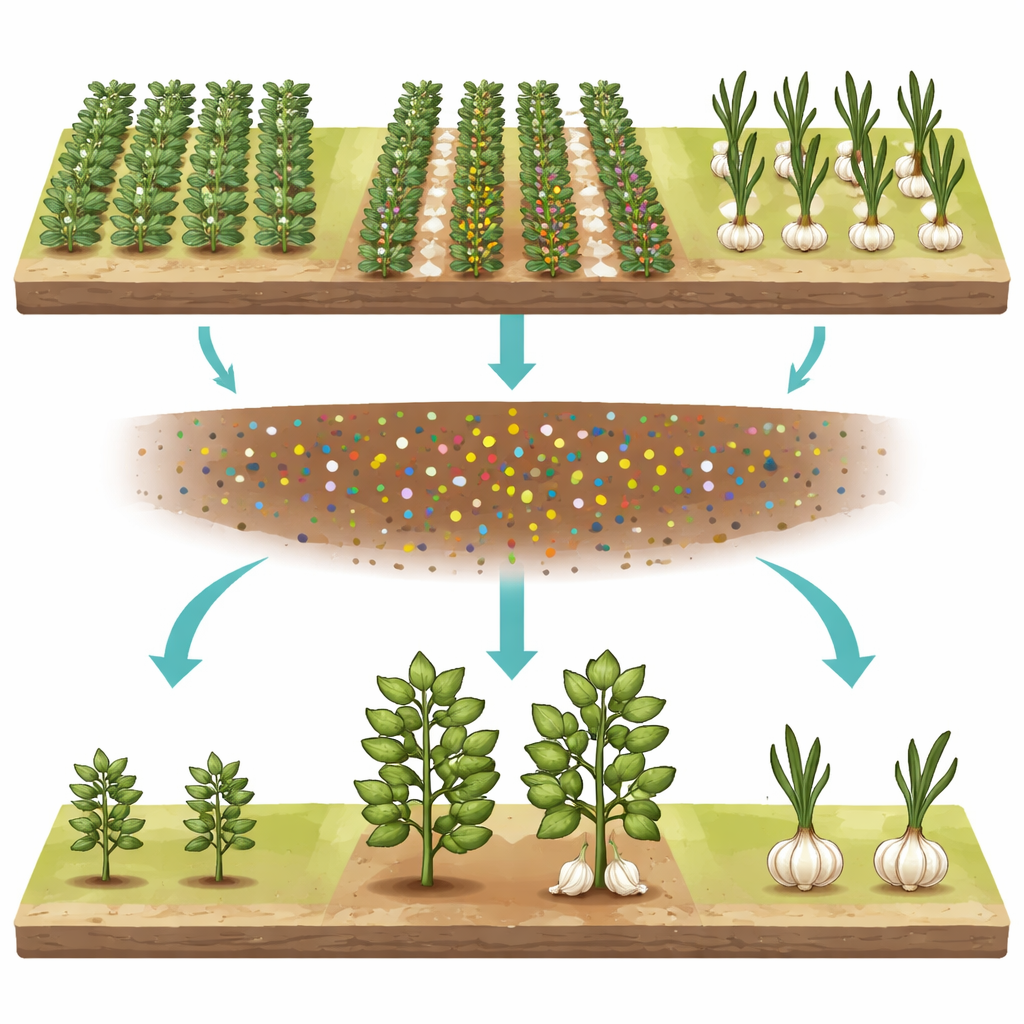
The researchers ran two years of field trials in Egypt, comparing five planting patterns: faba beans alone, garlic alone, and three intercropping designs. In one, two faba bean rows flanked a single garlic row on the same ridge. In another, beans and garlic shared opposite sides of the same ridge. In the third, the crops grew in alternating strips of two ridges of beans followed by two ridges of garlic. All were managed with the same fertilizers and irrigation so that only spatial layout differed. The team measured soil organic acids around faba bean roots, detailed growth traits of both crops, final yields, and how strongly each crop competed with the other.
What Happens Underground
The most tightly mixed pattern—beans on one side of a ridge and garlic on the other—created the most chemically active root zone. Levels of several low‑molecular‑weight organic acids, such as ascorbic, citric, and oxalic acid, were several times higher there than under beans grown alone. These compounds help dissolve locked‑up phosphorus and trace metals and can also influence soil microbes and pests. Overall, any bean–garlic mixture raised total organic acids compared with monocultures, confirming that root interactions between the two species make the soil more chemically dynamic and potentially more fertile.
Balancing Competition and Cooperation Aboveground
Yet more root activity did not automatically mean better yields. In the dense pattern with two bean rows squeezing a single garlic row on the same ridge, both crops suffered: faba beans had fewer branches, lighter stems, and lower seed yields, and garlic bulbs were smaller and lighter. Tall bean plants shaded the shorter garlic heavily, and all plants competed intensely for water and nutrients. By contrast, the alternating strip design (two ridges of beans, then two ridges of garlic) struck a more favorable balance. Here, beans reached nearly the same seed yield as when grown alone, and garlic achieved much higher yields than in the cramped layouts. Land equivalent ratios—a measure of how much land would be needed in separate monocultures to match the intercrop’s output—ranged up to about 1.6 in this strip system, meaning the mixed field produced the same combined harvest as roughly 60% more land planted in single crops.
Who Wins the Underground Tug‑of‑War?
Competition indicators showed that garlic was the more assertive partner. It captured more of the shared resources and was labeled the dominant crop across all mixtures, partly because it was planted earlier and responded strongly to added nitrogen. Still, in the strip layout, this dominance did not come at the bean’s expense. Both crops used light and soil resources more completely, so the whole system gained. Statistical tools such as principal component analysis, radar plots, and heat maps all converged on the same message: the alternating two‑ridge bean–garlic system gave the best combination of growth, yield, and efficient land use.
Profits and Practical Takeaways
From a farmer’s perspective, the bottom line matters as much as biology. When the researchers translated yields into local market prices and subtracted production costs, all intercropping treatments outperformed either crop grown alone. The alternating two‑ridge pattern was the clear winner, generating the highest net return—over three thousand dollars per hectare in the first season and nearly four thousand in the second—with benefit‑cost ratios well above 2. In plain terms, arranging faba beans and garlic in well‑designed strips allowed farmers to harvest more product and more profit from the same area of land while enriching the soil through natural root processes rather than extra fertilizer.
Citation: Hamoda, A., El-Mehy, A.A., Dabbour, M. et al. Effect of faba bean-garlic intercropping on low-molecular-weight organic acids, yield components, and profitability under different spatial arrangements. Sci Rep 16, 13888 (2026). https://doi.org/10.1038/s41598-026-49974-2
Keywords: intercropping, faba bean, garlic, soil organic acids, land use efficiency