Clear Sky Science · en
Hydrogen in the Earth core inferred from neutron imaging and diffraction
A hidden store of Earth’s lightest element
Hydrogen is best known as the main ingredient of water and the Sun, but this study suggests that enormous amounts of it may also be locked deep inside our planet’s metallic heart. By recreating the intense pressures and heat found far below Earth’s surface and watching how hydrogen behaves inside molten iron, the authors offer a new window into what the core is made of and how our planet formed.
Why Earth’s core seems too light
Seismic waves reveal that Earth’s core is less dense than a sphere of pure iron and nickel. To explain this “missing” mass, scientists have proposed that lighter elements such as silicon, sulfur, oxygen, carbon, and hydrogen are mixed into the core. Hydrogen is an especially intriguing candidate because it is abundant in the early Solar System and readily dissolves into iron when squeezed at very high pressures. However, measuring how much hydrogen actually enters liquid iron has been difficult, because the iron hydride compounds that form under pressure fall apart when brought back to normal conditions.

Watching hydrogen in molten iron
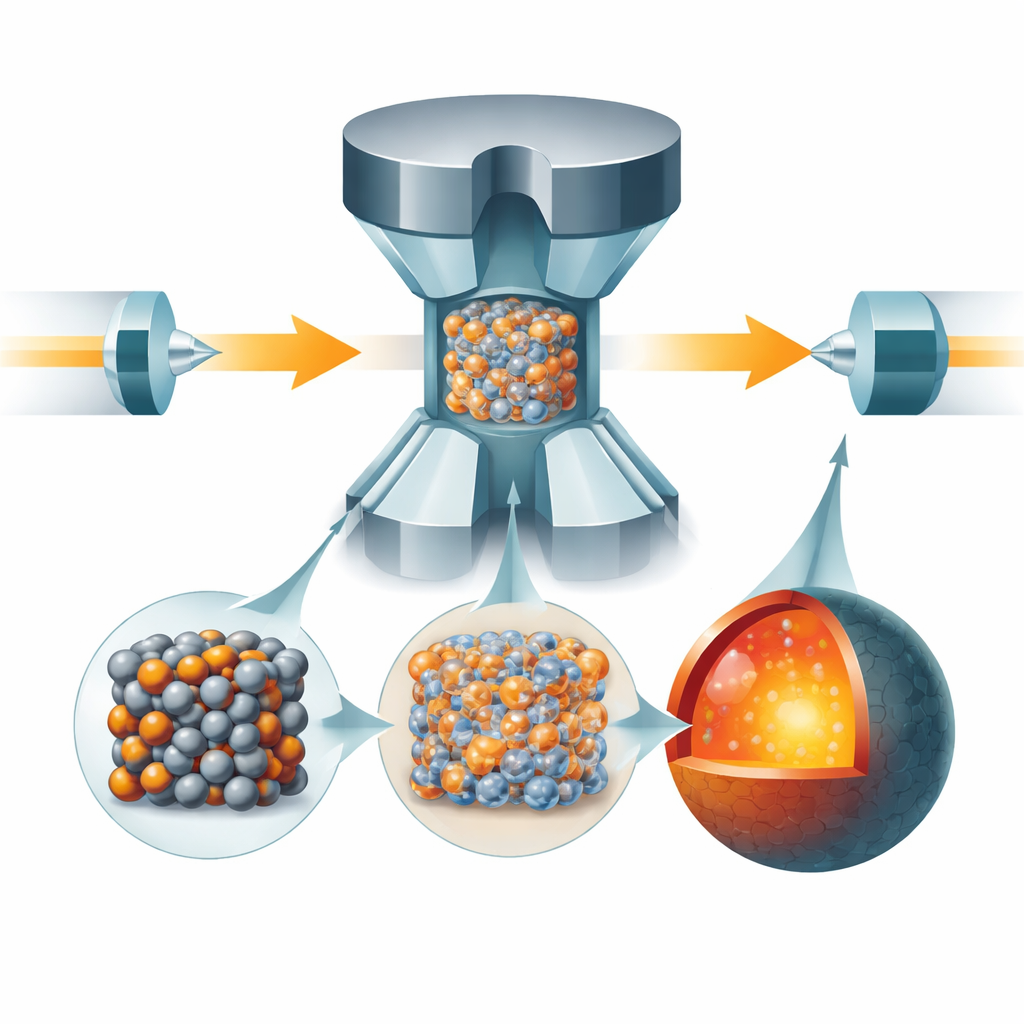
The researchers tackled this challenge using beams of neutrons, particles that easily pass through metal but are strongly affected by hydrogen. At a powerful neutron source in Japan, they placed a tiny iron sample, together with a hydrogen-rich material, inside a multi-anvil press that squeezed it to about 3–3.5 gigapascals and heated it up to 1400 kelvin, similar to conditions near the base of an early magma ocean on young Earth. Neutron diffraction, which reveals how atoms are arranged, showed when the iron changed from a solid crystal to a fully molten state. Neutron imaging, which records how strongly the sample absorbs neutrons, revealed how much hydrogen had entered the iron at each stage.
Turning neutron shadows into numbers
To translate the neutron images into hydrogen content, the team first calibrated how the mass absorption of neutrons changed as more hydrogen was added to solid iron. They showed that absorption increased nearly linearly with hydrogen fraction, allowing them to build a simple conversion curve. For molten iron, the density is not directly known, so they combined their measurements with advanced computer simulations of liquid iron hydride that relate pressure, temperature, and composition to density. Putting these pieces together, they inferred that liquid iron at 3.4 gigapascals and 1400 kelvin can hold about 0.17 weight percent hydrogen.
From lab capsule to planetary core
Next, the authors used a modified form of a classic rule, Sieverts’ law, which links how much hydrogen dissolves in metal to the surrounding hydrogen pressure and temperature. Anchored by their experimental result, they calculated how much hydrogen molten iron could take up at the base of a deep magma ocean beneath a hydrogen-rich early atmosphere. Under these favorable conditions, they estimate that core-forming liquid iron could have contained roughly 0.6 to 0.7 weight percent hydrogen. As the core later separated into a liquid outer shell and a solid inner sphere, hydrogen would prefer the liquid, leaving the outer core richer in hydrogen than the inner core.
What this means for Earth’s deep interior
Using standard models of Earth’s interior, the team translates these percentages into a striking budget: the core could store 72 to 87 times as much hydrogen as all of today’s oceans combined. In their scenario, the outer core alone would hold 70 to 85 ocean-equivalents of hydrogen, while the inner core would contain a smaller, but still sizeable, share. Such amounts can explain more than half of the observed density shortfall of the outer core if hydrogen were the only light element present. In reality, other elements almost certainly join hydrogen there, but this work shows that hydrogen can no longer be treated as a minor player in shaping the structure and evolution of Earth’s deepest region.
A new piece in the story of Earth’s origin
For a non-specialist, the key message is that Earth’s core may be a huge, hidden reservoir of hydrogen that rivals or exceeds the water at the surface. By directly measuring hydrogen in molten iron under realistic conditions instead of relying on indirect clues, this study strengthens the idea that early Earth’s hydrogen-rich atmosphere and molten mantle fed vast amounts of the lightest element into the forming core. That quiet stash of hydrogen continues to influence the planet today through its effect on the core’s density, dynamics, and magnetic behavior.
Citation: Takahashi, N., Sakamaki, T., Hattori, T. et al. Hydrogen in the Earth core inferred from neutron imaging and diffraction. Sci Rep 16, 14162 (2026). https://doi.org/10.1038/s41598-026-49969-z
Keywords: Earth core, hydrogen in iron, neutron experiments, magma ocean, planetary formation